

- Updated: January 5, 2026
- 6 min read
Boston Dynamics Atlas Humanoid Robot Powers Hyundai Factory Automation by 2028
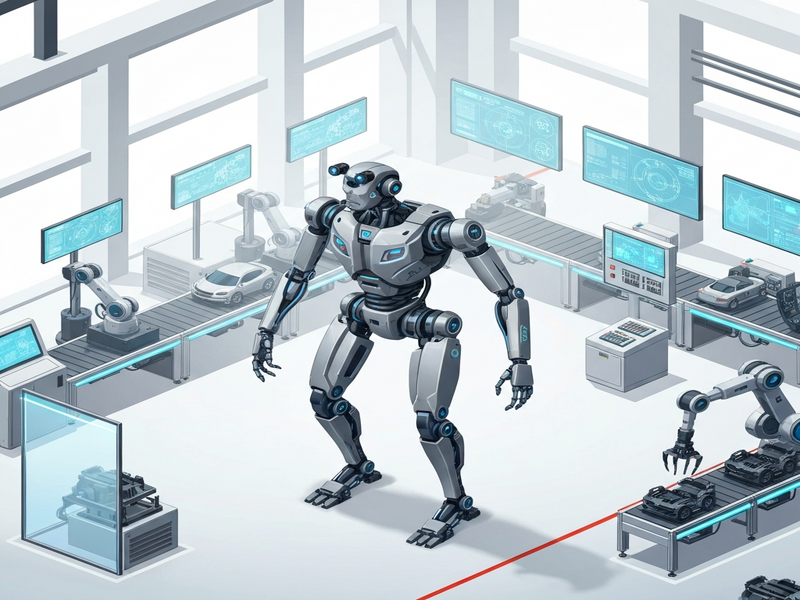
Boston Dynamics’ Atlas humanoid robot will enter mass production for Hyundai in 2028, with an initial target of 30,000 units per year to work alongside human operators at the Savannah, Georgia Metaplant, handling parts sequencing, heavy‑load lifting, and repetitive motions.
Why This Announcement Matters for Factory Automation
At CES 2026, Boston Dynamics unveiled the newest iteration of its Atlas robot, a fully electric, battery‑powered humanoid with a glowing circular “face.” Hyundai Motor Group, the robot’s corporate parent, announced a bold plan to mass‑produce Atlas as a “production‑ready humanoid” beginning in 2028. The partnership promises 30,000 robots annually, initially deployed at Hyundai’s Savannah Metaplant—a flagship “AI‑driven” facility designed to showcase next‑generation manufacturing. This move signals a shift from research prototypes to large‑scale, revenue‑generating robotics in the automotive sector.
Atlas Specs: From Backflips to Factory Floors
The CES demo highlighted several technical upgrades that make Atlas viable for industrial work:
- 56 degrees of freedom (DoF), up from 50 in the previous model, enabling finer manipulation.
- Human‑scale hands equipped with tactile sensors for delicate part handling.
- Payload capacity of up to 110 lb (50 kg) and a reach comparable to an average adult.
- All‑electric drivetrain with autonomous battery‑swap capability for uninterrupted 24‑hour shifts.
- Operating temperature range from –4 °F to 104 °F (–20 °C to 40 °C) and water‑resistant sealing.
These capabilities allow Atlas to perform “parts sequencing” – the precise ordering and placement of components – a task traditionally reserved for human line workers. The robot can be taught most new tasks in a single day using a combination of motion‑capture programming and on‑board AI, dramatically reducing integration time.
Hyundai’s 2028 Mass‑Production Roadmap
Hyundai’s announcement outlines a phased rollout:
- 2028: Begin low‑volume production of 30,000 Atlas units per year at the Savannah Metaplant.
- 2029‑2030: Expand robot duties from parts sequencing to repetitive motions, heavy‑load transport, and complex assembly tasks.
- Beyond 2030: Scale production globally, leveraging Hyundai’s supply‑chain expertise and AI partnerships with Google DeepMind and Nvidia.
Hyundai estimates the Savannah facility will create 14,000 direct jobs while the robots augment productivity, a “harmonious collaboration” that the company says will improve safety and quality without displacing workers en masse.
From Assembly Line to Smart Factory: Atlas’s New Role
The integration of Atlas into automotive manufacturing addresses three core challenges:
- Labor Shortages: With a tightening skilled‑worker pool, humanoid robots can fill gaps in repetitive or ergonomically demanding tasks.
- Quality Consistency: Precise motion control and tactile feedback reduce error rates in component placement.
- Safety: Robots can operate in hazardous zones (e.g., high‑temperature stamping areas) while humans focus on supervision and decision‑making.
By pairing Atlas with Hyundai’s AI automation platform, manufacturers can orchestrate robot fleets through a unified workflow engine, enabling real‑time task allocation, predictive maintenance, and data‑driven process optimization.
Industry Reaction: Opportunities and Cautions
Analysts see the move as a watershed moment for humanoid robotics. “Atlas’s transition from a research showcase to a production‑ready asset demonstrates that the economics of bipedal robots are finally aligning with large‑scale manufacturing needs,” said Maya Patel, senior analyst at McKinsey & Company.
Labor unions, however, remain wary. A spokesperson for the United Auto Workers noted, “While Hyundai promises job creation, we must ensure that workers receive upskilling opportunities to collaborate effectively with these machines.”
From a technology perspective, the partnership leverages Boston Dynamics’ mechanical expertise and Hyundai’s AI stack, including AI automation tools that can translate high‑level production goals into robot‑level commands. This synergy mirrors the broader trend of “digital twins” and “edge AI” that is reshaping the factory floor.
How Atlas Fits Into the Growing Robotics Landscape
Atlas joins a rapidly expanding portfolio of industrial robots, from collaborative arms to autonomous mobile units. Companies such as UBOS Robotics are already offering turnkey solutions that combine hardware, AI, and low‑code workflow orchestration. For example, the Workflow automation studio lets engineers design task sequences that can be exported to Atlas’s control system, reducing integration friction.
The UBOS platform overview highlights a modular architecture that supports heterogeneous robot fleets, making it easier for manufacturers to add Atlas alongside existing cobots and AGVs. This modularity is crucial as factories move toward “plug‑and‑play” automation ecosystems.
What Manufacturing Leaders Should Consider
When evaluating Atlas for your plant, keep these criteria in mind:
| Evaluation Area | Key Questions |
|---|---|
| Technical Fit | Does Atlas’s payload and DoF match the tasks you need to automate? |
| Integration Cost | Can your existing PLC or MES systems communicate with Atlas via standard APIs? |
| Workforce Impact | What upskilling programs are required for operators to supervise Atlas? |
| Scalability | Is the robot’s software stack compatible with cloud‑based fleet management? |
Leveraging tools like the AI SEO Analyzer can help you benchmark the ROI of robot‑driven automation against traditional labor costs, while the AI Article Copywriter can generate internal documentation for training staff.
Looking Ahead
The Atlas‑Hyundai partnership marks a pivotal step toward truly autonomous factories. As production ramps up in 2028, the industry will watch closely to see whether the promised “harmonious collaboration” translates into measurable gains in safety, quality, and throughput. For manufacturers ready to explore humanoid robotics, integrating Atlas with a robust AI‑driven automation stack—such as the AI automation solutions offered by UBOS—will be a decisive advantage.
For a deeper dive into how AI and robotics converge in modern factories, explore the Enterprise AI platform by UBOS, or check out the UBOS templates for quick start that include pre‑built robot workflow modules.
Source: Original Verge article
Related UBOS Resources
- UBOS homepage
- About UBOS
- AI marketing agents
- UBOS partner program
- UBOS for startups
- UBOS solutions for SMBs
- Web app editor on UBOS
- UBOS pricing plans
- UBOS portfolio examples
- Telegram integration on UBOS
- ChatGPT and Telegram integration
- OpenAI ChatGPT integration
- Chroma DB integration
- ElevenLabs AI voice integration
- AI YouTube Comment Analysis tool
- AI Video Generator
- AI Audio Transcription and Analysis
- Generative AI Text-to-Video
- AI Chatbot template
- Customer Support with ChatGPT API
- Multi-language AI Translator
- Translate Natural Language to SQL
- Factual Answering AI with ChatGPT API
- Grammar Correction AI
- Summarize for a 2nd Grader
- AI Language Model Tutorial Chatbot
- JavaScript Helper AI Chatbot
- Movie to Emoji AI Application
- Sarcastic AI Chat Bot
- Unstructured Data AI Parser
- Product Name Generator AI
- Python Bug Fixer AI
- Airport Code Extractor
- Custom Interview Questions with AI
- Create Study Notes with AI
- AI Restaurant Review App
- AI for Turn-by-Turn Directions
- AI Chat App with ChatGPT API
- AI Recipe Creator
- AI-Powered Essay Outline Generator
- AI-Powered VR Fitness Idea Generator
- AI App with Text-to-Command
- Calculate Time Complexity with ChatGPT
- Keywords Extraction with ChatGPT
- AI Voice Assistant
- Extract Contact Information AI
- AI File Manager
- GPT-Powered Telegram Bot
- Video AI Chat Bot
- Pharmacy Admin Panel
- Help Me Write AI
- Text-to-Speech Google AI
- AI Image Generator
- AI Email Marketing