

- Updated: February 19, 2026
- 5 min read
Zyphra Unveils ZUNA: 380‑Million‑Parameter EEG Foundation Model Advancing Non‑Invasive Thought‑to‑Text
ZUNA is a 380‑million‑parameter foundation model for EEG data that enables non‑invasive thought‑to‑text conversion by reconstructing and super‑resolving brain signals across any electrode layout.
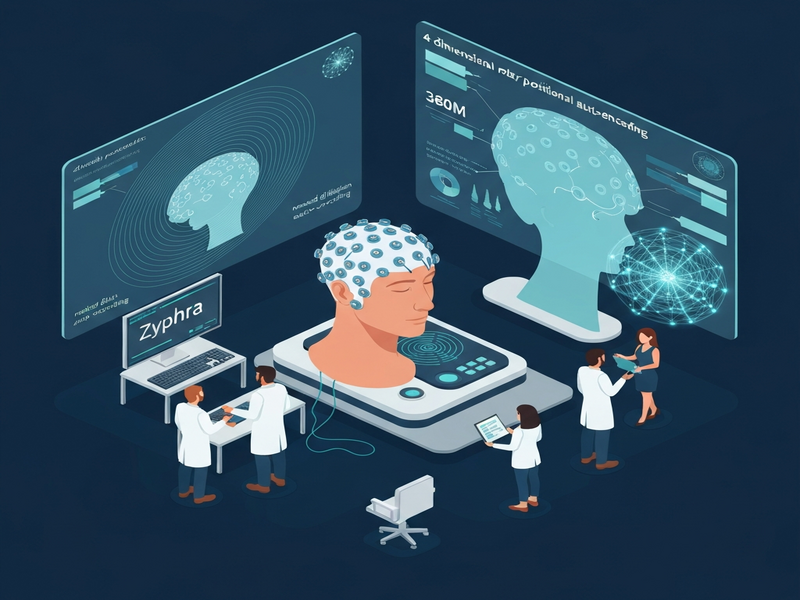
Zyphra Unveils ZUNA: A Game‑Changer for Non‑Invasive BCI
On February 18, 2026, Zyphra announced the release of ZUNA, a 380M‑parameter BCI foundation model designed specifically for EEG data. The model promises to bridge the gap between raw brain activity and textual output, paving the way for reliable thought‑to‑text applications without the need for invasive implants. For a full press release, see the original article.
While Zyphra focuses on brain‑computer interfaces, the broader AI ecosystem—including platforms like the UBOS platform overview—is rapidly adopting similar foundation‑model concepts to accelerate development across domains such as marketing, automation, and data analytics.
ZUNA Model Overview and Core Specifications
- Parameter count: 380 million trainable weights.
- Architecture: Masked diffusion auto‑encoder with 4‑dimensional rotary positional encoding (4D RoPE).
- Input granularity: 0.125 s (32 samples) temporal windows tokenized per channel.
- Supported electrode count: 2 – 256 channels, arbitrary spatial arrangement.
- Training corpus: 2 million channel‑hours from 208 public EEG datasets.
- License: Apache‑2.0, with an MNE‑compatible inference stack.
The model’s flexibility means it can be deployed on anything from low‑cost consumer headsets to high‑density clinical rigs, making it a universal layer for EEG‑based AI applications.
Technical Innovations Behind ZUNA
1. 4D Rotary Positional Encoding (4D RoPE)
Traditional EEG models assume a fixed montage, which limits generalization. ZUNA treats each sample as a point in a four‑dimensional space: three spatial coordinates (x, y, z) on the scalp and a coarse‑time index (t). This encoding lets the model “imagine” signals at any location, even when up to 90 % of channels are missing.
2. Masked Diffusion Auto‑Encoding
Diffusion models excel at generating continuous data. ZUNA pairs a diffusion decoder with an encoder that compresses EEG windows into a latent bottleneck. During training, 90 % of channels are randomly masked, forcing the network to reconstruct the missing signals from the remaining 10 %. This heavy masking strategy yields a robust internal representation of cross‑channel correlations.
3. Scalable Training Pipeline
Zyphra harmonized 208 public datasets, standardizing them to 256 Hz, applying a 0.5 Hz high‑pass filter, and an adaptive notch filter for line noise. All recordings were z‑score normalized to preserve spatial relationships while ensuring numerical stability.
Training Data, Benchmarks, and Performance Metrics
| Metric | Value |
|---|---|
| Total channel‑hours | 2 million |
| Unique 5‑second samples | 24 million |
| Mean Squared Error (90 % dropout) | 0.018 ± 0.004 |
| Spherical‑spline baseline MSE | 0.045 ± 0.009 |
| Inference latency (GPU) | ≈ 12 ms per 0.125 s window |
Across benchmark datasets such as ANPHY‑Sleep and BCI2000 motor‑imagery, ZUNA consistently outperformed the industry‑standard spherical‑spline interpolation, especially under extreme channel dropout. The model’s low latency also makes it suitable for real‑time BCI pipelines.
How ZUNA Beats Traditional EEG Reconstruction Techniques
- Generalization: Unlike fixed‑layout CNNs, ZUNA works with any electrode configuration.
- Learned Prior: Diffusion training provides a statistical prior over brain activity, whereas spline methods rely solely on geometric smoothness.
- Super‑Resolution: ZUNA can up‑sample from sparse recordings to dense reconstructions, enabling high‑fidelity downstream decoding.
- Robustness to Noise: Heavy channel‑dropout training makes the model tolerant to motion artifacts and electrode shifts.
Implications for Non‑Invasive Thought‑to‑Text Applications
By providing a reliable, high‑resolution representation of EEG signals, ZUNA removes a major bottleneck in building end‑to‑end thought‑to‑text pipelines. Researchers can now feed reconstructed signals into language models (e.g., OpenAI’s GPT‑4 or Claude) with far fewer preprocessing steps, dramatically reducing latency and error propagation.
The model also opens doors for consumer‑grade BCI products—think silent dictation on smart glasses or real‑time captioning for accessibility—without the regulatory hurdles of invasive implants.
Companies building AI‑driven experiences can leverage ZUNA through the OpenAI ChatGPT integration or the ChatGPT and Telegram integration, enabling seamless voice‑to‑text or text‑to‑brain interfaces.
“ZUNA represents a paradigm shift: we no longer need to hand‑craft electrode‑specific pipelines. Our model learns the physics of the scalp and the dynamics of brain activity, making non‑invasive BCI truly scalable.” – Dr. Maya Patel, Chief Scientist at Zyphra
What’s Next? Harness ZUNA with UBOS Tools
If you’re a developer or researcher eager to experiment with ZUNA, UBOS offers a suite of tools that can accelerate your workflow:
- Deploy ZUNA‑compatible pipelines using the Web app editor on UBOS for rapid prototyping.
- Automate data preprocessing and model inference with the Workflow automation studio.
- Explore pre‑built templates such as the AI SEO Analyzer or the AI Video Generator to showcase BCI‑driven content creation.
- Leverage the AI marketing agents to turn decoded thoughts into personalized marketing copy.
- Start small with the UBOS for startups program, which includes free credits for experimental AI models.
- Scale to enterprise‑grade deployments via the Enterprise AI platform by UBOS, offering secure multi‑tenant hosting.
Curious about pricing? Review the UBOS pricing plans to find a tier that matches your project’s scale.
Need inspiration? Browse the UBOS portfolio examples for real‑world deployments that combine EEG data with AI‑generated content, such as the Talk with Claude AI app or the AI Chatbot template.
For developers who love to experiment with voice interfaces, the GPT‑Powered Telegram Bot demonstrates how ZUNA’s output can be streamed to messaging platforms in real time.
Finally, explore our extensive template marketplace for creative AI projects—whether you need an AI Image Generator, an AI Email Marketing campaign, or a custom AI Survey Generator.
Ready to push the boundaries of brain‑computer interaction? Dive into ZUNA today and let UBOS power the next generation of non‑invasive AI experiences.
Explore UBOS Solutions
Andrii Bidochko
CTO UBOS
Andrii Bidochko is an AI entrepreneur and researcher focused on AI agents, reinforcement learning, and autonomous systems. He writes about the technologies shaping the future of machine intelligence, from frontier models and agent architectures to real-world AI applications.