

- Updated: March 26, 2026
- 6 min read
Spotify Launches AI Music Attribution Tool to Give Artists Control Over Misattributed Tracks
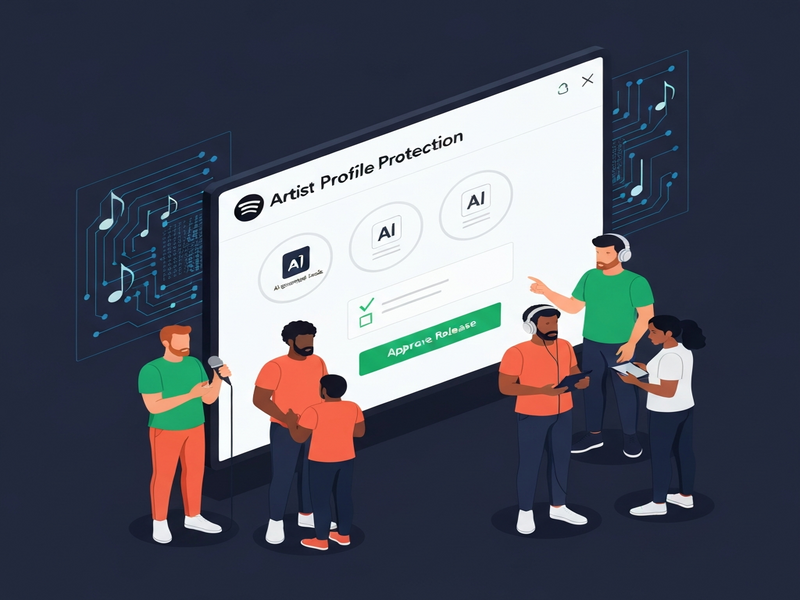
Spotify’s new “Artist Profile Protection” tool lets musicians review and approve every track that is about to appear on their profile, effectively stopping AI‑generated or misattributed songs from polluting their catalog.
What is Spotify’s AI‑misattribution tool and why does it matter?
In March 2026, Spotify announced a beta‑only feature that gives artists a final say before any new release—whether human‑made or AI‑generated—shows up under their name on the streaming service. The move comes as “AI slop” floods music platforms, creating confusion for fans and damaging the credibility of artist discographies. By inserting an approval workflow directly into Spotify for Artists, the company hopes to protect creator identity, preserve accurate streaming metrics, and restore trust in recommendation algorithms.
How the “Artist Profile Protection” feature works
1. Automated detection of AI‑generated or misattributed uploads
Spotify’s backend now runs a two‑layer verification:
- Metadata cross‑check: The system compares the submitted ISRC, UPC, and artist name against an internal registry to flag mismatches.
- AI‑signature analysis: Using a proprietary neural network, Spotify scans audio fingerprints for patterns typical of synthetic generation (e.g., overly smooth vocal timbres, repetitive chord progressions, or watermark‑like artifacts).
2. Real‑time artist review workflow
When a track passes the automated filter, the artist receives an email notification with a concise preview:
- Track title, album art, and a 30‑second audio snippet.
- Origin details (uploader, distribution partner, and submission date).
- Two action buttons: Approve or Reject.
Artists can also access the same interface from the “Spotify for Artists” dashboard on desktop or mobile. The UI follows Tailwind’s clean design language, with bg-green-100 for approved items and bg-red-100 for rejected ones, making the decision process visually intuitive.
3. Approval, rejection, and downstream effects
If an artist clicks Approve, the track is instantly added to their public profile, contributes to streaming counts, and becomes eligible for algorithmic recommendations such as Release Radar and Discover Weekly. Conversely, a Reject action triggers an automatic removal request to the distributor, and the track is flagged for further investigation to prevent repeat offenses.
“We wanted a safety net that respects the creator’s agency while still allowing the open‑distribution model to thrive,” said Spotify’s Head of Artist Relations in the official blog post.
Industry reactions: Artists, labels, and experts weigh in
The rollout has sparked a lively debate across the music ecosystem. Below are some of the most vocal perspectives:
- Independent artists: “Finally, I won’t have to chase down fake streams that ruin my royalty reports,” said indie singer‑songwriter Maya Torres.
- Major label executives: A senior Sony Music spokesperson noted, “Spotify’s tool aligns with our recent request to remove over 135,000 AI‑generated impostor tracks, reinforcing a unified front against misattribution.”
- Tech analysts: Music Business Worldwide highlighted that the feature could become a de‑facto industry standard, urging other platforms to adopt similar safeguards.
- AI ethicists: Dr. Lena Wu of the AI Ethics Lab cautioned, “While the tool mitigates harm, it also raises questions about who decides what qualifies as ‘AI‑generated’ content.”
The broader context: Sony’s removal request and the AI attribution challenge
Spotify’s initiative did not emerge in a vacuum. In early March 2026, Sony Music publicly demanded the takedown of more than 135,000 AI‑fabricated songs that were masquerading as works by its signed artists. The request highlighted three core problems:
- Metadata manipulation: Bad actors upload tracks with swapped or misspelled artist names to siphon royalties.
- AI impersonation: Deep‑learning models can mimic vocal styles, making it difficult for listeners to discern authenticity.
- Algorithmic distortion: Misattributed songs pollute recommendation engines, leading to irrelevant suggestions for users.
Spotify’s tool directly addresses the first two points by inserting a human verification layer, while also preserving the integrity of its recommendation pipelines.
Benefits for creators, listeners, and Spotify itself
The ripple effects of “Artist Profile Protection” extend beyond the immediate problem of AI slop:
- Accurate royalty distribution: Artists receive payments only for tracks they truly own, reducing disputes.
- Cleaner discovery experience: Listeners encounter fewer mislabeled songs, improving satisfaction with curated playlists.
- Enhanced brand trust: Spotify positions itself as a guardian of artistic integrity, a narrative that resonates with both creators and fans.
- Data hygiene for AI training: By filtering out synthetic noise, Spotify’s own recommendation models can be trained on higher‑quality data, leading to smarter suggestions.
- Competitive differentiation: The feature may attract artists who were previously hesitant to join a platform plagued by misattribution.
Read the original announcement
For a full breakdown of Spotify’s beta rollout, see the TechCrunch article that first reported the development.
How UBOS is helping the music tech ecosystem
While Spotify tackles misattribution at the platform level, developers and studios can leverage UBOS’s suite of AI‑focused tools to build compliant, creator‑friendly applications.
- AI music – A collection of pre‑built templates for generating royalty‑safe tracks.
- Spotify updates – Stay informed about policy changes, API enhancements, and new developer resources.
- UBOS homepage – Explore the full platform and its low‑code environment.
- About UBOS – Learn about our mission to democratize AI for creators.
- AI marketing agents – Automate promotion of new releases across social channels.
- UBOS platform overview – A deep dive into the architecture that powers scalable AI services.
- UBOS for startups – Tailored resources for emerging music tech ventures.
- UBOS solutions for SMBs – Affordable AI tools for independent labels.
- Enterprise AI platform by UBOS – Enterprise‑grade security and compliance for major record companies.
- Web app editor on UBOS – Drag‑and‑drop builder for custom music dashboards.
- Workflow automation studio – Automate metadata validation before publishing.
- UBOS pricing plans – Transparent pricing for AI services.
- UBOS portfolio examples – Real‑world case studies of AI in music.
- UBOS templates for quick start – Ready‑made solutions to jump‑start your project.
Conclusion: A pivotal step toward trustworthy streaming
Spotify’s AI‑misattribution safeguard marks a decisive move in the battle against synthetic noise and metadata abuse. By empowering artists with a simple approval workflow, the platform not only protects creator revenue but also restores confidence for listeners who rely on accurate recommendations. As AI‑generated content continues to proliferate, similar verification layers will likely become industry standards.
If you’re a developer, label, or independent artist looking to stay ahead of the curve, explore how UBOS’s AI tools can complement Spotify’s new safeguards—whether you need to generate royalty‑safe tracks, automate metadata checks, or launch AI‑driven marketing campaigns.
Andrii Bidochko
CTO UBOS
Andrii Bidochko is an AI entrepreneur and researcher focused on AI agents, reinforcement learning, and autonomous systems. He writes about the technologies shaping the future of machine intelligence, from frontier models and agent architectures to real-world AI applications.