- Updated: January 17, 2026
- 5 min read
OpenAI Taps Contractors to Feed Real‑World Work Data to Train Next‑Gen AI Agents – Privacy and Industry Implications
OpenAI is recruiting third‑party contractors to submit real work samples so it can benchmark and train next‑generation AI agents against human performance.
Inside OpenAI’s Contractor Data Program: Real‑World Tasks, Privacy Safeguards, and the Future of Generative AI
What the program aims to achieve
In early 2024 OpenAI launched a covert initiative that asks vetted contractors to upload authentic deliverables from their current or previous jobs. The goal is to create a “human baseline” for a wide range of professional tasks—ranging from legal memos to marketing decks—so that the company can measure how its upcoming AI agents stack up against seasoned experts. This effort is part of a broader push to demonstrate measurable progress toward artificial general intelligence (AGI), defined by OpenAI as systems that outperform humans on most economically valuable tasks.
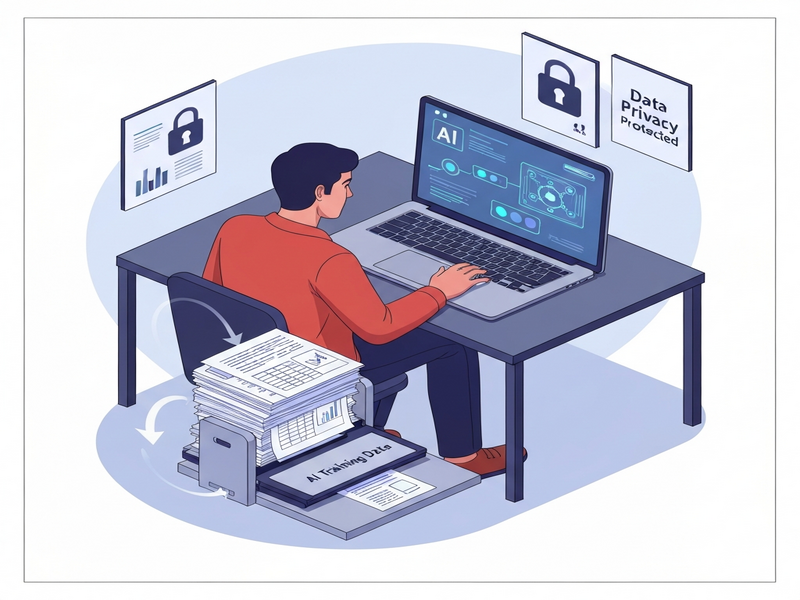
The program, first reported by Wired, reveals a systematic approach: contractors describe a real assignment, upload the original file (Word doc, PDF, spreadsheet, code repo, etc.), and then the data is anonymized before being fed into OpenAI’s evaluation pipelines.
For tech‑savvy professionals and AI enthusiasts, this development signals a shift from synthetic benchmark datasets to truly production‑grade data—an evolution that could accelerate the readiness of AI agents for enterprise deployment.
Training AI agents with real‑world tasks
OpenAI’s internal documentation describes a two‑step workflow for each contractor submission:
- Task request: The original brief from a manager or client (e.g., “Create a 7‑day yacht itinerary for a high‑net‑worth family”).
- Task deliverable: The final artifact produced by the contractor (the actual PDF itinerary, PowerPoint deck, code snippet, etc.).
By feeding these paired inputs into its evaluation suite, OpenAI can:
- Quantify the gap between human and model performance on identical inputs.
- Identify failure modes that only surface on complex, multi‑step business workflows.
- Iteratively fine‑tune models using reinforcement learning from human feedback (RLHF) anchored in real‑world outcomes.
The data also powers UBOS AI news feeds that track emerging trends in AI‑driven automation, giving enterprises a glimpse of how soon they might replace manual processes with AI agents.
Privacy, IP, and trade‑secret protection
The program’s documentation repeatedly stresses the removal of any personally identifiable information (PII) or proprietary content before upload. Contractors receive a checklist that includes:
- Redaction of client names, employee IDs, and contact details.
- Deletion of confidential strategy documents, unreleased product specs, and any material non‑public information.
- Use of an internal tool dubbed “Superstar Scrubbing” to automate the sanitization process.
Despite these safeguards, intellectual‑property experts warn that even heavily scrubbed files can inadvertently expose trade secrets. As About UBOS notes, “trust in contractor judgment is a critical risk vector; rigorous automated checks are essential but not foolproof.”
OpenAI’s legal team reportedly requires contractors to sign additional non‑disclosure agreements that extend the protection of the original employer’s IP, mitigating potential litigation.
Industry impact and how OpenAI compares
OpenAI is not alone in leveraging contractor‑generated data. Competitors such as Anthropic and Google DeepMind have also built “data farms” staffed by highly skilled freelancers. However, OpenAI’s approach differs in three key ways:
- Task fidelity: OpenAI insists on raw, un‑summarized deliverables, whereas others often accept synthetic or simulated outputs.
- Scale of professional diversity: The program spans 30+ occupations—from legal analysts to luxury concierge planners—creating a broader benchmark set.
- Integration with RLHF pipelines: OpenAI directly feeds the cleaned data into its reinforcement‑learning loops, shortening the feedback cycle.
The ripple effect is already visible. Enterprises are watching the program as a bellwether for when AI agents will be “good enough” to handle end‑to‑end workflows. For instance, the Enterprise AI platform by UBOS now offers pre‑built connectors that let businesses plug in OpenAI‑trained agents for tasks like contract review or financial forecasting.
What Wired uncovered
The Wired investigation highlighted several nuances that are easy to miss in press releases:
- OpenAI’s partnership with Handshake AI, a data‑labeling firm valued at $3.5 billion in 2022, underscores the financial stakes of high‑quality training data.
- Contractors are encouraged to submit “fabricated” examples when real data cannot be shared, raising questions about the authenticity of the benchmark set.
- The program’s internal code name, “Superstar Scrubbing,” suggests a proprietary scrubbing engine that could become a marketable product in its own right.
Wired also quoted IP lawyer Evan Brown, who warned that “the AI lab is putting a lot of trust in its contractors to decide what is confidential.” This caution aligns with the broader industry debate on data provenance and model liability.
Why UBOS is tracking this story
At UBOS we maintain a live feed of AI‑related developments. Our OpenAI updates page now features a dedicated section on the contractor data program, complete with timeline charts and risk assessments.
Moreover, the program illustrates a use case for our Workflow automation studio, which can orchestrate the ingestion, scrubbing, and labeling of contractor files at scale—exactly the pipeline OpenAI needs.
Looking ahead: Will contractor data become the gold standard?
As AI agents inch closer to human‑level competence, the quality of training data will be the decisive factor. OpenAI’s contractor program is a bold experiment that could set a new benchmark for the industry—provided the privacy safeguards hold up under legal scrutiny.
If successful, we can expect:
- More enterprises adopting AI agents for mission‑critical tasks.
- Regulatory frameworks that specifically address contractor‑sourced data.
- New market opportunities for data‑scrubbing and labeling platforms, such as the Chroma DB integration that powers semantic search over sanitized corpora.
For businesses eager to stay ahead, the time to experiment with AI‑driven automation is now. UBOS offers a suite of ready‑made templates—like the AI Article Copywriter and the AI SEO Analyzer—that can be combined with OpenAI’s emerging agents to accelerate productivity without compromising data security.