

- Updated: February 18, 2026
- 7 min read
Open‑Source AMRadio Project Enables Emergency Alerts via 12‑Channel AM Broadcast System
The AMRadio project is an open‑source, FPGA‑based 12‑channel AM broadcast system designed for emergency alerts in tunnels and other critical infrastructure.
AMRadio: Open‑Source AM Broadcast Engine Powered by Red Pitaya FPGA
In February 2026 the AMRadio GitHub repository went public, unveiling a fully documented, hardware‑accelerated solution that turns a Red Pitaya STEMlab board into a 12‑channel AM transmitter. The system targets engineers, tunnel operators, and safety‑critical facilities that need a reliable, low‑cost way to push emergency messages to any standard AM radio inside a confined space where cellular coverage is unavailable.
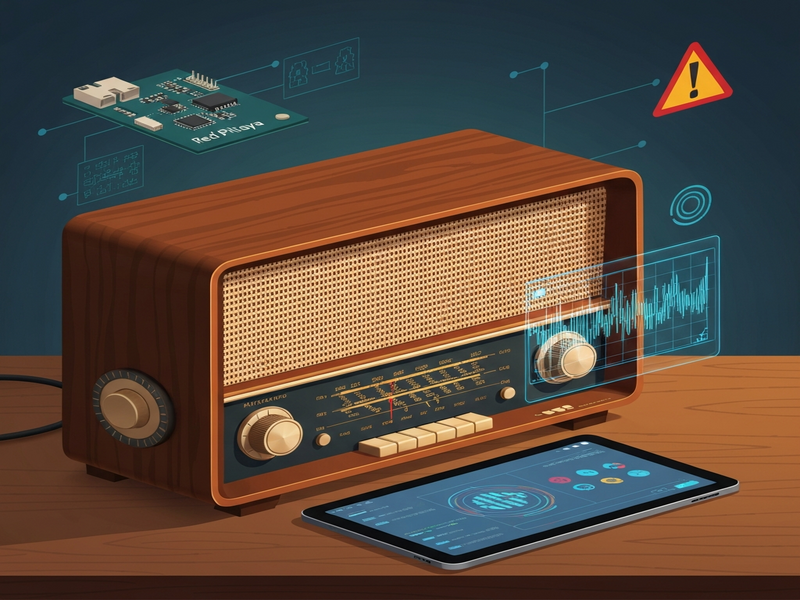
Beyond the immediate safety use‑case, AMRadio showcases a modern software stack—Rust backend, JavaScript MVC frontend, and formal verification of the FPGA watchdog—making it a compelling reference for developers interested in high‑integrity embedded systems.
Core Technology Stack
Red Pitaya FPGA and 12‑Channel AM Modulation
The heart of AMRadio is the Red Pitaya FPGA, a versatile, low‑cost platform that provides:
- 12 independent Numerically Controlled Oscillators (NCOs) covering 505 kHz – 1605 kHz.
- AM modulation with a 16 384‑sample BRAM audio buffer, delivering pre‑recorded alerts at ~5 kHz playback rate.
- Dynamic power scaling that automatically reduces output when fewer channels are active, preserving energy and complying with RF regulations.
- A hardware watchdog timer that disables RF output if the control software stops sending heartbeats for 5 seconds, guaranteeing a fail‑safe state.
Rust Backend + JavaScript MVC Frontend
The user interface follows a strict Model‑View‑Controller (MVC) pattern:
- Model (Rust): Handles TCP/SCPI communication, device state, and a 500 ms polling loop with exponential back‑off.
- View (JavaScript): Stateless rendering that only reflects confirmed hardware state, eliminating UI‑drift.
- Controller (JavaScript): Translates user actions into events published on a central event bus, which the Rust layer consumes via the Tauri bridge.
This separation ensures that the UI never assumes a state that the hardware hasn’t verified, a design principle that aligns with the About UBOS philosophy of reliable, observable systems.
Formal Verification of Safety Properties
Using SymbiYosys and the Z3 SMT solver, the project proves 14 safety properties and 6 coverage scenarios for the watchdog timer. Unlike traditional simulation, formal verification guarantees correctness for every possible input sequence, a practice championed by the Enterprise AI platform by UBOS for mission‑critical AI workloads.
Real‑World Use Cases
Emergency Alerts in Tunnels
During construction or maintenance, vehicles equipped with standard AM radios travel through tunnels where cellular signals cannot penetrate. AMRadio leverages leaky‑feeder cables that guide the AM carrier along the tunnel walls, ensuring every driver hears the same pre‑recorded warning regardless of the exact frequency they tune to.
Critical Infrastructure & Mining
Underground mines, subway stations, and large industrial complexes often lack reliable broadband. By broadcasting on multiple AM channels simultaneously, operators can reach handheld radios, legacy equipment, and even IoT devices that still support AM demodulation.
Temporary Event Coverage
Music festivals, outdoor rallies, or disaster‑relief camps can deploy a single Red Pitaya board to broadcast safety instructions, schedule updates, or multilingual announcements without needing a full‑scale FM infrastructure.
“AMRadio turns a $500 development board into a legally compliant, multi‑channel emergency broadcast system—an unprecedented ROI for safety‑critical projects.” – UBOS blog
Installation & Usage Guide
Prerequisites
- Red Pitaya STEMlab 125‑10 board (or compatible).
- SSH access to the board (default
root/root). - Rust toolchain (
curl https://sh.rustup.rs -sSf | sh). - Node.js LTS for the JavaScript UI.
- Python 3.5 on Red Pitaya (pre‑installed) plus
numpyfor audio loading.
Step‑by‑Step Build Process
- Clone the repository:
git clone https://github.com/Park07/amradio.git && cd amradio/am_radio - Compile the GUI (macOS example):
curl --proto '=https' --tlsv1.2 -sSf https://sh.rustup.rs | sh
source $HOME/.cargo/env
brew install node
cd gui
npm install
npm run build
The compiled binary appears under
gui/src-tauri/target/release/. - Upload FPGA bitstream and scripts to the Red Pitaya via
scp:scp fpga/red_pitaya_top.bit root@:/root/ scp am_scpi_server.py axi_audio_sequence_loop.py root@:/root/ - Load the bitstream on the device:
ssh root@ cat /root/red_pitaya_top.bit > /dev/xdevcfg - Start the SCPI server (keeps the FPGA registers in sync):
python3 /root/am_scpi_server.py & - Launch the audio loop:
sudo python3 /root/axi_audio_sequence_loop.py - Run the GUI on your workstation and connect to the board’s IP. Enable the desired channels, adjust frequencies, and press START BROADCAST.
SCPI Command Reference
| Command | Description |
|---|---|
*IDN? |
Device identification |
CH1:FREQ 700000 |
Set channel 1 to 700 kHz |
CH1:OUTPUT ON |
Enable carrier on channel 1 |
WATCHDOG:RESET |
Clear watchdog timer |
All commands are sent over a TCP socket; the Rust model translates them into SCPI strings and forwards them to the Red Pitaya.
Community, Contributions & Roadmap
The AMRadio project is hosted under an open‑source MIT license, encouraging contributions from hobbyists, academia, and industry. The repository already includes:
- Unit tests covering the Rust state machine (11 tests).
- Formal verification scripts for the watchdog (14 proven properties).
- Mock server for UI development without hardware.
Future milestones listed on the UBOS projects page include:
- Integration with Chroma DB integration for storing broadcast logs and analytics.
- Support for ElevenLabs AI voice integration to generate dynamic, multilingual alerts on‑the‑fly.
- Embedding the OpenAI ChatGPT integration for natural‑language command parsing.
- Extending the UI with the ChatGPT and Telegram integration so operators can trigger alerts via a secure chat bot.
Developers interested in extending the platform can start by forking the repo, adding a new SCPI command, and submitting a pull request. The project’s documentation encourages the use of the Web app editor on UBOS to prototype additional UI widgets without recompiling the Rust backend.
Conclusion & Next Steps
AMRadio demonstrates how a modest FPGA board, combined with modern Rust‑based control software, can deliver a robust, low‑cost emergency broadcast solution. Its open‑source nature, formal safety guarantees, and modular architecture make it an ideal foundation for any organization that needs reliable tunnel communication.
Ready to experiment?
- Visit the UBOS homepage for a quick start guide on deploying AI‑enhanced edge applications.
- Explore the UBOS platform overview to see how the same stack powers other IoT and AI workloads.
- Check out the UBOS templates for quick start, including the AI Article Copywriter template that can help you document your own projects.
- For marketing automation, the AI marketing agents can automatically generate safety notices and distribute them via email or SMS.
- If you represent a startup, learn how UBOS for startups accelerates time‑to‑market for hardware‑software co‑design.
- SMBs can leverage UBOS solutions for SMBs to monitor and broadcast on‑site alerts without a large IT team.
- Enterprise teams interested in scaling the solution should review the Enterprise AI platform by UBOS, which offers centralized device management and compliance reporting.
- To automate deployment pipelines, the Workflow automation studio provides ready‑made actions for SSH, file transfer, and CI/CD.
- Pricing details for commercial support are available on the UBOS pricing plans page.
- Explore real‑world implementations in the UBOS portfolio examples to see how other organizations have integrated similar broadcast systems.
By combining the proven reliability of AMRadio with UBOS’s AI‑centric ecosystem, you can build a next‑generation safety network that is both cost‑effective and future‑proof.
Stay tuned to the UBOS news feed for upcoming releases, community webinars, and partnership opportunities through the UBOS partner program.