

- Updated: March 24, 2026
- 6 min read
Cuba’s Fragile Power Grid Secures New Renewable Energy Partnership
Cuba’s aging power grid is receiving a major boost from a new renewable‑energy partnership with China, which promises large‑scale solar parks, a flagship wind farm, and financing that could reshape the island’s electricity landscape.
After a 30‑hour blackout triggered by a U.S. oil blockade, the Cuban government announced a strategic alliance with Beijing to accelerate its transition to clean power. The deal includes the delivery of hundreds of megawatts of solar capacity, the construction of the island’s largest wind project, and a financing framework that could unlock up to $10 billion in investments over the next decade. For analysts tracking Latin American energy markets, this partnership signals a shift in regional power dynamics and a potential template for other island nations facing similar grid fragility.
Why Cuba’s Grid Is on the Brink
Cuba’s electricity system was built in the 1970s with Soviet‑era thermal plants that rely on imported fuel. Today, the grid consumes roughly 100,000 barrels of oil per day, a volume that is both costly and vulnerable to geopolitical shocks. Aging turbines, limited transmission capacity, and chronic under‑investment have left the island with a reserve margin of less than 5 %, far below the 15 % benchmark recommended by the International Energy Agency (IEA).
- Over 70 % of generation capacity is fossil‑fuel based.
- Renewables account for only 9 % of the energy mix.
- Frequent voltage drops and rolling blackouts affect both residential and industrial consumers.
The recent blackout highlighted how a single supply disruption can cascade through an already overstressed network, prompting the Cuban Ministry of Energy to fast‑track external partnerships that can deliver reliable, locally‑generated power.
China’s Renewable Energy Offer: Scope and Scale
Beijing’s involvement goes beyond equipment sales. The agreement, signed in early March 2026, outlines three core pillars:
- Solar Expansion: Delivery of 5 GW of photovoltaic modules, enough to power roughly 3 million homes. China will also finance the construction of nearly 100 solar parks across Cuba’s southern provinces by 2028.
- Wind Development: Joint engineering of the La Herradura 1 wind farm, projected to generate 250 MW of clean electricity, making it the island’s largest wind installation.
- Financing & Technical Support: A blended loan facility, partially backed by the China Development Bank, that could unlock up to $10 billion in additional renewable projects, coupled with training programs for Cuban engineers.
According to the UBOS energy analysis, the solar equipment shipments from China surged from $5 million in 2023 to $117 million in 2025—a 2,240 % increase—demonstrating Beijing’s growing commitment to the Caribbean market.
Strategic Implications for Cuba and the Wider Region
The partnership carries several layers of impact:
Energy Security
By diversifying generation away from imported oil, Cuba can reduce its exposure to external embargoes and price volatility. The projected increase in renewable capacity could raise the reserve margin to over 20 % by 2030, aligning the island with regional best practices.
Economic Growth
Reliable electricity is a prerequisite for attracting foreign direct investment. The new projects are expected to create 15,000 jobs during construction and generate long‑term maintenance positions, stimulating local economies in provinces such as Santiago de Cuba and Camagüey.
Geopolitical Balance
The alliance deepens China’s foothold in the Western Hemisphere, offering Havana a counterweight to U.S. pressure. Analysts note that the partnership also serves Beijing’s strategic interest in securing a foothold near the Gulf of Mexico.
Technology Transfer
Training modules embedded in the financing package will upskill Cuban technicians in solar PV design, wind turbine operation, and smart‑grid management, laying the groundwork for a homegrown renewable industry.
Expert Commentary
“Cuba’s energy transition is a classic case of a small economy leveraging a great‑power partnership to leapfrog outdated infrastructure,” says Ricardo Torres, senior energy economist at the American University. “The $8‑$10 billion investment horizon is ambitious, but with Chinese financing and technology, the island can realistically achieve a 30‑40 % renewable share by 2035.”
Torres also cautions that while the financing terms are favorable, Cuba must manage debt sustainability and ensure transparent procurement to avoid cost overruns—a lesson learned from other Belt‑and‑Road projects in Africa and Asia.
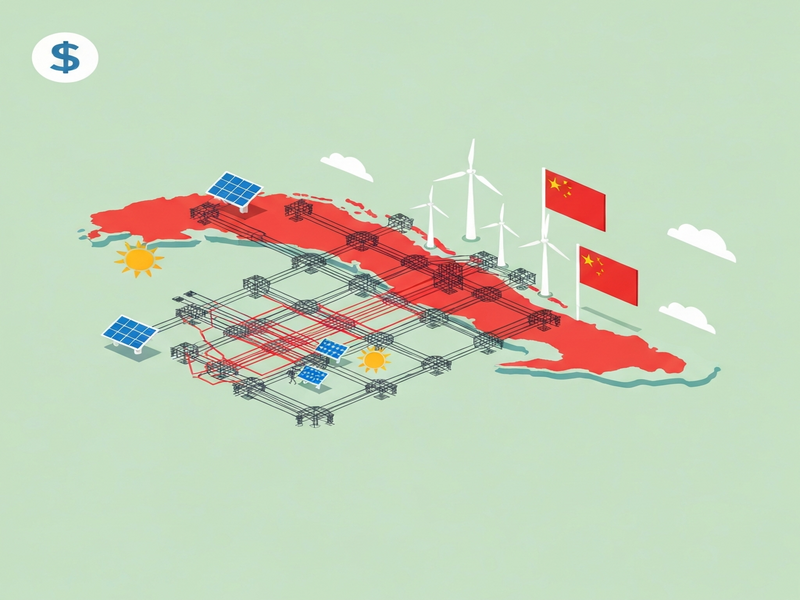
Illustration: Solar and wind assets slated for deployment under the China‑Cuba renewable partnership.
For a full read of the original reporting, see the original source article.
How UBOS Can Help Stakeholders Track This Transition
Energy analysts looking to model the impact of Cuba’s renewable surge can leverage the UBOS platform overview, which offers real‑time data ingestion, AI‑driven forecasting, and customizable dashboards.
For startups aiming to build SaaS solutions around grid analytics, the UBOS for startups program provides low‑cost access to the Web app editor on UBOS, enabling rapid prototyping of monitoring tools.
Mid‑size utilities can explore the UBOS solutions for SMBs, which include the Workflow automation studio for automating maintenance alerts and reporting.
Enterprises seeking a holistic AI‑powered approach can adopt the Enterprise AI platform by UBOS, integrating modules such as AI marketing agents to promote clean‑energy projects.
Pricing transparency is essential; the UBOS pricing plans page outlines tiered options that scale from pilot projects to nation‑wide deployments.
For quick proof‑of‑concepts, developers can browse the UBOS templates for quick start, including the “AI SEO Analyzer” and “AI Article Copywriter” which can be repurposed for energy‑report generation.
Relevant UBOS Templates for Energy Professionals
- Energy Insights – a dashboard template for tracking renewable capacity growth.
- Renewable Energy Trends – visualizes regional solar and wind adoption curves.
- Cuba Energy Analysis – pre‑built models for simulating grid stability under different import scenarios.
Key Takeaways
1. Strategic partnership: China’s renewable‑energy package offers Cuba a lifeline to replace aging oil‑fired plants with solar and wind assets.
2. Investment magnitude: Up to $10 billion in financing could transform the island’s generation mix, pushing renewables toward a 30‑40 % share by 2035.
3. Regional ripple effects: The deal reshapes Caribbean energy geopolitics, giving Beijing a foothold while providing Cuba with greater energy independence.
4. Data‑driven monitoring: Platforms like UBOS enable analysts, startups, and utilities to track progress, model scenarios, and automate reporting in real time.
As the partnership unfolds, stakeholders should watch for milestones such as the commissioning of the first solar park, the operational start‑up of La Herradura 1, and the rollout of financing tranches. The convergence of policy, technology, and AI‑enabled analytics promises to turn Cuba’s fragile grid into a resilient, low‑carbon backbone for the island’s future.
Stay informed on the latest energy‑tech developments. Subscribe to UBOS’s newsletter for weekly insights on AI‑driven energy analytics.