

- Updated: December 30, 2025
- 6 min read
Investors Discuss Climate‑Tech Trends and 2026 Outlook
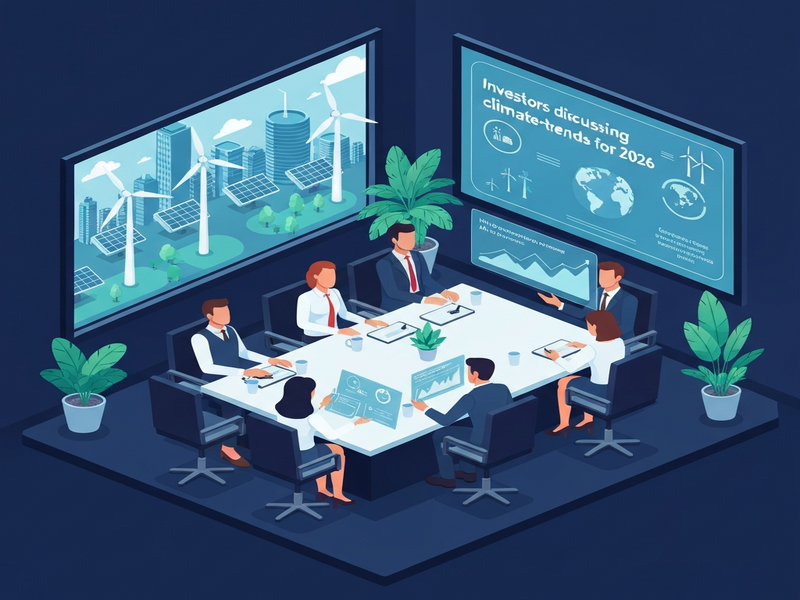
Investors see 2026 as a watershed year for climate tech, with AI‑driven data centers, next‑generation renewable power, and advanced storage solutions poised to dominate the venture capital landscape.
Investor Sentiment on Climate‑Tech for 2026
A fresh round of interviews with leading climate‑tech backers reveals a surprisingly resilient market despite political headwinds in the United States and Europe. The full discussion can be read in the original TechCrunch story, but the key takeaways are distilled below for venture capitalists, founders, and sustainability‑focused investors seeking a clear 2026 outlook.
Key Takeaways from the Investor Survey
- Climate‑tech funding held steady in 2025, contradicting expectations of a collapse.
- AI‑powered data centers are now the primary demand driver for clean power.
- Solar, wind, and battery costs continue to undercut fossil alternatives, accelerating adoption.
- Geothermal, advanced nuclear, and emerging fusion projects are moving from “lab” to “commercial” status.
- Grid‑software, robotics, and AI‑enabled optimization are the “quiet winners” that will unlock scale.
- Several high‑profile IPOs and SPACs are slated for 2026, especially in nuclear and geothermal.
2025 Trends Carrying Over to 2026
AI‑Driven Data Centers
In 2025, hyperscale operators locked in multi‑year power‑offtake agreements to fuel AI workloads. Investors now expect data centers to shift focus from sheer demand to resilience and grid decoupling. As Lisa Coca of Toyota Ventures notes, “the 2026 data center energy conversation is likely to shift from demand to resilience and the need to accelerate plans to decouple from the grid.” This creates a surge in demand for on‑site generation—solar canopies, battery‑backed micro‑grids, and even modular nuclear units.
Solar & Wind – The Cost‑Leadership Edge
Solar PV and on‑shore wind have reached price points that are now cheaper than new natural‑gas peaker plants in many U.S. markets. Daniel Goldman of Clean Energy Ventures emphasizes that “zero‑carbon generation is already among the cheapest sources of power.” Expect continued megawatt‑scale deployments, especially in sun‑rich states where transmission bottlenecks are being addressed through AI‑driven grid‑software.
Next‑Generation Batteries & Storage
Grid‑scale batteries are transitioning from lithium‑ion dominance to diversified chemistries such as sodium‑ion and zinc‑based systems. Leo Banchik of Voyager highlights that “we’ll see growth in 2026 with new plays on battery chemistry and business models.” These technologies enable 24/7 clean power, a prerequisite for AI data centers and industrial decarbonization.
Geothermal & Advanced Nuclear
Enhanced geothermal is gaining traction as a “ready‑to‑scale” technology. Joshua Posamentier of Congruent Ventures predicts “geothermal will be hot on solar’s heels in terms of new generation.” Meanwhile, private‑equity‑backed fission startups have raised over $1 billion in 2025, positioning them for potential IPOs or SPAC listings in 2026.
Fusion & Long‑Duration Storage
Fusion remains a high‑risk, high‑reward frontier. Government funding is expected to rise as geopolitical competition intensifies, but commercial deployment is still a decade away. In the interim, long‑duration storage (e.g., flow batteries, compressed air) will bridge the gap between intermittent renewables and baseload demand.
Grid Software, Robotics & AI Optimization
The “quiet winners” are software platforms that accelerate interconnection, permit faster deployment, and optimize real‑time dispatch. Amy Duffuor of Azolla Ventures stresses that “grid execution as a category” will be a major value driver. Robotics, especially for transmission line installation and battery plant automation, is also set to scale, reducing labor costs and project timelines.
Notable Funding Rounds and IPO Candidates for 2026
The investor cohort highlighted several companies poised for public markets:
| Sector | Company | Funding / IPO Signal |
|---|---|---|
| Geothermal | Fervo Energy | $462 M Series D (2025) – IPO target 2026 |
| Nuclear Fission | Commonwealth Fusion | Series C $800 M – SPAC speculation |
| Battery Chemistry | Voyage Energy | Series B $250 M – Scaling gigafactory |
| Grid Software | GridCare | Series A $45 M – Strategic partnerships with utilities |
| Robotics for Transmission | Robotic Line Burial | Seed $12 M – Pilot with regional utility |
Strategic Implications for VCs and Founders
The consensus among the surveyed investors points to three actionable themes:
- Prioritize Resilience Over Pure Scale. Projects that can operate off‑grid or provide firm capacity (geothermal, modular nuclear, advanced batteries) will attract premium offtake contracts.
- Layer AI Across the Stack. From predictive maintenance in data centers to AI‑driven grid dispatch, integrating generative AI creates cost‑curves that outpace traditional engineering solutions.
- Invest in Enabling Software. Platforms that shorten permitting, automate interconnection studies, or provide real‑time market analytics are the “quiet winners” that can generate outsized returns with relatively low capital intensity.
Capital Allocation Tips
- Allocate 30‑40% of climate‑tech fund capital to infrastructure‑adjacent software (grid‑ops, AI‑optimizers).
- Reserve a tranche for “hard‑tech” bets (geothermal, nuclear) that have clear regulatory pathways and government incentives.
- Maintain a flexible reserve for opportunistic SPACs or IPOs that emerge from the $1 B+ funding rounds highlighted above.
Actionable Steps & Resources
To accelerate your climate‑tech journey, leverage the UBOS homepage for a unified AI‑first development environment. The platform offers:
- UBOS platform overview – a low‑code stack that integrates data ingestion, AI modeling, and deployment.
- AI marketing agents that can auto‑generate pitch decks and investor updates for climate‑tech startups.
- UBOS for startups – pre‑built templates for rapid MVP creation.
- UBOS solutions for SMBs – scalable tools for mid‑size clean‑energy firms.
- Enterprise AI platform by UBOS – enterprise‑grade governance and security for large‑scale grid‑software projects.
- Web app editor on UBOS – drag‑and‑drop UI builder for dashboards and monitoring tools.
- Workflow automation studio – orchestrate data pipelines, model training, and deployment with zero code.
- UBOS pricing plans – flexible subscription tiers that grow with your project.
- UBOS portfolio examples – case studies of climate‑tech firms that have accelerated time‑to‑market using UBOS.
- UBOS templates for quick start – ready‑made blueprints for AI‑enabled energy analytics, carbon accounting, and more.
The UBOS Template Marketplace also hosts niche tools that align perfectly with the 2026 trends:
- AI SEO Analyzer – boost visibility of your climate‑tech product pages.
- AI Article Copywriter – generate technical whitepapers at scale.
- AI Video Generator – create investor pitch videos with synthetic voice and animation.
- AI YouTube Comment Analysis tool – gauge market sentiment for renewable tech launches.
- AI LinkedIn Post Optimization – amplify founder outreach to VCs.
- Image Generation with Stable Diffusion – produce high‑impact visual assets for grant applications.
- AI Chatbot template – embed a knowledge‑base assistant on your product site.
- Customer Support with ChatGPT API – automate technical support for complex hardware deployments.
Conclusion & Call to Action
The 2026 climate‑tech horizon is defined by a convergence of AI, resilient clean power, and software‑enabled scale. Investors who double‑down on resilient generation (geothermal, advanced nuclear), next‑gen storage, and grid‑software will capture the most upside. Founders should embed AI early, leverage modular hardware, and partner with platforms that accelerate development—UBOS being a prime example.
Ready to position your climate‑tech venture for 2026 success? Explore the UBOS partner program for co‑development opportunities, or start a free trial on the UBOS homepage today.
© 2025 UBOS. All rights reserved.