

- Updated: November 26, 2025
- 6 min read
Voyager 1 Nears One Light‑Day From Earth – A Milestone in Interstellar Exploration
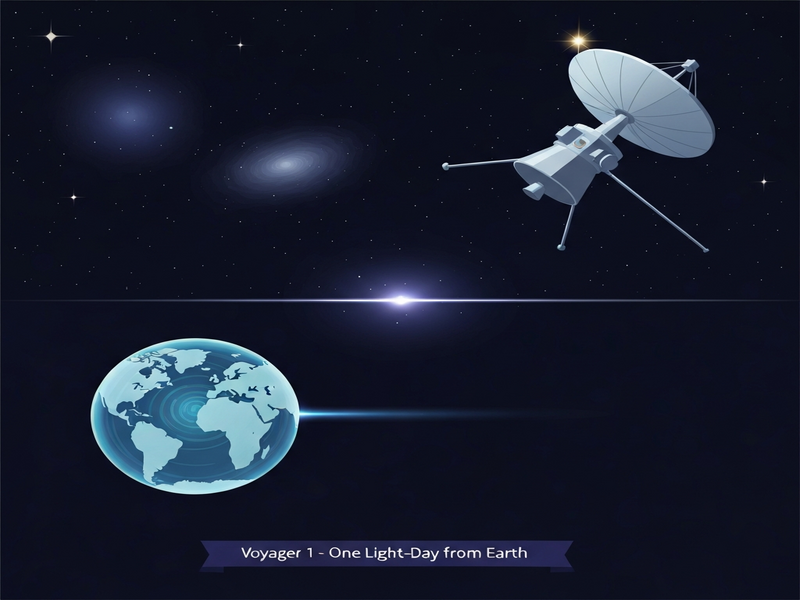
Voyager 1 will be exactly one light‑day away from Earth on 15 November 2026, marking the first time a human‑made object is a full day’s light‑travel time from our planet.
Voyager 1’s Upcoming Light‑Day Milestone
After nearly five decades roaming the cosmos, NASA’s legendary deep‑space probe is about to achieve a record that few can even imagine: a radio signal will need a full 24 hours to travel between Earth and the spacecraft. This milestone underscores the sheer scale of interstellar space and the endurance of a probe launched in 1977. For a deeper dive into the original announcement, see the NASA press release.
While the world watches this historic moment, modern AI platforms like the UBOS homepage are helping scientists and engineers visualize and analyze the data streaming back from the farthest reaches of our solar system.
Voyager 1 Milestone Details
Distance and the Meaning of a Light‑Day
By 15 November 2026, Voyager 1 will be 16.1 billion miles (25.9 billion km) from Earth. Light travels at roughly 186,282 miles per second (299,792 km/s), so a light‑day—the distance light covers in 24 hours—is about 16.1 billion miles, matching Voyager’s distance at that moment. In comparison, a light‑year (the distance light travels in a year) is about 5.88 trillion miles, making a light‑day a tiny fraction of interstellar distances but a massive gap for human‑made communication.
Timeline to the Milestone
- 1977 – Launch from Cape Canaveral aboard a Titan IIIE rocket.
- 1979 – Fly‑by of Jupiter, revealing its intense radiation belts and massive storms.
- 1980 – Fly‑by of Saturn, discovering its complex ring system and moons.
- 2012 – Entered interstellar space, crossing the heliopause.
- 2026 – Will reach a one‑day light‑delay from Earth.
The probe’s journey has been a continuous outward march, adding roughly 3.5 AU (the average Earth‑Sun distance) each year. This steady progress is a testament to the precision of its original trajectory and the reliability of its power source.
Technical Background: Speed, Power, and Communication
Speed and Distance Accumulation
Voyager 1 travels at about 11 miles per second (17.7 km/s). At this velocity, it covers the distance from Earth to the Sun (1 AU) in roughly 8 hours. Over the decades, this modest speed has compounded into billions of miles, illustrating how even slow, steady motion can achieve extraordinary distances given enough time.
Power: Radioisotope Thermoelectric Generators (RTGs)
The spacecraft is powered by three RTGs that convert heat from the decay of plutonium‑238 into electricity. These generators have supplied enough power for scientific instruments and communications for more than 45 years and are expected to remain functional into the early 2030s, albeit at reduced output.
Communication Delay and Data Rate
As Voyager 1 recedes, the round‑trip signal time grows. By the upcoming light‑day milestone, a command sent from Earth will take 24 hours to reach the probe, and the reply will need another 24 hours—totaling a 48‑hour round‑trip. Data rates have also dropped dramatically, from 115 kbps at Jupiter to less than 160 bps today, requiring sophisticated error‑correction algorithms.
Modern AI tools, such as the OpenAI ChatGPT integration, assist engineers in parsing these low‑bandwidth telemetry streams, extracting meaningful trends without overwhelming the limited bandwidth.
Why Voyager 1 Matters for Interstellar Research
Scientific Instruments and Discoveries
Voyager 1 carries a suite of instruments—including a plasma spectrometer, magnetometer, and cosmic ray detector—that continue to sample the interstellar medium (ISM). These measurements have revealed:
- The density and temperature of interstellar plasma.
- Variations in the galactic magnetic field beyond the heliopause.
- Unexpected bursts of cosmic rays, hinting at nearby supernova remnants.
Cultural Impact: The “Pale Blue Dot”
In 1990, Voyager 1 turned its camera back toward Earth, capturing the iconic “Pale Blue Dot” photograph. This image, taken from a distance of 3.7 billion miles, reminded humanity of our fragile place in the cosmos and continues to inspire generations of scientists and artists alike.
Driving Future Exploration
The data gathered by Voyager 1 informs the design of next‑generation interstellar probes, such as the proposed Interstellar Probe mission, which aims to travel even farther and faster. Understanding the ISM’s properties helps engineers develop better shielding, communication strategies, and power systems for future deep‑space explorers.
Companies leveraging AI for outreach, like AI marketing agents, use Voyager’s story to craft compelling narratives that engage the public and attract funding for ambitious space projects.
Future Outlook: What Lies Ahead for Voyager 1?
Operational Expectations
Even after the light‑day milestone, Voyager 1 will keep transmitting data as long as its RTGs provide sufficient power. Engineers anticipate that by the early 2030s, power levels will dip below the threshold needed for most instruments, leading to a gradual shutdown of scientific operations.
Potential for New Discoveries
The probe’s trajectory will take it through regions of the galaxy that have never been sampled. Unexpected phenomena—such as variations in interstellar dust density or magnetic turbulence—could still be captured, offering fresh insights into the Milky Way’s structure.
Implications for Enterprise AI Platforms
The challenges of managing a spacecraft with such extreme latency inspire innovations in autonomous decision‑making. The Enterprise AI platform by UBOS incorporates similar principles, enabling businesses to operate with minimal human intervention across distributed networks.
Conclusion: Voyager 1’s Legacy and How You Can Join the Journey
Voyager 1’s upcoming one‑day light‑delay is more than a record; it’s a living laboratory that continues to expand humanity’s knowledge of the cosmos. Its endurance showcases the power of robust engineering, long‑term planning, and the relentless curiosity that drives scientific discovery.
If you’re inspired by Voyager’s story and want to explore how cutting‑edge AI can accelerate your own projects, discover the UBOS pricing plans that fit any budget, or browse the UBOS portfolio examples for real‑world success cases.
For developers eager to prototype AI‑enhanced tools, the UBOS templates for quick start include ready‑made solutions like the AI SEO Analyzer and the AI Article Copywriter, which can help you craft compelling content about space exploration and beyond.
Join the conversation, share this article, and let Voyager 1’s legacy inspire the next generation of explorers—both in space and in the digital frontier.