

- Updated: February 18, 2026
- 6 min read
SpaceX Veterans’ Mesh Optical Technologies Secures $50M Series A for AI Data Center Optical Transceivers
Mesh Optical Technologies raised $50 million in a Series A round to accelerate the mass production of optical transceivers that will power next‑generation AI data‑center interconnects.
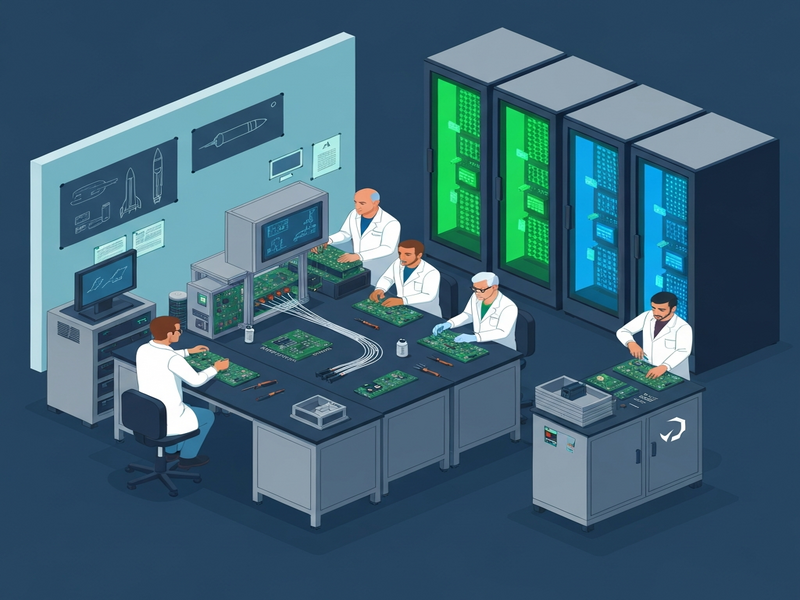
Los Angeles‑based Mesh Optical Technologies announced a $50 million Series A financing led by Thrive Capital, with participation from several strategic investors. The capital infusion is earmarked for scaling a U.S.‑based manufacturing line that will produce thousands of optical transceivers daily—critical components that translate light‑based signals into electrical data for AI‑intensive GPU clusters. By localizing production, Mesh aims to reduce reliance on overseas suppliers, strengthen the national AI data‑center supply chain, and deliver measurable power‑efficiency gains for hyperscale operators.
Founders: SpaceX Veterans Turned Photonics Pioneers
The trio behind Mesh—Travis Brashears (CEO), Cameron Ramos (President), and Serena Grown‑Haeberli (VP of Product)—first crossed paths at SpaceX, where they engineered the optical communications backbone for the Starlink satellite constellation. Their experience designing high‑throughput, low‑latency links for thousands of orbiting satellites gave them a unique perspective on the bottlenecks of terrestrial data‑center interconnects.
“When we built the next‑gen Starlink satellites, we realized the existing optical transceiver market couldn’t keep up with the bandwidth and power‑efficiency demands of massive AI workloads,” Brashears explained in the TechCrunch interview. This insight sparked the idea to create a domestic, high‑volume production line for next‑generation transceivers.
Mesh Optical’s Core Technology
Mesh’s flagship product is a compact, low‑power optical transceiver that eliminates a traditionally power‑hungry component found in most commercial designs. The result is a 3‑5 % reduction in overall GPU cluster power consumption—a meaningful saving when scaling to million‑GPU deployments.
Why Optical Transceivers Matter for AI
- Bandwidth density: Modern AI models require petabit‑scale data movement; optical links provide the necessary throughput without the electromagnetic interference of copper.
- Latency reduction: Light‑speed transmission across fiber cuts inter‑GPU latency, accelerating training cycles.
- Energy efficiency: Converting photons to electrons at the chip level reduces the power budget of large clusters.
Design Highlights
- Monolithic silicon‑photonic integration that removes the need for discrete lasers.
- Thermal‑aware packaging to keep power draw under 5 W per port.
- Modular form factor compatible with existing server racks, easing adoption.
These innovations position Mesh as a potential “domestic champion” in a market currently dominated by Chinese manufacturers. By establishing a supply chain within the United States, Mesh directly addresses emerging national‑security concerns around critical AI infrastructure.
Series A Funding: $50 Million Led by Thrive Capital
The $50 million round was led by Thrive Capital, with participation from Andreessen Horowitz, Sequoia Capital, and several strategic corporate investors from the AI‑hardware ecosystem.
Key terms of the round include:
- Allocation of $30 M for building a 1,000‑units‑per‑day production line by Q4 2027.
- $10 M earmarked for R&D on next‑generation photonic integration.
- $10 M reserved for go‑to‑market activities, including partnerships with hyperscale cloud providers.
Thrive Capital’s partner Philip Clark emphasized the strategic importance of domestic optical components: “If AI is the most important technology for several generations, we cannot afford to have critical parts of AI data‑center capex sourced from misaligned or competitive nations.”
Strategic Impact on the AI Data‑Center Ecosystem
Mesh’s entry into the market could reshape the supply dynamics for AI data centers in three major ways:
1. Supply‑Chain Resilience
By manufacturing transceivers in the United States, Mesh reduces exposure to export controls, tariffs, and geopolitical risk. This aligns with the broader push for a secure AI data centers infrastructure that can operate independently of foreign supply chains.
2. Cost & Power Efficiency
Early adopters report a 3‑5 % drop in power consumption per GPU cluster, translating into millions of dollars saved annually for hyperscalers. The lower cost of domestically produced transceivers also promises to compress overall capex for new AI‑focused facilities.
3. Innovation Acceleration
With a dedicated production line, Mesh can iterate quickly on photonic designs, enabling future generations of wavelength‑division multiplexing (WDM) that could further multiply bandwidth without adding physical fibers.
What the Founders and Investors Are Saying
“Our goal is to build a thousand‑unit‑per‑day factory that can meet the exploding demand for AI‑grade interconnects while keeping the supply chain secure and American‑made,” said Travis Brashears, CEO of Mesh Optical Technologies.
“Mesh is solving a critical bottleneck in AI scaling. Their approach to photonic integration is both technically elegant and strategically vital for U.S. competitiveness,” added Philip Clark, Partner at Thrive Capital.
Read the Full Story
For a comprehensive account of the funding round and the technology behind Mesh Optical, see the original report on TechCrunch.
Why This Matters for the Broader AI Ecosystem
Companies building AI workloads need end‑to‑end solutions that combine hardware, software, and operational tooling. Platforms like the Enterprise AI platform by UBOS already integrate with cutting‑edge hardware, and the arrival of domestic optical transceivers will further streamline deployment pipelines.
Startups looking to accelerate time‑to‑market can leverage the UBOS templates for quick start, many of which now include pre‑configured modules for high‑performance data‑center networking.
SMBs aiming to adopt AI can explore UBOS solutions for SMBs, which now feature cost‑effective connectivity options that benefit from Mesh’s upcoming transceiver line.
Investors tracking the AI hardware wave can follow the UBOS startup funding page for insights into emerging opportunities, including photonics‑focused ventures like Mesh.
Explore More AI‑Focused Resources on UBOS
- AI marketing agents – automate campaign creation with generative AI.
- Workflow automation studio – orchestrate data‑pipeline tasks across hardware and software.
- Web app editor on UBOS – build custom dashboards to monitor transceiver performance.
- UBOS pricing plans – flexible tiers for startups to enterprises.
Future Outlook
Mesh Optical Technologies is positioned at the intersection of photonics innovation and national‑security imperatives. With a robust $50 million war chest, the company plans to hit a production capacity of 1,000 transceivers per day by the end of 2027, paving the way for large‑scale adoption in AI data centers across the United States.
As AI models continue to grow in size and complexity, the demand for high‑bandwidth, low‑latency interconnects will only intensify. Mesh’s domestic supply chain could become a cornerstone of the next wave of AI infrastructure, offering both performance gains and strategic independence.
Stakeholders—from hyperscale cloud providers to venture capitalists—should watch Mesh closely. Its success could signal a broader shift toward U.S.-based photonic manufacturing, reshaping the global AI hardware landscape for years to come.