

- Updated: January 18, 2026
- 6 min read
AI Data Centers Face Critical Shortage of Electricians and Plumbers – A Growing Skills Gap
The rapid expansion of AI data centers is being held back by a severe shortage of electricians, plumbers, and other skilled trades needed to build and maintain the physical infrastructure that powers AI.
AI Data Centers Face a Critical Skilled‑Trades Shortage: Electricians & Plumbers in High Demand
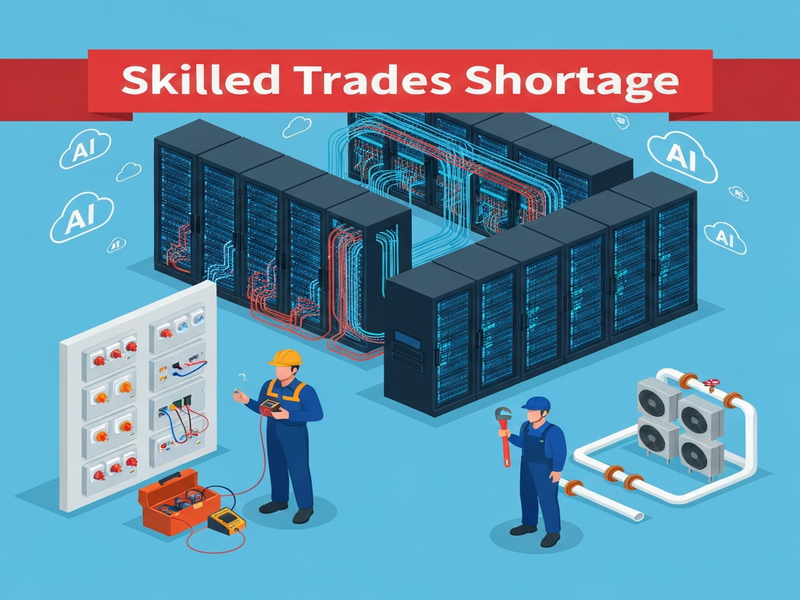
AI‑driven workloads are driving an unprecedented boom in data‑center construction across the United States. While headlines often focus on the race for AI researchers and software engineers, a quieter but equally vital battle is unfolding on the ground: the shortage of electricians, plumbers, and HVAC technicians who can wire, cool, and keep these massive facilities operational.
According to the U.S. Bureau of Labor Statistics, an average of 81,000 electrician positions will remain unfilled each year between 2024 and 2034. A McKinsey analysis adds that the U.S. will need an additional 130,000 trained electricians, 240,000 construction laborers, and 150,000 supervisors by 2030 to keep pace with demand.
For tech executives, data‑center managers, and IT planners, understanding this workforce gap is essential to avoid costly delays, budget overruns, and missed market opportunities.
The Scale of the Shortage
National Statistics
- 81,000 average annual electrician vacancies (BLS, 2024‑2034).
- 9 % projected growth for electricians—far above the average for all occupations.
- McKinsey: 130,000 extra electricians, 240,000 laborers, 150,000 supervisors needed by 2030.
Regional Hotspots
Data‑center clusters in Northern Virginia, Texas, and the Pacific Northwest are experiencing the most acute pressure. In Northern Virginia, for example, union representatives report “two, three, sometimes four times” the usual membership needed for a single project.
Why AI Amplifies the Gap
AI models consume massive amounts of electricity, requiring larger power‑distribution systems, advanced cooling, and redundant backup infrastructure. Each new megawatt of capacity translates into thousands of linear feet of conduit, high‑voltage panels, and precision‑engineered HVAC loops—tasks that only certified electricians and plumbers can safely execute.
Impact on AI Data Center Projects
When skilled‑trade talent is scarce, the ripple effects are felt across the entire AI supply chain:
- Schedule Delays: Tight construction timelines leave little room for the learning curve of apprentices, forcing developers to postpone power‑up dates.
- Cost Inflation: Overtime premiums and “skill‑scarcity premiums” can add 15‑30 % to labor budgets.
- Design Compromises: Engineers may simplify cooling layouts or reduce redundancy to match available trade expertise, potentially lowering uptime guarantees.
- Operational Risk: Inadequately trained crews increase the likelihood of wiring errors, leading to outages or safety incidents.
These challenges are not theoretical. Companies such as Google, Amazon, and Meta have publicly acknowledged that “the competition for trades talent is fierce,” and that without a pipeline of qualified workers, the AI infrastructure rollout could stall.
Industry Responses and Training Initiatives
Corporate Funding for Apprenticeships
Google pledged an undisclosed sum to the Electrical Training Alliance to upskill 100,000 existing electricians and launch 30,000 new apprenticeships by 2030. The goal is a 70 % increase in the trade’s workforce size.
Union‑Led Training Programs
The International Brotherhood of Electrical Workers (IBEW) and the United Association (UA) for plumbers have accelerated their apprenticeship pipelines, offering fast‑track certifications for data‑center‑specific modules. However, the rigorous safety standards of data‑center construction mean that apprentices often undergo “extra training” before being field‑deployed.
Tech‑Enabled Upskilling Platforms
Emerging SaaS solutions are bridging the gap between traditional trade schools and modern data‑center requirements. For instance, the UBOS platform overview includes a Workflow automation studio that lets contractors simulate power‑distribution layouts before physical installation, reducing on‑site rework.
Other UBOS tools that can accelerate trade‑skill acquisition include:
- AI data centers – a knowledge hub for best‑practice guidelines.
- UBOS templates for quick start – pre‑built schematics for electrical and plumbing systems.
- AI marketing agents – automate recruitment outreach to trade schools.
Incentives & Compensation
Data‑center developers are offering higher hourly rates, overtime pay, and signing bonuses to attract plumbers and electricians. According to the Plumbing‑Heating‑Cooling Contractors Association (PHCC), “workers can earn up to 30 % more on a data‑center project than on a typical commercial build.”
Future Outlook: Why It Matters for the Tech Industry
Even if AI‑driven construction slows, the maintenance phase of data centers will continue to demand a stable crew of skilled tradespeople. Facilities operate 24/7, requiring ongoing electrical inspections, HVAC servicing, and rapid fault remediation.
Three scenarios dominate industry forecasts:
- Sustained Boom: Continued AI model growth fuels new megawatt‑scale builds, cementing the trades shortage as a long‑term strategic risk.
- Gradual Taper: As AI efficiency improves, construction slows, but a residual demand for upgrades and retrofits keeps the trade pipeline active.
- Sharp Contraction: An economic downturn could freeze new builds, leaving a surplus of trained electricians and plumbers who must pivot to other sectors.
For executives, the prudent path is to invest now in talent pipelines—whether through corporate‑funded apprenticeships, partnerships with unions, or leveraging platforms like Enterprise AI platform by UBOS to automate parts of the construction workflow.
Take Action: Close the Gap Today
Ready to future‑proof your AI infrastructure projects? Consider the following steps:
- Partner with the UBOS partner program to access pre‑built trade‑skill modules.
- Leverage the Web app editor on UBOS to create custom onboarding portals for apprentices.
- Explore the UBOS pricing plans that include dedicated support for construction‑focused teams.
- Browse the UBOS portfolio examples for case studies of successful data‑center rollouts.
- Start a pilot with the AI SEO Analyzer to ensure your project documentation is searchable by AI assistants.
By integrating these resources, you not only mitigate construction delays but also position your organization as a leader in responsible AI infrastructure development.
Source Attribution
The data and quotes in this article are derived from a Wired investigation into the skilled‑trades shortage affecting AI data centers.
Explore More UBOS Solutions
Beyond the trade‑skill focus, UBOS offers a suite of AI‑powered tools that can accelerate every phase of your AI projects:
- AI Video Generator – create training videos for apprentices.
- AI Chatbot template – provide instant support for on‑site crews.
- AI Image Generator – visualize wiring diagrams quickly.
- AI Email Marketing – promote apprenticeship programs to target audiences.
- AI Survey Generator – assess skill gaps within your workforce.
Andrii Bidochko
CTO UBOS
Andrii Bidochko is an AI entrepreneur and researcher focused on AI agents, reinforcement learning, and autonomous systems. He writes about the technologies shaping the future of machine intelligence, from frontier models and agent architectures to real-world AI applications.