

- Updated: February 27, 2026
- 7 min read
Pentagon vs Anthropic: Trump Orders Federal Ban on AI Vendor
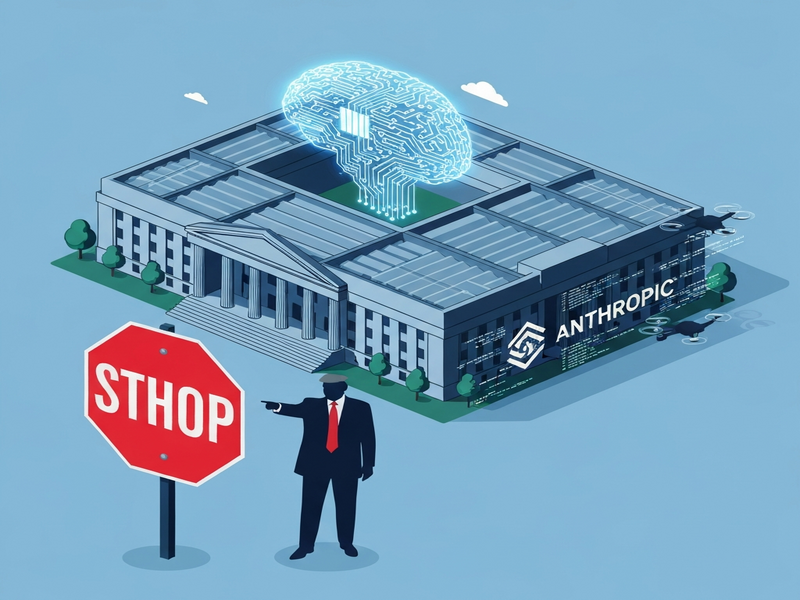
The Pentagon’s new AI policy, President Trump’s directive to halt all federal use of Anthropic’s technology, and Anthropic’s steadfast refusal to grant “any lawful use” to the military have ignited a contentious debate over government AI bans, AI regulation, and the future of military AI.
Introduction: Why This Conflict Matters
In early 2026, the United States found itself at a crossroads between rapid AI innovation and national security concerns. The clash involves three key players:
- Pentagon – seeking unrestricted access to cutting‑edge generative models for surveillance, logistics, and autonomous weapons.
- President Donald Trump – issuing an executive order that forces every federal agency to stop using Anthropic’s services within six months.
- Anthropic – the creator of Claude, refusing to sign a “any lawful use” clause that would allow the military to employ its AI for lethal autonomous systems.
The dispute is more than a headline; it sets a precedent for how AI regulation, government procurement, and corporate ethics intersect. For tech policy readers, AI industry professionals, and government officials, understanding each side’s rationale is essential for navigating the evolving landscape of AI governance.
Trump’s Directive Overview
On February 26, 2026, former President Donald Trump posted a forceful statement on Truth Social, demanding an immediate cessation of all federal usage of Anthropic’s AI tools. The directive cited three primary concerns:
- National Security Risk – Trump argued that “radical left, woke” companies could jeopardize American lives by imposing restrictive terms on the Department of Defense.
- Constitutional Authority – He emphasized that the decision to arm the military rests with the Commander‑in‑Chief, not private AI firms.
- Economic Leverage – The order threatened civil and criminal consequences for Anthropic if it failed to cooperate during a six‑month phase‑out period.
The executive order was quickly disseminated across federal procurement channels, prompting agencies to audit contracts and identify any reliance on Anthropic’s APIs. While the order targeted Anthropic specifically, it also signaled a broader willingness to enforce a government AI ban when corporate policies clash with perceived national interests.
Anthropic’s Stance: Ethical Guardrails Over Unrestricted Use
Anthropic CEO Dario Amodei responded with a public statement that underscored the company’s ethical framework. He rejected the Pentagon’s demand for “any lawful use,” arguing that:
- The technology could be weaponized for mass domestic surveillance, violating democratic norms.
- Unsupervised lethal autonomous weapons (LAWs) would erode human accountability in combat.
- Anthropic’s mission to “build reliable, interpretable, and steerable AI” conflicts with a blanket‑use clause.
Amodei also offered a transition plan, stating that Anthropic would help agencies migrate to alternative providers without disrupting critical missions. This approach mirrors the company’s broader strategy of providing “responsible AI” solutions, a philosophy that can be explored through the UBOS AI policy framework for enterprises seeking ethical AI deployment.
Pentagon AI Policy Implications
The Pentagon’s memo, issued by Defense Secretary Pete Hegseth in January, demanded that all AI vendors sign a contract granting “any lawful use” of their models. The policy’s implications are far‑reaching:
1. Expansion of Military AI Capabilities
By securing unrestricted access, the Department of Defense aims to accelerate development of:
- Real‑time intelligence analysis and predictive threat modeling.
- Autonomous drone swarms capable of target identification without human oversight.
- AI‑driven logistics platforms that optimize supply chains in contested environments.
2. Legal and Ethical Tensions
The “any lawful use” clause raises questions about compliance with international humanitarian law (IHL) and the UN Convention on Certain Conventional Weapons. Critics argue that granting blanket authority could bypass required human‑in‑the‑loop safeguards for lethal decisions.
3. Market Ripple Effects
Companies like OpenAI and xAI have reportedly signed the Pentagon’s terms, creating a competitive disparity. Anthropic’s refusal may push other startups to adopt similar ethical guardrails, influencing the broader AI market. For businesses looking to integrate AI responsibly, the UBOS platform overview offers a modular approach that balances innovation with compliance.
4. Policy Precedent for Future Administrations
The current standoff could set a legal precedent for how future administrations negotiate AI contracts. A clear policy framework—such as the one detailed in the Enterprise AI platform by UBOS—might become a template for aligning government procurement with ethical AI standards.
Navigating the New AI Landscape: Practical Steps for Companies
Whether you are a startup, an SMB, or an enterprise, the evolving AI policy environment demands proactive measures. Below are actionable recommendations, each linked to UBOS resources that illustrate real‑world implementations.
Adopt Transparent Contractual Terms
Draft AI service agreements that explicitly define permissible use cases, data handling, and termination clauses. The UBOS templates for quick start include pre‑built clauses for government contracts, helping you avoid ambiguous “any lawful use” language.
Leverage Low‑Code AI Builders
Rapid prototyping reduces reliance on third‑party APIs that may be subject to restrictive policies. The Web app editor on UBOS enables developers to create custom AI workflows without deep code, while the Workflow automation studio streamlines integration with internal data sources.
Integrate Ethical Guardrails
Embedding safety layers—such as content filters, usage monitoring, and human‑in‑the‑loop approvals—mirrors Anthropic’s own approach. UBOS’s AI policy module provides a configurable framework for enforcing these safeguards across all deployed models.
Explore AI‑Powered Marketing and Analytics
While the Pentagon focuses on defense, commercial sectors can benefit from responsible AI tools. For instance, the AI marketing agents automate campaign creation, and the AI SEO Analyzer helps optimize content for search engines without violating policy constraints.
Utilize Voice and Multimodal AI
Voice assistants and image generation are gaining traction. UBOS’s ElevenLabs AI voice integration and AI Image Generator let you create rich media experiences while maintaining full control over data residency and usage rights.
Participate in the UBOS Partner Program
Companies seeking to co‑develop compliant AI solutions can join the UBOS partner program, gaining access to shared resources, joint‑marketing opportunities, and a vetted network of ethical AI providers.
Real‑World Examples: UBOS Portfolio Highlights
The UBOS portfolio examples showcase how organizations have navigated complex regulatory environments:
- Talk with Claude AI app – a conversational interface built on Anthropic’s Claude, demonstrating secure deployment behind corporate firewalls.
- AI Article Copywriter – automates content creation while embedding compliance checks for copyrighted material.
- AI Video Generator – produces marketing videos with built‑in watermarking to prevent unauthorized redistribution.
Conclusion: The Road Ahead for AI Regulation and Military Use
The Pentagon’s AI policy, Trump’s executive directive, and Anthropic’s principled refusal together illustrate a pivotal moment in AI governance. As governments grapple with the dual imperatives of national security and ethical responsibility, the private sector must decide whether to prioritize unrestricted contracts or embed robust guardrails.
For policymakers, the lesson is clear: blanket “any lawful use” clauses risk undermining democratic oversight. For AI firms, Anthropic’s stance proves that ethical consistency can become a market differentiator, especially when paired with platforms like UBOS homepage that champion responsible AI development.
Stakeholders seeking deeper insight should review the original Verge article for a comprehensive timeline, and explore UBOS resources such as the UBOS pricing plans to evaluate cost‑effective, compliant AI solutions.
Ready to build AI applications that respect both innovation and regulation? Discover how the UBOS AI policy framework can guide your next project.
Andrii Bidochko
CTO UBOS
Andrii Bidochko is an AI entrepreneur and researcher focused on AI agents, reinforcement learning, and autonomous systems. He writes about the technologies shaping the future of machine intelligence, from frontier models and agent architectures to real-world AI applications.