

- Updated: March 12, 2026
- 5 min read
Oil Prices Surge Above $100 a Barrel Amid Middle East Tensions
Oil prices have broken the $100‑a‑barrel barrier, driven by heightened geopolitical tension in the Strait of Hormuz and the International Energy Agency’s (IEA) record‑size emergency‑reserve release.
Oil Prices Surge Past $100 a Barrel Amid Iran‑Related Supply Risks
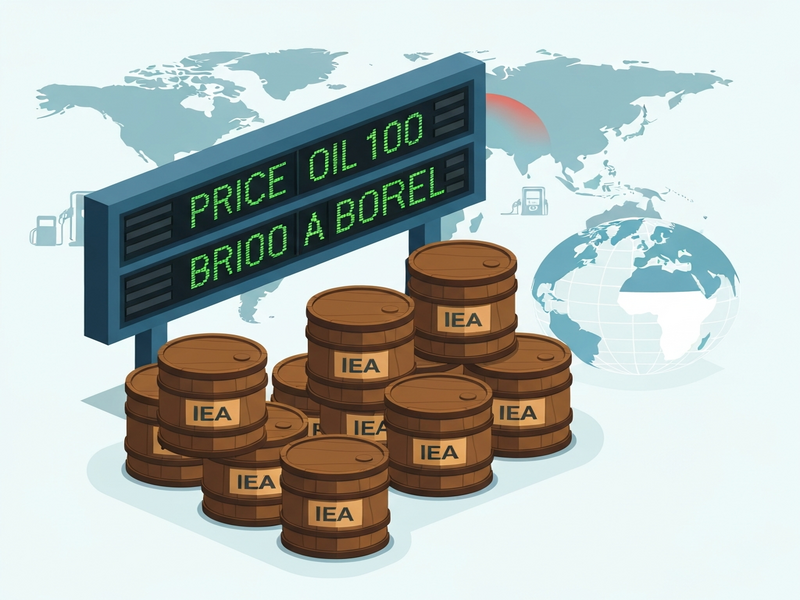
On Thursday, Brent crude climbed to $100.74 per barrel in Asian trading, a near‑9 % jump that persisted even after all 32 IEA members pledged to release a historic 400 million barrels from their strategic stockpiles. The surge reflects a market that remains jittery over Iran’s escalating attacks on shipping lanes and the broader uncertainty surrounding Middle‑East energy flows.
1. Summary of the Price Spike and IEA Emergency‑Reserve Release
The IEA’s decision to tap emergency reserves is the largest ever, dwarfing the 2022 response to Russia’s invasion of Ukraine. While the move provides a “temporary buffer,” analysts warn it cannot fully offset the risk premium baked into oil contracts.
- Brent crude topped $100 per barrel, up 8.9 % from the previous session.
- IEA members collectively hold roughly two‑thirds of global energy production and consumption.
- The 400 million‑barrel release is expected to last only a few weeks, offering short‑term relief.
“The release is historically significant but merely a stop‑gap,” said Martin Ma of the Singapore Institute of Technology.
Despite the release, traders remain wary. The market’s “prolonged disruption” expectation suggests that price pressures could linger well beyond the reserve drawdown.
2. Iran‑Related Supply Risks: Why the Threat Persists
Iran’s Revolutionary Guard Corps (IRGC) has warned that oil could soar to $200 a barrel if attacks on vessels in the Strait of Hormuz intensify. The strait, a chokepoint for roughly 20 % of the world’s oil, is critical for both European and Asian energy imports.
Key risk factors include:
- Targeted attacks on U.S., Israeli, and allied vessels. The IRGC’s statements signal a willingness to disrupt shipping.
- Potential escalation of regional conflict. Any broader military engagement could further tighten supply.
- Insurance premiums and rerouting costs. Even without direct hits, higher freight rates feed into retail fuel prices.
These dynamics have already manifested in long queues at petrol stations across the Philippines, Thailand, and Vietnam, as consumers scramble to fill up before prices climb higher.
3. Global Fuel Costs and Market Repercussions
Higher crude prices ripple through the entire energy value chain, affecting everything from gasoline to jet fuel. Recent data show:
| Region | Average Pump Price (USD/gal) | Recent Change |
|---|---|---|
| United States | $3.58 | +4.2 % |
| Europe (average) | €1.85/L | +5.1 % |
| Southeast Asia | $1.30/L | +6.8 % |
Governments are already taking mitigation steps. Thailand has urged public‑sector employees to work from home, while the Philippines introduced a four‑day work week for government staff to curb energy consumption.
4. Strategic Implications for Investors and Energy Analysts
For market participants, the current environment presents both risk and opportunity:
- Short‑term volatility: Expect rapid price swings as news of attacks or reserve releases emerges.
- Long‑term supply‑risk premium: Companies with exposure to Middle‑East oil may see sustained earnings pressure.
- Alternative energy acceleration: Higher oil prices often boost investment in renewables and energy‑efficiency technologies.
Analysts can leverage AI‑driven platforms to model scenario‑based forecasts. For instance, the Enterprise AI platform by UBOS enables rapid integration of real‑time market data, while the Workflow automation studio can automate alerts when price thresholds are breached.
5. How AI Tools Are Shaping Energy‑Market Analysis
Artificial intelligence is becoming a cornerstone for deciphering complex market signals. Below are a few UBOS‑hosted AI applications that can help analysts stay ahead:
- AI SEO Analyzer – Optimizes research reports for discoverability.
- AI Article Copywriter – Generates concise market briefs.
- Talk with Claude AI app – Provides conversational insights on commodity trends.
- AI YouTube Comment Analysis tool – Gauges sentiment from industry‑related video content.
These tools integrate seamlessly with the Web app editor on UBOS, allowing analysts to build custom dashboards without writing extensive code.
6. Practical Steps for Energy Professionals
To navigate the current price environment, consider the following actionable checklist:
- Monitor IEA reserve‑release updates daily.
- Set price‑alert thresholds in your AI marketing agents or custom dashboards.
- Incorporate geopolitical risk models using the ChatGPT and Telegram integration for real‑time alerts.
- Evaluate exposure to Middle‑East supply chains and consider hedging strategies.
- Leverage the UBOS templates for quick start to accelerate scenario analysis.
7. Conclusion & Call‑to‑Action
Oil’s breach of the $100 mark underscores the fragility of global energy supplies amid geopolitical turbulence. While the IEA’s emergency‑reserve release offers a fleeting cushion, the underlying risk from Iran’s aggressive posture remains a potent price driver.
Energy analysts, investors, and policy makers should adopt AI‑enhanced analytics to stay ahead of market swings. Explore the UBOS platform overview to discover how AI can transform your energy‑market intelligence workflow.
For a deeper dive into the original reporting, read the BBC article that first highlighted the price breakout.
Stay informed, stay agile, and let AI power your next strategic decision.
Learn more about how startups are leveraging AI at UBOS for startups, or discover solutions tailored for small‑business needs via UBOS solutions for SMBs. For pricing details, visit the UBOS pricing plans. Explore real‑world case studies in the UBOS portfolio examples. To understand the company’s mission, read About UBOS and consider joining the UBOS partner program.
Andrii Bidochko
CTO UBOS
Andrii Bidochko is an AI entrepreneur and researcher focused on AI agents, reinforcement learning, and autonomous systems. He writes about the technologies shaping the future of machine intelligence, from frontier models and agent architectures to real-world AI applications.