

- Updated: April 2, 2026
- 7 min read
New York Proposes Ban on 3D‑Printed Ghost Gun Components
New York is proposing a ban that would make it illegal to sell, distribute, or print 3‑D‑printed ghost‑gun components, aiming to close a loophole that allowed the murder of UnitedHealthcare CEO Brian Thompson using a privately‑manufactured firearm.
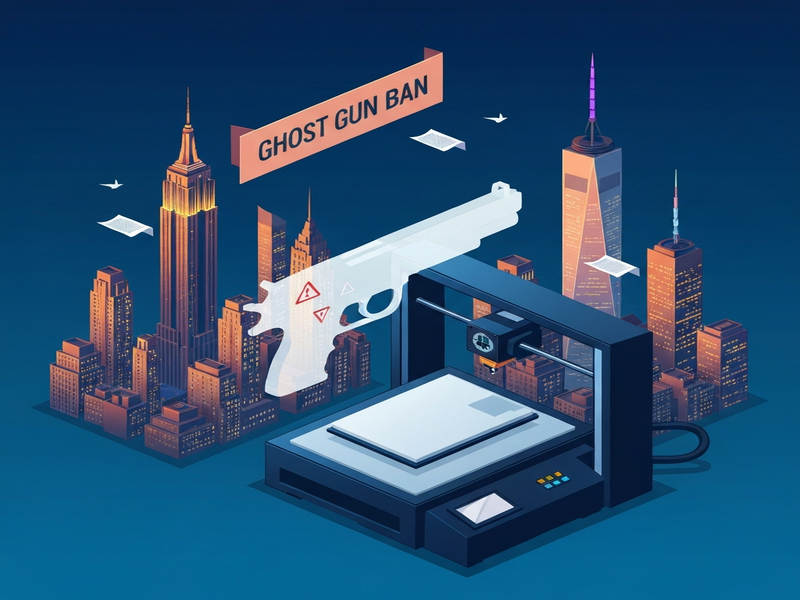
Governor Kathy Hochul and state lawmakers introduced legislation this week that targets the digital supply chain of untraceable firearms. The bill follows a high‑profile killing in December 2024, where investigators linked a 3‑D‑printed pistol and silencer to the shooter, Luigi Mangione. If enacted, New York would join a growing list of states imposing strict controls on 3‑D‑printed gun parts, while also compelling 3‑D‑printer manufacturers to embed blocking technology.
Background on the 3‑D‑Printed Gun Murder Case
The tragedy that sparked the legislative push involved Luigi Mangione, a 28‑year‑old from Queens, who was arrested after a police raid uncovered a partially assembled 3‑D‑printed handgun in his apartment. The weapon, combined with a commercially available suppressor, was used in the fatal shooting of UnitedHealthcare CEO Brian Thompson on December 12, 2024.
Investigators discovered that Mangione had downloaded the firearm’s CAD files from a public repository, printed the lower receiver on a hobby‑grade printer, and purchased the barrel and other metal components online. Wired’s 2025 deep‑dive demonstrated how a novice could, within a weekend, research, print, and fire a functional pistol using freely available tutorials.
Following the case, Manhattan District Attorney Alvin Bragg publicly warned that “you can’t print counterfeit money. We don’t let you do that. So why would we let you print lethal guns?” His office subsequently secured voluntary agreements from two 3‑D‑printer companies to embed detection filters that block the printing of known gun components.
Why the case matters for policy
- It highlighted the ease of acquiring lethal weapons without background checks.
- It exposed a gap in existing federal regulations, which focus on physical parts, not digital files.
- It galvanized advocacy groups on both sides of the gun‑control debate.
Details of the Proposed New York Legislation
The bill, formally titled the Digital Firearms Prevention Act, contains several interlocking provisions designed to disrupt the end‑to‑end workflow of ghost‑gun production.
Key provisions
- Prohibition of CAD file distribution: It becomes a felony to sell, share, or host firearm‑related CAD files without a state‑issued license.
- Mandatory printer‑level blocking: All 3‑D printers sold or operated in New York must incorporate firmware that detects and blocks the printing of components listed in the state’s “restricted parts” registry.
- Labeling and traceability: Manufacturers must embed a unique, tamper‑proof identifier in each printer’s firmware, enabling law‑enforcement to trace illegal prints.
- Penalties: Violations carry up to five years imprisonment and fines up to $50,000 per offense.
Enforcement mechanisms
Enforcement will be coordinated by the New York State Police’s Cybercrime Unit, which will receive real‑time alerts from compliant printers via a secure API. The bill also authorizes subpoenas for online platforms that host CAD files, compelling them to delete prohibited content and provide user data.
To support compliance, the state will fund a “Digital Firearms Registry” managed by the Department of Consumer Affairs, where licensed entities can register permissible CAD files and request updates to the restricted‑parts list.
Industry and Advocacy Group Reactions
Reactions have been sharply divided along traditional lines of gun‑rights advocacy and technology‑industry self‑regulation.
Gun‑rights organizations
The National Rifle Association (NRA) issued a statement calling the bill “an unconstitutional overreach that criminalizes lawful hobbyists.” They argue that the legislation infringes on the First and Second Amendments by targeting digital expression and lawful manufacturing.
Conversely, Everytown for Gun Safety praised the bill as “a necessary step to stop a new wave of untraceable firearms that threaten public safety.” Their policy director, Justin Wagner, highlighted the need for “technology‑enabled enforcement” to keep pace with evolving threats.
Tech‑industry response
Several 3‑D‑printer manufacturers have welcomed the move, noting that “responsible innovation” aligns with their corporate values. One leading company announced a partnership with the state to develop an open‑source detection algorithm, citing the Telegram integration on UBOS as a model for secure, real‑time alerts.
Open‑source communities expressed concern about potential chilling effects on legitimate research. A spokesperson for the OpenAI ChatGPT integration emphasized the importance of “balanced policies that protect public safety without stifling innovation.”
Comparison to Existing Federal and State Regulations
Federal background
At the federal level, the 2022 Undetectable Firearms Act criminalizes the manufacturing of firearms that cannot be detected by metal detectors, but it does not address digital files or 3‑D‑printed components. The Bureau of Alcohol, Tobacco, Firearms and Explosives (ATF) has issued guidance on “ghost guns,” focusing on the sale of unfinished frames and receivers, yet enforcement remains fragmented.
State‑level precedents
New York’s proposal mirrors measures already enacted in Colorado, Washington, and New Jersey, where statutes require background checks for “buy‑build‑shoot” kits and ban the sale of certain 3‑D‑printed parts. However, New York’s approach is more aggressive by mandating printer‑level blocking and licensing of CAD files, a step not yet taken elsewhere.
Implications for Manufacturers and Consumers
3‑D‑printer manufacturers
Manufacturers will need to redesign firmware to incorporate detection signatures for every restricted component. This could increase production costs, but also opens new revenue streams through licensing of compliance modules. Companies that already offer cloud‑based printing services may leverage the Workflow automation studio to integrate compliance checks into their workflow pipelines.
CAD file marketplaces
Platforms hosting design files—such as Thingiverse or MyMiniFactory—will face legal pressure to vet uploads. Failure to comply could result in civil penalties or criminal liability. Some marketplaces are already exploring AI‑driven content moderation, similar to the Chroma DB integration that enables semantic search and filtering of prohibited content.
Legal risks for hobbyists
Individuals who own a 3‑D printer for legitimate purposes (e.g., prototyping, education) may now be required to register their devices and certify that they are not used to produce restricted parts. Ignorance of the law will not be a defense; inadvertent violations could lead to felony charges.
Call‑to‑Action: Resources and Next Steps
Stakeholders looking to stay informed or comply with the upcoming law can explore the following resources:
- Visit the UBOS homepage for a comprehensive overview of compliance‑ready AI tools.
- Read the About UBOS page to understand the company’s mission in secure technology deployment.
- Explore the UBOS platform overview for modular solutions that can be integrated into printer firmware.
- Start a pilot project with UBOS templates for quick start to accelerate compliance testing.
- Leverage the Enterprise AI platform by UBOS for large‑scale monitoring across multiple manufacturing sites.
- Check out the UBOS pricing plans to find a tier that matches your organization’s size.
- Review real‑world case studies in the UBOS portfolio examples to see how other firms have tackled regulatory challenges.
- Join the UBOS partner program to collaborate on future‑proof compliance solutions.
For a detailed journalistic account of the incident that sparked this legislation, see the original report on The Verge.
Conclusion
New York’s proposed ban on 3‑D‑printed ghost‑gun components represents a watershed moment in the intersection of firearms policy and digital manufacturing. By targeting both the distribution of CAD files and the hardware that could produce lethal weapons, the state aims to close a loophole that has already claimed a high‑profile victim. While supporters argue the measure is essential for public safety, opponents warn of overreach and potential stifling of legitimate innovation.
As the bill moves through the legislature, manufacturers, hobbyists, and policy analysts will watch closely. The outcome could set a national precedent, influencing how other jurisdictions balance the promise of additive manufacturing with the imperative to prevent untraceable firearms from proliferating.
Stay updated on this evolving story and explore how emerging AI‑driven compliance tools can help your organization navigate the new regulatory landscape.
Andrii Bidochko
CTO UBOS
Andrii Bidochko is an AI entrepreneur and researcher focused on AI agents, reinforcement learning, and autonomous systems. He writes about the technologies shaping the future of machine intelligence, from frontier models and agent architectures to real-world AI applications.