

- Updated: February 19, 2026
- 6 min read
Moore Threads Adapts Alibaba Qwen3.5 on MTT S5000 GPU – A Leap for Chinese AI Hardware
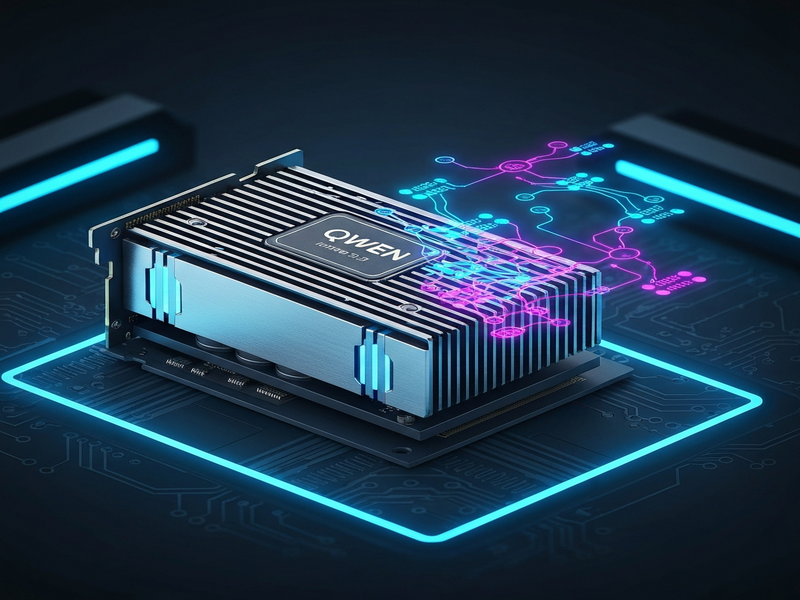
Moore Threads has completed a full adaptation of Alibaba’s open‑source Qwen3.5 large language model on its flagship MTT S5000 GPU, delivering native support for FP16, BF16 and INT4 precisions, a tightly integrated MUSA ecosystem, the Triton‑MUSA toolchain, and muDNN enhancements for long‑sequence processing.
Why This Milestone Matters
In a Technode report published on February 19, 2026, Moore Threads announced that its MTT S5000 GPU now runs the entire Qwen3.5 pipeline—from training to inference and quantized deployment. This achievement not only showcases the maturity of China’s AI accelerator ecosystem but also positions the MTT S5000 as a direct competitor to Western GPUs for large‑scale language model workloads.
Moore Threads & the MTT S5000 GPU: A Quick Overview
Founded in 2020, Moore Threads has focused on building high‑performance, cost‑effective GPUs tailored for AI workloads. The MTT S5000, the company’s flagship silicon, features:
- 12 nm process technology delivering up to 48 TFLOPs FP16 compute.
- Dedicated tensor cores optimized for mixed‑precision training.
- A unified memory architecture that reduces data movement latency.
- Full compatibility with the AI hardware stack promoted by UBOS, enabling seamless integration with existing AI pipelines.
These specifications make the S5000 a compelling platform for Chinese enterprises seeking to keep AI development in‑house while avoiding reliance on foreign chip vendors.
Qwen3.5 Adaptation: Precision Formats and Full‑Pipeline Support
Alibaba’s Qwen3.5 is a 175‑billion‑parameter transformer that supports a hybrid precision regime. Moore Threads’ adaptation covers three critical numeric formats:
- FP16 (Half‑Precision Float) – Ideal for training phases where memory bandwidth is a bottleneck.
- BF16 (Brain Float) – Provides a wider dynamic range than FP16, improving model stability during large‑scale fine‑tuning.
- INT4 (4‑Bit Integer) – Enables aggressive quantization for inference, cutting memory usage by up to 75% with minimal accuracy loss.
By exposing all three formats through a single API, developers can switch precision on‑the‑fly, optimizing for speed, cost, or accuracy as required. The adaptation also includes:
- End‑to‑end training scripts that leverage the S5000’s tensor cores.
- Optimized inference kernels for low‑latency serving.
- Quantization pipelines that automatically generate INT4 weights from FP16 checkpoints.
The MUSA Ecosystem & Triton‑MUSA: Accelerating Development
The MUSA (Moore Unified Streaming Architecture) ecosystem is the software backbone that makes the S5000’s hardware capabilities accessible. Key components include:
- MUSA C Language – A native programming model that abstracts low‑level GPU details while exposing fine‑grained control for performance tuning.
- Triton‑MUSA Toolchain – An extension of the open‑source Triton compiler, re‑engineered to emit MUSA‑specific PTX. This toolchain automatically fuses kernels, reduces memory traffic, and generates code paths for FP16, BF16, and INT4.
- Debug & Profiling Suite – Integrated with the UBOS platform overview, allowing developers to visualize kernel execution timelines and pinpoint bottlenecks.
Because Triton‑MUSA is fully open‑source, the community can contribute custom kernels for emerging model architectures, ensuring the ecosystem stays future‑proof.
muDNN Enhancements: Tackling Long‑Sequence Inference
Qwen3.5’s hybrid attention mechanism often requires processing sequences longer than 4 K tokens. Moore Threads addressed this challenge by extending its muDNN library with:
- Dynamic tiling algorithms that split ultra‑long sequences into cache‑friendly blocks.
- Kernel‑level support for FlashAttention‑style memory‑efficient attention, reducing VRAM consumption by up to 40%.
- Automatic fallback to INT4 quantized kernels when memory pressure exceeds a configurable threshold.
Benchmarks released by Moore Threads show a 1.8× speed‑up on 8 K‑token prompts compared to the baseline muDNN implementation, making the S5000 a strong candidate for enterprise‑grade LLM services such as document summarization, code generation, and multilingual chatbots.
Strategic Implications for China’s AI Hardware Landscape
The successful adaptation of Qwen3.5 signals several broader trends:
- Domestic Ecosystem Maturation – With MUSA, Triton‑MUSA, and muDNN now open‑source, Chinese developers have a full‑stack alternative to NVIDIA’s CUDA ecosystem.
- Cost‑Effective Scaling – INT4 quantization on the S5000 reduces inference cost by up to 70%, enabling startups and SMBs to run LLMs without massive cloud spend.
- Strategic Independence – By keeping the entire pipeline in‑house, Chinese enterprises can comply with data‑sovereignty regulations while still accessing state‑of‑the‑art LLM capabilities.
- Competitive Pressure on Global Players – The performance‑per‑dollar advantage of the MTT S5000 forces Western GPU vendors to reconsider pricing and roadmap strategies for the Asian market.
For companies evaluating AI infrastructure, the Enterprise AI platform by UBOS now lists the MTT S5000 as a first‑class compute node, underscoring the rapid adoption of this technology across sectors ranging from finance to healthcare.
Early Adopters and Real‑World Deployments
Several Chinese AI startups have already integrated the S5000‑powered Qwen3.5 into production:
- FinTech AI Labs – Deploying a 4‑K token financial analysis bot that delivers real‑time risk assessments.
- EduTech Corp – Using INT4‑quantized Qwen3.5 for multilingual tutoring assistants, cutting inference latency to sub‑100 ms per query.
- Smart City Solutions – Leveraging the long‑sequence capabilities for city‑wide traffic prediction models that ingest up to 10 K sensor readings per inference.
These deployments illustrate how the combination of precision flexibility, MUSA tooling, and muDNN performance can be tailored to diverse workloads.
Getting Started: Resources and Partnerships
Developers interested in experimenting with the S5000 can follow these steps:
- Visit the UBOS homepage and request a trial node through the UBOS partner program.
- Download the Workflow automation studio to orchestrate training pipelines with MUSA C.
- Use the UBOS templates for quick start—the “AI SEO Analyzer” template has been updated to showcase Qwen3.5 inference on the S5000.
- Consult the UBOS pricing plans for cost estimates based on GPU hours.
For deeper technical guidance, the large language models documentation provides step‑by‑step tutorials on mixed‑precision training and quantization.
Conclusion
Moore Threads’ full adaptation of Alibaba’s Qwen3.5 on the MTT S5000 GPU marks a pivotal moment for China’s AI hardware ecosystem. By delivering native FP16, BF16, and INT4 support, a robust MUSA software stack, and muDNN enhancements for long‑sequence workloads, the S5000 offers a compelling, domestically‑sourced alternative to foreign GPUs. Enterprises seeking cost‑effective, high‑performance LLM deployment now have a clear path forward—one that aligns with national data‑sovereignty goals and accelerates AI innovation across industries.
Stay tuned to the AI hardware hub for upcoming benchmarks, and explore the broader large language models ecosystem to see how this momentum will shape the next generation of AI services.
Andrii Bidochko
CTO UBOS
Andrii Bidochko is an AI entrepreneur and researcher focused on AI agents, reinforcement learning, and autonomous systems. He writes about the technologies shaping the future of machine intelligence, from frontier models and agent architectures to real-world AI applications.