

- Updated: January 31, 2026
- 7 min read
LLM Inference Hardware Challenges and Research Directions – Insights from David Patterson’s Generative AI Study
LLM inference hardware is bottlenecked primarily by memory capacity, bandwidth, and inter‑connect latency, and the paper by Xiaoyu Ma and David Patterson proposes four research directions—high‑bandwidth flash, processing‑near‑memory, 3‑D memory‑logic stacking, and ultra‑low‑latency interconnects—to overcome these challenges.
Why LLM Inference Hardware Matters Today
The explosive growth of generative AI models such as GPT‑4, Claude, and LLaMA has shifted the industry focus from training to real‑time inference. Unlike training, inference runs the autoregressive decode phase of Transformers, demanding rapid access to massive model parameters. The seminal arXiv paper “Challenges and Research Directions for Large Language Model Inference Hardware” dissects these bottlenecks and outlines a roadmap for next‑generation AI accelerators.
For enterprises looking to embed LLM capabilities into products, understanding these hardware constraints is essential. Whether you are a startup building a chatbot or an established data‑center operator, the insights from Ma and Patterson help you anticipate cost, latency, and scalability hurdles before they become show‑stoppers.
Key Challenges in LLM Inference Hardware
While raw compute power has historically driven AI performance, the authors argue that inference now hinges on three inter‑related challenges:
- Memory Capacity: State‑of‑the‑art LLMs exceed 1 TB of parameters, far beyond the limits of conventional DRAM.
- Memory Bandwidth: Autoregressive decoding requires fetching billions of weights per token, demanding bandwidth comparable to high‑bandwidth memory (HBM) but at much larger capacities.
- Inter‑connect Latency: Distributed inference across multiple chips introduces synchronization delays that erode real‑time responsiveness.
These challenges are amplified in edge and mobile scenarios, where power budgets and physical space are even tighter. The paper emphasizes that solving memory‑centric issues will unlock both datacenter‑scale and on‑device LLM deployments.
Research Directions Proposed by Patterson et al.
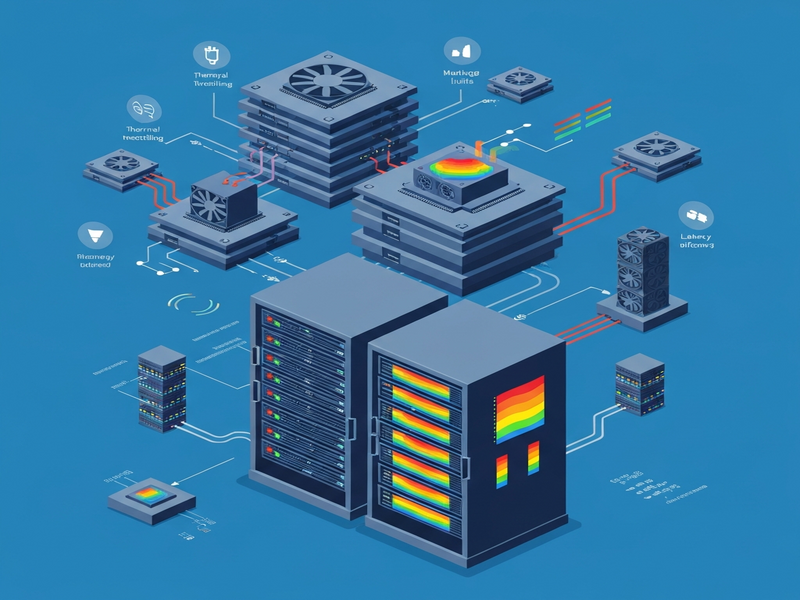
To address the memory‑first bottleneck, the authors outline four promising architectural avenues:
- High‑Bandwidth Flash (HB‑Flash): Emerging non‑volatile memory that offers HBM‑like bandwidth while scaling to multi‑terabyte capacities.
- Processing‑Near‑Memory (PNM): Embedding compute units directly within memory chips to reduce data movement and latency.
- 3‑D Memory‑Logic Stacking: Vertically integrating logic dies with DRAM or emerging memory to achieve ultra‑high bandwidth pathways.
- Low‑Latency Interconnects: Designing network‑on‑chip fabrics and silicon‑photonic links that shrink synchronization overhead for multi‑chip inference.
These directions are not mutually exclusive; a holistic accelerator will likely combine HB‑Flash with PNM and a high‑speed interconnect fabric to meet the diverse demands of modern LLM workloads.
Industry Implications and Future AI Hardware Trends
Enterprises that adopt these emerging hardware paradigms can expect:
- Reduced inference latency, enabling real‑time conversational agents.
- Lower total cost of ownership by minimizing data‑movement energy.
- Scalable deployment from cloud datacenters to edge devices.
Companies like UBOS homepage are already building platforms that abstract these hardware complexities. The UBOS platform overview provides a unified API for developers to tap into high‑performance inference engines without deep hardware expertise.
Startups can accelerate time‑to‑market using UBOS for startups, while SMBs benefit from UBOS solutions for SMBs. Large enterprises looking for a comprehensive stack can explore the Enterprise AI platform by UBOS, which integrates cutting‑edge memory technologies behind the scenes.
Beyond raw inference, UBOS offers specialized AI agents that leverage these hardware advances. For example, the AI marketing agents can generate personalized copy in milliseconds, thanks to low‑latency memory access. The Workflow automation studio lets engineers orchestrate multi‑step pipelines that combine LLM inference with data preprocessing, all on the same high‑bandwidth fabric.
Developers can also prototype applications quickly using the Web app editor on UBOS. Coupled with the UBOS templates for quick start, teams can spin up solutions such as the AI SEO Analyzer or the AI Article Copywriter in minutes, leveraging the underlying inference hardware without manual optimization.
Pricing transparency is also critical. The UBOS pricing plans are tiered to match the memory and bandwidth needs of different workloads, from hobbyist prototypes to enterprise‑grade deployments.
Real‑World Use Cases Powered by Advanced Inference Hardware
Below are select UBOS marketplace templates that illustrate how next‑gen hardware can be harnessed across domains:
- Talk with Claude AI app – conversational AI with sub‑millisecond response times.
- Your Speaking Avatar template – combines LLM text generation with ElevenLabs AI voice integration for lifelike avatars.
- Before-After-Bridge copywriting template – leverages fast inference to produce high‑impact marketing copy on the fly.
- AI YouTube Comment Analysis tool – processes millions of comments in real time using high‑bandwidth memory.
- Image to Text AI service – demonstrates seamless integration of vision models with LLMs on the same memory fabric.
- AI Survey Generator – creates dynamic questionnaires powered by low‑latency inference.
- Web Scraping with Generative AI – combines retrieval and generation in a single pipeline.
- AIDA Marketing Template – real‑time personalization for email and ad copy.
- Elevate Your Brand with AI – end‑to‑end brand strategy generation.
- AI Video Generator – renders video frames on‑the‑fly using GPU‑accelerated inference.
- AI Audio Transcription and Analysis – showcases low‑latency audio pipelines.
- Generative AI Text-to-Video – a demanding workload that benefits from 3‑D memory‑logic stacking.
- Know Your Target Audience – rapid persona generation for marketers.
- AI LinkedIn Post Optimization – instant post refinement using high‑throughput inference.
- Image Generation with Stable Diffusion – leverages the same memory bandwidth as LLMs for diffusion models.
- AI Chatbot template – a plug‑and‑play conversational agent.
- Customer Support with ChatGPT API – demonstrates seamless API integration.
- Multi-language AI Translator – real‑time multilingual inference.
- Translate Natural Language to SQL – showcases low‑latency query generation.
- Factual Answering AI with ChatGPT API – high‑precision retrieval‑augmented generation.
- Grammar Correction AI – instant proofreading for content pipelines.
- Summarize for a 2nd Grader – demonstrates flexible token‑level control.
- AI Language Model Tutorial Chatbot – educational use case powered by fast inference.
- JavaScript Helper AI Chatbot – assists developers in real time.
- Movie to Emoji AI Application – a fun, low‑latency demo.
- Sarcastic AI Chat Bot – showcases nuanced language generation.
- Unstructured Data AI Parser – processes raw logs with high bandwidth.
- Product Name Generator AI – rapid ideation for marketers.
- Python Bug Fixer AI – instant code debugging assistance.
- Airport Code Extractor – lightweight inference on edge devices.
- Custom Interview Questions with AI – HR automation powered by fast LLM calls.
- Create Study Notes with AI – educational content generation.
- AI Restaurant Review App – sentiment analysis at scale.
- AI for Turn-by-Turn Directions – low‑latency navigation assistance.
- AI Chat App with ChatGPT API – end‑to‑end chat solution.
- AI Recipe Creator – culinary creativity powered by rapid inference.
- AI-Powered Essay Outline Generator – academic assistance.
- AI-Powered VR Fitness Idea Generator – immersive content creation.
- AI App with Text-to-Command – voice‑driven automation.
- Calculate Time Complexity with ChatGPT – developer tooling.
- Keywords Extraction with ChatGPT – SEO automation.
- AI Voice Assistant – speech‑enabled interfaces.
- Extract Contact Information AI – data enrichment.
- AI File Manager – intelligent file organization.
- GPT-Powered Telegram Bot – integrates with Telegram integration on UBOS for instant notifications.
- Video AI Chat Bot – multimodal interaction.
- Pharmacy Admin Panel – domain‑specific AI workflow.
- Help Me Write AI – content creation assistant.
- Text-to-Speech Google AI – high‑quality voice output.
- AI Image Generator – leverages the same memory bandwidth as LLMs.
- AI Email Marketing – personalized campaigns at scale.
These templates illustrate how the research directions outlined by Ma and Patterson translate into real products that deliver sub‑second latency, even for the most memory‑intensive models.
Conclusion: Act Now to Future‑Proof Your AI Deployments
Large language model inference will remain a cornerstone of AI‑driven services, but without addressing memory capacity, bandwidth, and inter‑connect latency, organizations risk falling behind. The four research avenues highlighted by Ma and Patterson—HB‑Flash, processing‑near‑memory, 3‑D stacking, and ultra‑low‑latency interconnects—offer a clear roadmap for hardware innovators.
For businesses eager to stay ahead, partnering with platforms that already embed these advances is the fastest path. Explore the UBOS partner program to co‑create solutions, or browse the UBOS portfolio examples for inspiration.
Ready to accelerate your LLM workloads with next‑generation hardware? Contact us today and let our AI experts design a solution that aligns with the research directions shaping the future of inference.