

- Updated: February 1, 2026
- 6 min read
Integrating PLECS Spice for Advanced Power Electronics Simulation
PLECS Spice integrates SPICE simulation directly into the PLECS environment, letting electrical engineers combine fast system‑level analysis with high‑fidelity device‑level detail without switching tools.
Bridging the Gap: PLECS Spice Redefines Power‑Electronics Simulation
Power‑electronics designers have long wrestled with a trade‑off: system‑level simulators like PLECS offer speed and robustness for control development, while SPICE simulators deliver the granular device physics needed for component validation. PLECS Spice eliminates this compromise by embedding SPICE capabilities inside PLECS, creating a unified workflow that accelerates innovation and cuts costly re‑modeling effort.
What Is PLECS Spice?
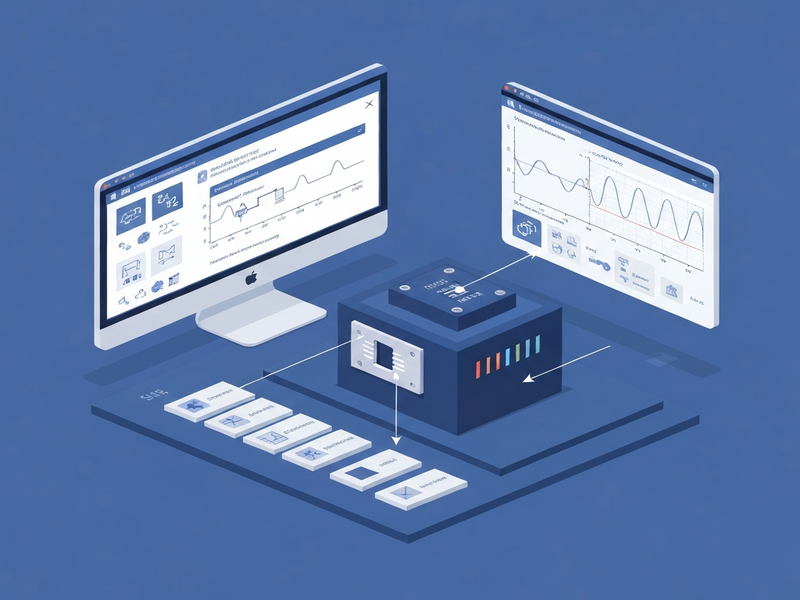
Released with PLECS 5.0, PLECS Spice is an extension that lets you drop SPICE netlists directly into a PLECS schematic. The result is a hybrid model where ideal switches coexist with detailed semiconductor descriptions, and you can toggle between the two with a single click.
For electrical engineers, this means:
- One‑stop simulation – no need to maintain duplicate libraries.
- Selective detail – add SPICE models only where device physics matters.
- Instant comparison – switch between ideal and detailed configurations without altering control logic.
Core Features That Power the Hybrid Engine
1. Multi‑Dialect Netlist Parser
SPICE netlists come in many flavors (LTspice, NGspice, Spectre, etc.). PLECS Spice’s parser automatically detects and translates these dialects, so you can import manufacturer‑provided models without manual editing.
2. Optimized Compact Models
Built‑in compact models for diodes, MOSFETs, BJTs, and switches are tuned for continuity and numerical stability. The models retain the physics‑based core while being lightweight enough for fast simulation.
3. Modified Nodal Analysis (MNA)
Traditional PLECS uses piecewise state‑space equations, which struggle with the strong non‑linearities of semiconductor devices. By switching to MNA for any circuit that contains a netlist, PLECS Spice solves the resulting differential‑algebraic equations (DAEs) robustly, handling both algebraic constraints and dynamic behavior in one pass.
4. Mixed‑Formulation Solver
The solver employs a third‑order implicit Runge‑Kutta method with circuit‑specific convergence helpers. Because it is a one‑step, self‑starting algorithm, it copes gracefully with topology changes, zero‑crossings, and the frequent discontinuities typical of hybrid simulations.
Why This Workflow Matters for Engineers
Adopting PLECS Spice reshapes the design cycle in three concrete ways:
- Reduced Development Time: No more exporting a PLECS model, rebuilding it in a SPICE tool, and then re‑importing results. The entire loop stays inside a single project file.
- Higher Accuracy Where It Counts: You can keep the bulk of the system modeled with fast ideal components while injecting detailed SPICE models for the power stage, gate drivers, or any critical sub‑circuit.
- Risk Mitigation: Early device‑level validation catches parasitic‑induced overshoots, thermal hotspots, and loss mechanisms before hardware prototypes are built.
These benefits align perfectly with modern UBOS platform overview, where rapid prototyping and AI‑assisted verification are core pillars.
Case Study: Soft‑Switching ZVS in a Dual Active Bridge Converter
The Dual Active Bridge (DAB) converter is a workhorse for bidirectional power flow in electric‑vehicle chargers and grid‑storage interfaces. Achieving Zero‑Voltage Switching (ZVS) in a DAB at hundreds of kilohertz is a classic “soft‑switching” challenge that demands both control‑level insight and device‑level fidelity.
System‑Level View (Ideal Switches)
Using standard PLECS models, engineers can sweep dead‑time, modulation index, and load conditions to locate the ZVS region. However, ideal switches lack parasitic output capacitance (Coss), so the simulation cannot reveal whether the chosen dead‑time truly eliminates turn‑on losses.
Device‑Level Augmentation with PLECS Spice
By swapping the ideal MOSFETs for manufacturer‑supplied SPICE netlists (including Coss, gate resistance, and diode recovery), the same schematic now shows the voltage‑current overlap that defines hard vs. soft switching. The mixed‑formulation solver captures the resonant discharge of Coss during dead‑time, making the ZVS boundary visible.
Two simulations illustrate the impact:
- 15 ns dead‑time: VDS remains high when the gate is driven, indicating hard switching and excess loss.
- 50 ns dead‑time: VDS falls to zero before the gate signal arrives, confirming successful ZVS and a substantial reduction in switching loss.
This side‑by‑side comparison would be impossible without the hybrid capability of PLECS Spice. Engineers can now iterate on dead‑time, gate‑drive resistance, and transformer leakage inductance in a single environment, dramatically shortening the design loop.
For teams that already leverage AI‑driven design assistance, the workflow integrates seamlessly with AI marketing agents that can auto‑generate design briefs, or with the Workflow automation studio to schedule batch simulations and collect performance metrics.
Startups looking to prototype such converters can benefit from the UBOS for startups program, which offers cloud‑based compute credits and pre‑built templates like the AI YouTube Comment Analysis tool that can be repurposed for data‑driven design reviews.
SMBs interested in scaling their power‑electronics portfolio can explore UBOS solutions for SMBs, which include ready‑to‑use UBOS templates for quick start and a UBOS portfolio examples library showcasing real‑world converter designs.
Conclusion: A Unified Future for Power‑Electronics Design
PLECS Spice marks a pivotal step toward a truly integrated simulation ecosystem. By marrying the speed of system‑level analysis with the precision of SPICE device models, it empowers engineers to adopt a genuine top‑down design philosophy—starting broad, then zooming in only where the physics demand it.
As power‑electronics systems become more complex and time‑to‑market pressures increase, this unified approach will be essential for maintaining competitiveness.
Ready to experience the next generation of simulation?
- Explore the UBOS homepage for a free trial.
- Read more about our About UBOS story and how we support engineers.
- Check out the UBOS pricing plans that fit every budget.
- Join the UBOS partner program to co‑develop custom simulation extensions.
For a deeper dive into the technical underpinnings of PLECS Spice, revisit the original announcement on Erick Schulz’s blog. Stay ahead of the curve, and let hybrid simulation accelerate your next breakthrough.