

- Updated: March 31, 2026
- 5 min read
CareCloud Data Breach Exposes Patient Records – What It Means for Healthcare Security
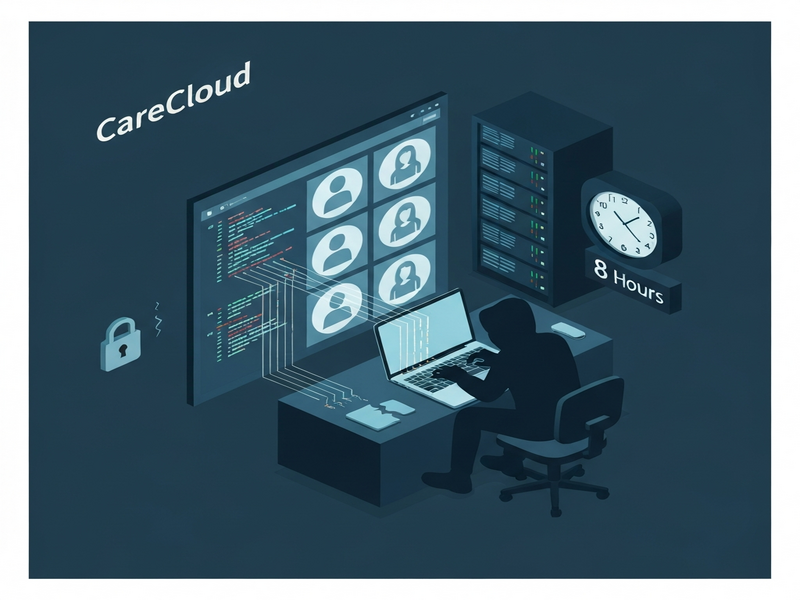
CareCloud suffered a confirmed data breach on March 16 2026, when unauthorized actors accessed one of its electronic health‑record (EHR) environments for more than eight hours, potentially exposing millions of patient records.
Incident Overview
Date, Detection, and Initial Disclosure
CareCloud’s security team detected anomalous activity on March 16, 2026. The intrusion was reported to the U.S. Securities and Exchange Commission (SEC) in a filing released on March 31, 2026. The breach affected one of six isolated storage environments that house patient medical records, lab results, and billing information.
Duration and Scope of Unauthorized Access
According to the SEC disclosure, the attackers maintained access for **over eight hours** before the environment was isolated and restored. While CareCloud has not confirmed the exact volume of compromised records, the company serves more than 45,000 providers and millions of patients nationwide, making the potential impact substantial.
Data Potentially Exposed
- Patient names, dates of birth, and contact information
- Medical histories, diagnoses, and treatment plans
- Prescription details and lab results
- Insurance identifiers and billing records
Company Response and Mitigation Steps
CareCloud acted swiftly after detection, employing a multi‑layered response plan that aligns with industry best practices.
- Immediate isolation of the compromised environment and restoration of services on the same day.
- Engagement of an independent cybersecurity firm to conduct a forensic investigation.
- Comprehensive password resets and multi‑factor authentication (MFA) enforcement for all privileged accounts.
- Deployment of additional intrusion‑detection sensors across all six storage environments.
- Notification of affected providers and patients in accordance with HIPAA breach‑notification rules.
- Public disclosure through the SEC filing and a dedicated CareCloud breach news page.
The company also announced enhancements to its security architecture, including integration with the Chroma DB integration for advanced anomaly detection and the adoption of the OpenAI ChatGPT integration to automate threat‑intelligence analysis.
Impact on Patients and Providers
The breach reverberates across three primary stakeholder groups:
Patients
Patients may face increased risk of identity theft, insurance fraud, and targeted phishing attacks. CareCloud has offered a one‑year complimentary credit‑monitoring service to all affected individuals.
Healthcare Providers
Clinics and hospitals that rely on CareCloud’s EHR platform must now audit their own access logs, re‑authenticate staff, and potentially adjust clinical workflows while the investigation continues.
Regulators and Insurers
Regulatory bodies are scrutinizing the incident for compliance gaps, while insurers may adjust cyber‑risk premiums for organizations using similar cloud‑based EHR solutions.
Expert Commentary on Healthcare Cybersecurity Trends
“The CareCloud breach underscores how attractive EHR systems have become to financially motivated threat actors. As we move deeper into AI‑driven automation, healthcare providers must adopt zero‑trust architectures and continuous monitoring to stay ahead of sophisticated attacks.” – Dr. Maya Patel, Chief Security Officer at UBOS
Dr. Patel highlights three emerging trends that are reshaping the security landscape:
- AI‑augmented threat hunting: Platforms like the AI marketing agents are being repurposed for security analytics, enabling faster detection of anomalous patterns.
- Zero‑trust networking: Continuous verification of user identity and device posture reduces the attack surface of multi‑tenant cloud environments.
- Secure data pipelines: Integrations such as the ChatGPT and Telegram integration demonstrate how real‑time alerts can be delivered securely to incident‑response teams.
What This Means for the Future of Healthcare Cybersecurity
CareCloud’s breach is a cautionary tale for any organization that stores protected health information (PHI) in the cloud. The incident reinforces the need for:
- Comprehensive encryption: Both at rest and in transit, using industry‑standard algorithms.
- Regular penetration testing: Simulated attacks that expose hidden vulnerabilities before real adversaries do.
- Vendor risk management: Continuous assessment of third‑party services, especially those that handle data ingestion or analytics.
Organizations looking to modernize their security posture can explore the Enterprise AI platform by UBOS, which offers built‑in compliance dashboards, automated policy enforcement, and AI‑driven incident response.
How You Can Protect Your Data – Immediate Steps
If you are an IT manager, security professional, or concerned patient, consider the following actionable checklist:
For Healthcare IT Managers
- Enable MFA for all admin and user accounts.
- Audit access logs for the past 30 days.
- Deploy a SIEM solution that integrates with Workflow automation studio for real‑time alerts.
- Review and update your incident‑response playbook.
For Patients & Providers
- Monitor credit reports for suspicious activity.
- Change passwords on patient portals and enable MFA where available.
- Stay informed through the Healthcare Cybersecurity blog.
- Consider using a secure voice assistant like the ElevenLabs AI voice integration for encrypted communications.
For ongoing updates on the investigation and best‑practice guidance, bookmark the Data Privacy resource center and follow UBOS on social channels.
Related UBOS Resources
Explore these UBOS tools that can help you build a more resilient healthcare technology stack:
- UBOS platform overview – a unified environment for data security and AI automation.
- UBOS templates for quick start – pre‑built workflows for compliance reporting.
- Web app editor on UBOS – create custom dashboards to monitor PHI access.
- UBOS pricing plans – scalable options for startups and SMBs.
- UBOS portfolio examples – case studies of healthcare organizations that have hardened their security posture.
For a detailed journalistic account of the breach, see the original TechCrunch article.
Stay vigilant, stay protected, and keep an eye on emerging AI‑driven security solutions that can safeguard the next generation of patient data.
Andrii Bidochko
CTO UBOS
Andrii Bidochko is an AI entrepreneur and researcher focused on AI agents, reinforcement learning, and autonomous systems. He writes about the technologies shaping the future of machine intelligence, from frontier models and agent architectures to real-world AI applications.