

- Updated: February 18, 2026
- 7 min read
BarraCUDA: Open‑Source CUDA‑to‑AMD GPU Compiler Bridges the Gap
BarraCUDA: Open‑Source CUDA‑to‑AMD GPU Compiler Unlocks AMD Acceleration for CUDA Code
BarraCUDA is an open‑source CUDA‑to‑AMD GPU compiler that translates NVIDIA‑style .cu source files directly into native GFX11 machine code, enabling AMD GPUs to run CUDA applications without any LLVM or HIP layers.
GPU developers have long been forced into a binary choice: write for NVIDIA and use nvcc, or rewrite code for AMD’s ROCm stack. BarraCUDA’s GitHub repository shatters that dilemma by offering a pure‑C99 compiler that emits AMD GFX11 .hsaco binaries straight from CUDA C source.
In this article we dive deep into the project’s purpose, its standout features, the technical wizardry under the hood, real‑world scenarios where it shines, and how you can join the community to shape its future.
Project Overview: Why BarraCUDA Exists
BarraCUDA was born from a simple question: “What if we could compile CUDA code for AMD GPUs without a heavyweight translation layer?” The answer is a lean, 15 000‑line C99 codebase that performs lexical analysis, parsing, semantic checks, and instruction selection—all without relying on LLVM.
The compiler targets AMD’s RDNA 3 (GFX11) architecture, producing ELF .hsaco objects that AMD drivers can load directly. By eliminating the HIP conversion step, developers gain:
- Faster build cycles (no intermediate translation)
- Full control over generated machine instructions
- A transparent, auditable compilation pipeline
Key Features & Supported CUDA Functionality
BarraCUDA focuses on the most widely used CUDA constructs, ensuring that everyday GPU kernels run unchanged on AMD hardware.
Core Language Support
__global__,__device__,__host__qualifiers- Thread and block built‑ins:
threadIdx,blockIdx,blockDim,gridDim - Standard C control flow (if/else, loops, switch, goto)
- Structs, enums, typedefs, namespaces, and basic templates
- Pointer arithmetic, arrays, and dynamic memory allocation patterns
CUDA‑Specific Features
__shared__memory allocated from LDS with proper lifetime tracking- Barrier synchronization via
__syncthreads() - Atomic operations (add, sub, min, max, exch, CAS, bitwise ops)
- Warp intrinsics (
__shfl_sync,__shfl_up_sync, etc.) - Cooperative groups API (e.g.,
cooperative_groups::this_thread_block()) - Vector types (
float2,int4, etc.) and half‑precision support - Launch bounds parsing for VGPR budgeting
Compiler‑Level Features
- Full C pre‑processor with macro expansion, conditional compilation, and include handling
- Recursive‑descent parser producing an abstract syntax tree (AST)
- Static single‑assignment (SSA) intermediate representation (BIR)
- Hand‑written instruction selector mapping BIR to AMDGPU opcodes
- Linear‑scan register allocator for VGPR/SGPR assignment
- ELF emission of
.hsacobinaries ready forhipModuleLoador AMD driver loading
Technical Implementation Highlights
BarraCUDA’s architecture is deliberately simple yet powerful. Below is a concise pipeline diagram that the project’s README visualizes:
Source (.cu) → Preprocessor → Lexer → Parser → Semantic Analysis → BIR (SSA) → mem2reg → Instruction Selection → Register Allocation → Binary Encoding → ELF Emission → .hsacoKey implementation notes that set BarraCUDA apart:
- No LLVM Dependency: All instruction encoding is handcrafted (≈1 700 lines), guaranteeing deterministic output and a tiny build footprint.
- Fixed‑Size Data Structures: The compiler avoids dynamic memory allocation in hot paths, using pre‑allocated arrays for speed and predictability.
- Validation Against LLVM‑objdump: Every emitted opcode is cross‑checked with LLVM’s disassembler to ensure 0% decode failures.
- Portable Build: A single
makecommand compiles the entire toolchain on any C99‑compatible compiler (gcc, clang, etc.). - Extensible Backend: The BIR is target‑agnostic, making future ports to Tenstorrent, Intel Arc, or RISC‑V vector extensions straightforward.
Use‑Case Scenarios & Benefits for Developers
BarraCUDA opens new doors for several developer personas:
1. Cross‑Platform Research Labs
Academic groups often own mixed GPU fleets. By compiling a single .cu source tree with BarraCUDA, they can benchmark algorithms on both NVIDIA and AMD hardware without maintaining separate codebases.
2. Start‑ups Targeting Cost‑Effective GPUs
AMD GPUs typically offer a better price‑to‑performance ratio for inference workloads. Start‑ups can now reuse existing CUDA kernels, reducing development time and licensing costs.
3. Cloud Providers Offering AMD Instances
Providers such as AWS, Azure, and GCP now expose AMD GPU instances. With BarraCUDA, customers can deploy CUDA‑based services (e.g., image processing pipelines) on these instances without rewriting code.
4. Continuous Integration Pipelines
Because the compiler is a single binary with no external dependencies, CI pipelines can add a simple make && ./barracuda --amdgpu-bin src.cu -o out.hsaco step, keeping build times low.
Overall, developers gain:
- Reduced code‑maintenance overhead
- Direct access to AMD’s latest ISA optimizations
- Freedom from vendor‑locked toolchains
Community, Roadmap, & How to Contribute
The project is hosted on GitHub under the permissive Apache‑2.0 license, encouraging both individual contributors and corporate sponsors.
Current Roadmap Highlights
- Near‑Term: Fill parser gaps (compound assignments, bare
unsigned, integer suffixes) to achieve drop‑in compatibility with real‑world CUDA libraries. - Mid‑Term: Implement instruction scheduling and graph‑coloring register allocation for performance‑critical kernels.
- Long‑Term: Add back‑ends for Tenstorrent RISC‑V AI accelerators, Intel Arc Xe, and potential RISC‑V vector extensions.
Community members can file issues, submit pull requests, or join the discussion on the repository’s issue tracker. The maintainers also welcome performance benchmarks and real‑world kernel tests to guide optimisation priorities.
Illustration: Visualizing the BarraCUDA Pipeline
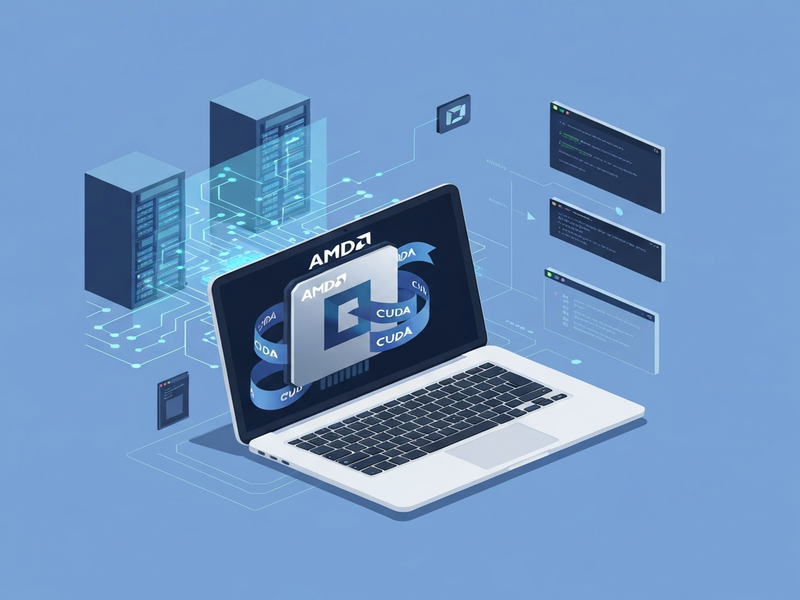
The graphic above, created by UBOS’s AI image generator, captures the end‑to‑end flow: source preprocessing, lexical analysis, parsing, semantic checks, BIR generation, instruction selection, register allocation, and final ELF emission. It serves as a quick reference for developers new to the project.
Related UBOS Resources for GPU‑Accelerated Development
While BarraCUDA handles the low‑level compilation, UBOS offers a suite of tools that complement GPU workflows:
- UBOS homepage – discover the full AI‑first platform.
- UBOS platform overview – see how the platform orchestrates AI services, including GPU‑backed inference.
- Enterprise AI platform by UBOS – scale AI workloads across multi‑GPU clusters.
- AI marketing agents – automate campaign creation with GPU‑accelerated language models.
- Workflow automation studio – build end‑to‑end pipelines that can invoke BarraCUDA‑generated kernels.
- UBOS templates for quick start – jump‑start projects with pre‑configured AI and GPU templates.
- Web app editor on UBOS – prototype UI front‑ends that call GPU‑accelerated back‑ends.
- UBOS pricing plans – find a cost‑effective tier for GPU‑intensive workloads.
- UBOS partner program – collaborate on joint GPU‑AI solutions.
- UBOS portfolio examples – see real‑world deployments that leverage GPU acceleration.
- AI SEO Analyzer – a tool that can run on AMD GPUs for massive site crawls.
- AI Article Copywriter – generate content at scale using GPU‑fast language models.
- Talk with Claude AI app – an example of a conversational AI that can be powered by AMD GPUs.
Conclusion: BarraCUDA’s Role in the Future of GPU Programming
BarraCUDA delivers a groundbreaking solution for developers who need CUDA compatibility on AMD hardware. By providing a lightweight, LLVM‑free compiler that directly emits GFX11 binaries, it reduces development friction, cuts costs, and opens AMD GPUs to the vast CUDA ecosystem.
Coupled with UBOS’s broader AI platform—ranging from AI marketing agents to the Workflow automation studio—developers can build end‑to‑end GPU‑accelerated applications faster than ever.
Whether you are a startup looking for affordable GPU compute, an enterprise scaling AI workloads, or an academic researcher needing cross‑vendor reproducibility, BarraCUDA is a compelling addition to your toolkit. Join the community, contribute to the roadmap, and help shape the next generation of open‑source GPU compilers.