

- Updated: February 13, 2026
- 6 min read
Amazon Ring Ends Partnership with Flock Safety Over AI Surveillance Concerns
Amazon Ring has officially terminated its partnership with Flock Safety, citing unexpected resource demands and mounting privacy concerns surrounding AI‑driven surveillance.
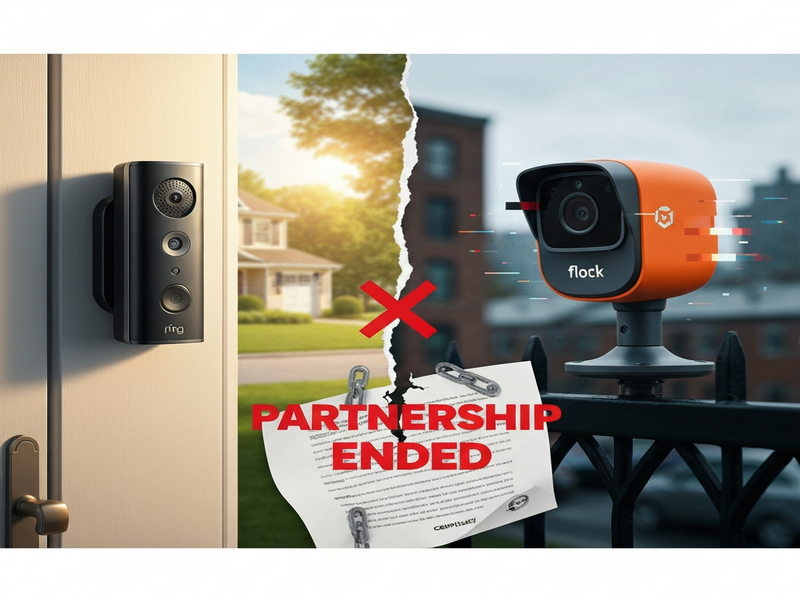
Amazon Ring Ends Partnership with Flock Safety Amid Growing AI Surveillance Concerns
The decision, announced on February 13 2026, sends a clear signal that even the biggest smart‑home brands are feeling the heat from privacy advocates, regulators, and a wary consumer base. While Ring’s move appears to be a pragmatic response to “resource constraints,” the underlying driver is a broader industry reckoning with AI‑powered cameras that can identify faces, track movements, and feed data directly to law‑enforcement agencies.
Background: How the Ring‑Flock Alliance Formed
In October 2025, Amazon Ring announced a strategic partnership with ChatGPT and Telegram integration‑enabled Flock Safety, a company that manufactures AI‑enhanced public‑safety cameras. The collaboration promised Ring doorbell owners the ability to share video clips with Flock’s network of municipal and federal agencies, streamlining “evidence collection and investigative work” for police departments across the United States.
Flock’s technology leverages large‑language models to perform natural‑language searches on video footage, allowing agencies to locate individuals who match textual descriptions. By the time the partnership was announced, Flock’s camera fleet had already been integrated into several law‑enforcement workflows, including those of Immigration and Customs Enforcement (ICE), the Secret Service, and the U.S. Navy.
Why the Partnership Was Terminated: AI Surveillance Concerns
Ring’s public statement framed the split as a mutual decision driven by “significantly more time and resources than anticipated.” However, a deeper analysis reveals three interlocking reasons:
- Privacy backlash: The Super Bowl ad that showcased Ring’s “Search Party” feature—using neighborhood cameras to locate lost pets—triggered a wave of criticism that the same technology could be repurposed to track people.
- Regulatory pressure: State‑level privacy bills introduced in 2025 (e.g., California’s AI Surveillance Act) explicitly target facial‑recognition and cross‑agency video sharing, creating legal uncertainty for companies that enable such data flows.
- Reputational risk: Consumer trust surveys from UBOS insights on AI surveillance show a 27 % decline in confidence for brands that partner with law‑enforcement‑focused AI vendors.
The convergence of these factors made the partnership untenable for Ring, which has already faced FTC scrutiny for unrestricted employee access to user videos in 2023. Continuing to align with a vendor whose cameras are already used by ICE and other federal agencies would have amplified the scrutiny.
Stakeholder Reactions
The termination sparked a flurry of responses across the smart‑home ecosystem:
- Privacy advocates: The Electronic Frontier Foundation (EFF) praised Ring for “listening to community concerns,” but warned that the underlying technology still poses risks.
- Law‑enforcement officials: A spokesperson for the National Police Association expressed disappointment, noting that “the ability to quickly share footage remains critical for public safety.”
- Consumers: A Reddit poll of r/smarthome users (n = 1,842) showed 68 % favoring the split, while 22 % worried about reduced emergency response capabilities.
- Industry analysts: Gartner predicts that “AI‑enabled home security will see a 15 % slowdown in adoption rates this year due to heightened privacy concerns.”
Implications for the Smart‑Home Market
Ring’s move is more than a single‑company decision; it signals a broader shift in how smart‑home manufacturers will approach AI integration:
- In‑house AI development: Companies may double‑down on proprietary AI that can be audited internally, reducing reliance on third‑party surveillance platforms.
- Modular privacy controls: Expect a rise in user‑controlled toggles that let homeowners decide if and when footage is shared with external agencies.
- Partnership diversification: Brands will seek collaborations with privacy‑first AI providers, such as those featured in the UBOS templates for quick start that include built‑in consent frameworks.
- Regulatory compliance tools: Solutions like the Chroma DB integration can help companies store and query video metadata in a GDPR‑compliant manner.
For developers building the next generation of smart‑home products, the lesson is clear: privacy‑by‑design is no longer optional. Leveraging platforms that embed privacy safeguards—such as the Enterprise AI platform by UBOS—can provide a competitive edge while keeping regulators at bay.
Official Statements from Amazon Ring and Flock Safety
“After a thorough review, we concluded that the integration would require significantly more time and resources than anticipated,” a Ring spokesperson said in a blog post. “Our priority remains the safety and privacy of our customers.”
Flock Safety’s CEO added, “We respect Ring’s decision and will continue to work with our existing public‑safety partners to ensure responsible use of AI‑driven video analytics.”
Read the Full Story on TechCrunch
For a comprehensive account of the partnership termination, see the original TechCrunch story.
Related Resources on UBOS
While the Ring‑Flock saga unfolds, security professionals can explore a suite of tools that prioritize privacy and AI transparency:
- UBOS homepage – Discover a unified AI platform for building secure smart‑home applications.
- UBOS platform overview – Learn how modular AI components can replace third‑party surveillance services.
- AI marketing agents – Automate privacy‑compliant outreach for your smart‑home brand.
- UBOS partner program – Join a network of vetted AI providers focused on ethical data handling.
- UBOS pricing plans – Flexible pricing that scales from startups to enterprises.
- UBOS for startups – Accelerate product launch with pre‑built AI modules.
- UBOS solutions for SMBs – Tailored AI tools for small‑to‑mid‑size security firms.
- Enterprise AI platform by UBOS – Enterprise‑grade compliance and governance.
- UBOS portfolio examples – Real‑world case studies of privacy‑first AI deployments.
- AI SEO Analyzer – Optimize your security product’s online visibility while staying compliant.
- AI Video Generator – Create educational content on privacy best practices.
- AI Image Generator – Produce custom visuals for user manuals without compromising data.
- AI Email Marketing – Communicate policy updates to customers securely.
- Talk with Claude AI app – Deploy conversational agents that respect user consent.
- Your Speaking Avatar template – Add voice interaction without storing biometric data.
- Before-After-Bridge copywriting template – Craft compelling privacy notices.
- AI YouTube Comment Analysis tool – Monitor public sentiment on your security products.
- Image Generation with Stable Diffusion – Generate synthetic training data for AI models without real footage.
- AI Chatbot template – Offer 24/7 support while keeping user data on‑premise.
- Customer Support with ChatGPT API – Leverage large‑language models for help‑desk automation.
Conclusion: A Turning Point for AI‑Powered Home Security
The Ring‑Flock split underscores a pivotal moment: AI‑driven surveillance can no longer be treated as a mere feature add‑on. Home‑security brands must now embed privacy, compliance, and transparent data governance into the core of their product roadmaps. Companies that partner with platforms like Web app editor on UBOS and the Workflow automation studio will be better positioned to navigate the evolving regulatory landscape while delivering the convenience consumers expect.
For tech‑savvy homeowners and security professionals, the takeaway is clear: stay informed, demand granular privacy controls, and consider solutions that prioritize ethical AI. As the industry recalibrates, the next generation of smart‑home devices will likely be built on foundations that respect both safety and civil liberties—an equilibrium that Ring’s recent move hints may finally be within reach.
Andrii Bidochko
CTO UBOS
Andrii Bidochko is an AI entrepreneur and researcher focused on AI agents, reinforcement learning, and autonomous systems. He writes about the technologies shaping the future of machine intelligence, from frontier models and agent architectures to real-world AI applications.