

- Updated: January 31, 2026
- 6 min read
AI Titans Clash at Davos 2026: Insights from Tech CEOs
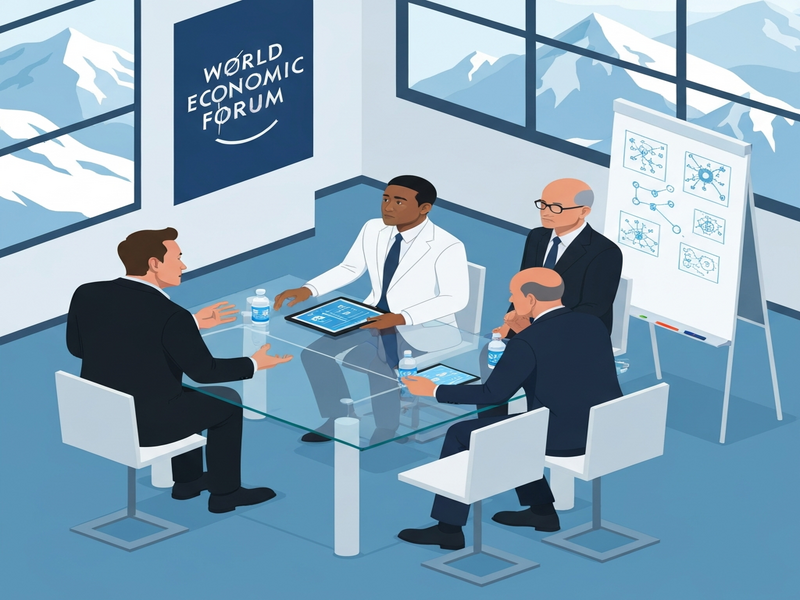
At Davos 2026, the world’s most influential tech CEOs gathered to debate the promise and perils of artificial intelligence, delivering bold visions, sharp criticisms, and a clear signal that AI will dominate global strategy for years to come.
The AI‑Centric Turn of Davos 2026
The World Economic Forum’s annual meeting in Davos has traditionally balanced economics, climate, and geopolitics. This year, however, the agenda was unmistakably reshaped by AI. Stages that once hosted political leaders were now dominated by tech titans—Tesla’s Elon Musk, Nvidia’s Jensen Huang, Anthropic’s Dario Amodei, and Microsoft’s Satya Nadella—each delivering a mix of optimism and caution.
The TechCrunch report captures the atmosphere: a “high‑powered tech conference” where AI was the sole magnet for attendees, while topics like climate change struggled to attract a crowd.
CEO Perspectives: Boast, Bicker, and Blueprint
Elon Musk – The Maverick’s Cautionary Tale
Elon Musk’s rare appearance at Davos broke his long‑standing pattern of avoidance. He warned that “unbridled AI development without robust safety nets could outpace our ability to control it.” Musk’s message echoed his earlier public statements about AI risk, but he also highlighted Tesla’s own AI‑driven autonomous driving roadmap, positioning his company as a responsible pioneer.
Jensen Huang – GPUs, Jobs, and “Token Factories”
Nvidia’s CEO framed data centers as “token factories,” a metaphor that resonated with developers building AI models that mint digital assets. Huang emphasized the need for massive capital infusion to sustain the rapid build‑out of GPU infrastructure, linking AI progress directly to job creation and economic growth.
Dario Amodei – Geopolitics Meets Genius
Anthropic’s founder took a bold stance on the U.S. decision to allow Nvidia chips to be shipped to China. He described an AI data center as “a country full of geniuses,” arguing that exporting such capabilities without safeguards could shift the balance of global technological power. Amodei’s remarks underscored the intertwining of AI, trade policy, and national security.
Satya Nadella – Scaling Equitably
Microsoft’s chief executive painted a picture of AI as a democratizing force, insisting that “more people need to use AI or the bubble will burst.” Nadella’s focus on equitable access contrasted with Amodei’s geopolitical concerns, highlighting a strategic tension between rapid adoption and responsible distribution.
Other Voices on the Promenade
Beyond the headline speakers, executives from Meta, Salesforce, and emerging Middle‑East tech firms populated the “USA House” sponsored by McKinsey and Microsoft. Their presence signaled that AI is no longer a niche for startups; it is a core pillar of enterprise strategy across continents.
Industry Implications and Geopolitical Ripples
The Davos dialogue revealed three interlocking themes that will shape AI’s trajectory in 2026 and beyond:
- Investment Pressure: CEOs collectively urged governments and private capital markets to fund the next wave of AI infrastructure, warning that under‑investment could stall innovation.
- Talent Competition: A “talent war” was evident, with each leader emphasizing the need to attract and retain top AI researchers without “overspending to death.”
- Regulatory Crossroads: The clash between Amodei’s security concerns and Nadella’s push for universal access highlights a looming regulatory dilemma—how to balance openness with national security.
These dynamics are already influencing product roadmaps. For instance, Nvidia announced a new line of energy‑efficient GPUs aimed at data‑center operators in regions with stricter carbon regulations, while Microsoft unveiled a suite of compliance tools for AI governance.
What This Means for AI Leaders, Investors, and Enterprises
For decision‑makers, the Davos takeaways translate into actionable strategies:
- Prioritize Scalable Architecture: Adopt platforms that can grow with demand. The Enterprise AI platform by UBOS offers modular compute layers that align with the “token factory” concept.
- Embed Ethical Guardrails Early: Leverage tools that audit model outputs. UBOS’s AI marketing agents include built‑in bias detection, echoing Nadella’s equity focus.
- Accelerate Time‑to‑Market with Templates: Use pre‑built solutions like the UBOS templates for quick start, such as the AI SEO Analyzer or the AI Article Copywriter, to prototype AI‑driven products faster.
- Leverage Low‑Code Automation: The Workflow automation studio lets enterprises orchestrate data pipelines without deep engineering, a direct response to the talent shortage highlighted at Davos.
- Consider Strategic Partnerships: UBOS’s partner program enables SaaS vendors to co‑sell AI capabilities, mitigating the risk of going it alone in a competitive market.
Investors should watch for companies that can demonstrate both rapid scaling and responsible AI governance—attributes that were repeatedly emphasized by the Davos speakers.
External Sources and Further Reading
The full conversation from TechCrunch’s Equity podcast provides deeper context on the statements made by each CEO. You can listen to the episode here.
Related UBOS Resources
For a curated roundup of AI news, including a detailed recap of the Davos summit, visit our AI news hub. A concise executive summary of the event is also available on the Davos 2026 summary page.
If you are a startup looking to embed AI quickly, explore UBOS for startups. For midsize firms, the UBOS solutions for SMBs provide a cost‑effective path to AI adoption.
Developers interested in voice AI can experiment with the ElevenLabs AI voice integration, while data scientists may find the Chroma DB integration useful for vector search workloads.
For those building conversational agents, the OpenAI ChatGPT integration and the ChatGPT and Telegram integration showcase how to blend messaging platforms with large language models.
Conclusion: AI’s Davos Moment Is Just the Beginning
The 2026 Davos summit proved that AI is no longer a side discussion—it is the central narrative driving corporate strategy, geopolitics, and investment flows. CEOs are simultaneously championing rapid adoption, warning of unchecked risks, and jostling for talent and market share. Companies that can navigate this complex landscape—by leveraging scalable platforms, embedding ethical safeguards, and accelerating development with low‑code tools—will emerge as the next generation of AI leaders.
Stay ahead of the curve by following UBOS’s AI updates, exploring our marketplace templates, and joining the conversation on how artificial intelligence will reshape the global economy.