

- Updated: February 25, 2026
- 5 min read
AI Agents Multi‑Agent Software Development with Sgai – Automation News
Sgai: The Goal‑Driven Multi‑Agent AI Factory Revolutionizing Software Development
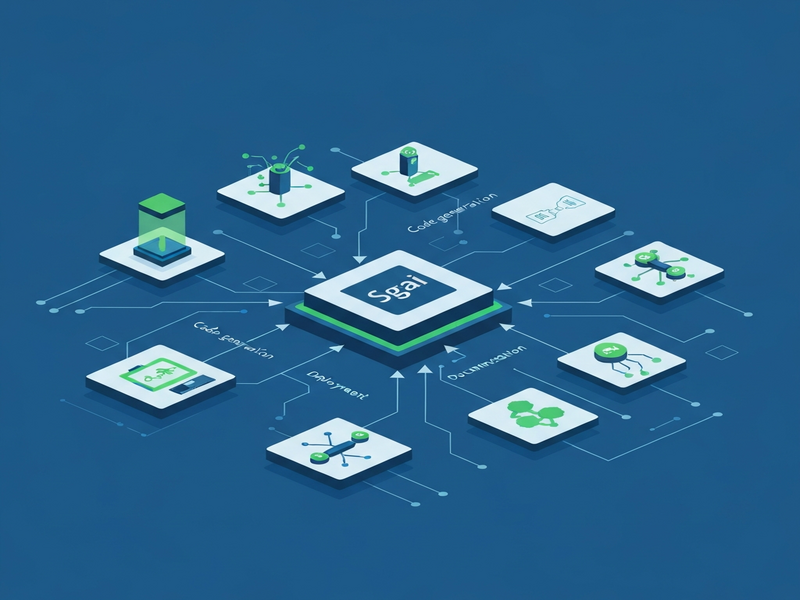
Sgai (pronounced “Sky”) is an open‑source, goal‑driven AI software factory that orchestrates multiple specialized agents to turn a high‑level objective into production‑ready code—all inside your local repository. The project lives on GitHub, where developers can clone, contribute, and watch live demos of agents planning, coding, reviewing, and validating software automatically.
What Is Sgai? – A Goal‑Driven Multi‑Agent AI Factory
Sgai transforms traditional, line‑by‑line prompting into a goal‑first workflow. You describe the desired outcome—e.g., “Create a drag‑and‑drop image compressor” —and a fleet of AI agents (developer, reviewer, designer, safety analyst) automatically:
- Plan a visual workflow diagram that captures task dependencies.
- Ask clarifying questions until you approve the plan.
- Execute the plan, writing code, running tests, and performing lint checks.
- Validate completion only when all success criteria are met.
The entire process runs locally, keeping your proprietary code and data under your control. Sgai is not a chat interface; it is a software factory that leverages AI agents to accelerate development cycles.
Key Features & Benefits
- Visual Planning Dashboard: See a real‑time workflow diagram instead of hidden AI reasoning.
- Specialized Agent Roles: Separate developer, reviewer, and safety analyst agents ensure code quality and compliance.
- Goal‑First Approach: Define outcomes, not implementation steps, reducing prompt fatigue.
- Local Execution: All operations happen inside your repository; no code is pushed to remote without your consent.
- Reusable Skills Library: Completed sessions generate reusable snippets that make future agents smarter.
- Extensible Integrations: Connect to OpenAI ChatGPT integration, Chroma DB integration, or even voice assistants via ElevenLabs AI voice integration.
- Enterprise‑Ready Security: Agents run in sandboxed environments, and you retain full version‑control authority.
How to Get Started – Installation & Usage
Getting Sgai up and running is straightforward. Follow the official installation guide or use the automated opencode script for a one‑click setup.
Quick Automated Setup
opencode update
opencode auth login
opencode --model anthropic/claude-opus-4-6 run "install Sgai"
Manual Installation (Linux/macOS)
- Install prerequisites:
Go,Node.js,bun, andGraphviz. - Clone the repository:
git clone https://github.com/sandgardenhq/sgai.git cd sgai - Build the binary:
go install github.com/sandgardenhq/sgai/cmd/sgai@latest - Start the web UI:
sgai serve
# Open http://localhost:8080 in your browser
Once the dashboard loads, click “Create Goal”, fill in a concise description (e.g., “Build a REST API for user authentication with JWT”), and watch the agents collaborate. The UI shows each agent’s status, generated code diffs, and test results in real time.
Community, Support & Future Roadmap
Sgai is an open‑source project maintained by Sandgarden. The community contributes new GOAL files, agent specifications, and integrations. You can:
- Open an issue on GitHub for bugs or feature requests.
- Start a discussion thread to share your custom agents or workflow patterns.
- Submit a pull request that adds a new
GOALtemplate or improves existing agents.
Upcoming roadmap items include:
- Native support for multi‑agent systems across heterogeneous cloud environments.
- Graphical drag‑and‑drop goal designer integrated with the Web app editor on UBOS.
- Enterprise‑grade policy enforcement via the Enterprise AI platform by UBOS.
Why Choose Sgai? – Quick‑Reference Summary
- Goal‑first workflow eliminates prompt fatigue.
- Multi‑agent specialization guarantees higher code quality.
- Local execution protects intellectual property.
- Visual dashboard provides transparency and control.
- Extensible ecosystem integrates with leading AI services.
- Open‑source community accelerates innovation.
Start Building with Sgai Today
Ready to experience AI‑driven development? Clone the repo, define your first goal, and let the agents do the heavy lifting. For teams looking to scale AI automation, explore how Sgai fits into the broader UBOS platform overview and leverage the UBOS partner program for dedicated support.
Need a quick start? Browse the UBOS templates for quick start and adapt them with Sgai‑generated code. For startups, the UBOS for startups page outlines pricing and resources that align with lean development cycles.
SMBs can benefit from the UBOS solutions for SMBs, while enterprises may explore the Enterprise AI platform by UBOS for large‑scale governance.
Explore real‑world examples in the UBOS portfolio examples. If you’re curious about AI‑enhanced marketing, check out the AI marketing agents that can be combined with Sgai‑generated APIs.
Looking for ready‑made AI applications? The marketplace offers an AI Chatbot template, an AI SEO Analyzer, an AI Article Copywriter, and even an AI Video Generator—all of which can be bootstrapped with Sgai‑produced back‑ends.
Finally, integrate voice capabilities using the Telegram integration on UBOS, the ChatGPT and Telegram integration, or the ElevenLabs AI voice integration for conversational agents built by Sgai.
Visit the About UBOS page to learn more about the team behind these innovations, and check the UBOS pricing plans to find a tier that matches your budget.
In summary, Sgai represents a new class of goal‑driven AI agents that turn abstract software requirements into fully tested applications, all while staying within the secure boundaries of your own development environment. Whether you are a developer seeking rapid prototyping, a startup aiming to accelerate product‑market fit, or an enterprise looking to embed AI‑driven automation into its software factory, Sgai’s multi‑agent architecture, open‑source flexibility, and seamless UBOS integrations make it a compelling choice for the future of AI‑driven development.
Andrii Bidochko
CTO UBOS
Andrii Bidochko is an AI entrepreneur and researcher focused on AI agents, reinforcement learning, and autonomous systems. He writes about the technologies shaping the future of machine intelligence, from frontier models and agent architectures to real-world AI applications.