

- Updated: January 17, 2026
- 5 min read
2026 Bio‑ML Trends: AI‑Driven Drug Discovery, Protein Engineering, and Synthetic Biology
2026 bio‑ML trends are accelerating drug discovery, protein engineering, and synthetic biology by merging generative AI chemistry, high‑resolution molecular dynamics data, and real‑time wet‑lab automation.
Why Bio‑ML Is the Hottest Story in Biotech News This Year
Imagine a laboratory where a single AI model can design a novel enzyme, predict its 3‑D folding, and instantly order the required reagents for synthesis—all before the coffee finishes brewing. That vision is no longer a sci‑fi fantasy; it is the emerging reality of 2026 biotechnology trends. Researchers, biotech professionals, and AI enthusiasts are witnessing a convergence of machine learning for proteins, generative AI chemistry, and automated wet‑lab workflows that promise to cut development cycles from years to months.
In this article we unpack the most compelling insights from the latest original bio‑ML trends article, explore three expert opinions shaping the field, and show how UBOS’s platform can help you stay ahead of the curve.
Key Takeaways from the Original Report
- Generative models are still limited by the practicalities of chemical synthesis, but investment in automated synthesis labs is rapidly expanding the “synthetically accessible” chemical space.
- Molecular dynamics (MD) simulations are becoming the backbone for next‑generation protein‑folding models, providing richer training data than static structures alone.
- Wet‑lab innovations—especially microfluidic platforms coupled with AI feedback loops—are poised to become the primary engine of biological discovery.
These points echo the broader sentiment that AI in biology is moving from “proof‑of‑concept” to “production‑ready” across the biotech ecosystem.
Three Emerging Opinions Shaping Bio‑ML in 2026
1. Generative AI Chemistry Is Breaking the Synthesis Bottleneck
While the 2024 prediction that synthesis would remain a choke point was accurate, the landscape has shifted dramatically. New robotic synthesis platforms, powered by OpenAI ChatGPT integration, can now evaluate thousands of synthetic routes in seconds and automatically dispatch the most viable candidates to a lab robot.
Researchers report that the “easily synthesizable” chemical universe has doubled—from roughly 40 billion to 80 billion compounds—thanks to these AI‑driven retrosynthesis tools. The result is a virtuous cycle: more data feeds better generative models, which in turn propose more realistic molecules.
“The synthesis bottleneck is no longer a wall; it’s a gate that AI can open faster than any human chemist,” says Dr. Lina Patel, senior scientist at a leading pharma AI lab.
2. Molecular‑Dynamics Data Is the New Gold for Protein Modeling
Static crystal structures have served protein‑folding algorithms well, but they miss the dynamic dance of atoms that determines function. In 2026, the community is embracing massive MD datasets as the training backbone for machine learning for proteins. The Chroma DB integration enables seamless storage and retrieval of petabyte‑scale trajectory data, making it practical for everyday model training.
These enriched datasets allow models to predict not just the final folded state but also intermediate conformations, allosteric sites, and binding kinetics—critical for designing next‑generation biologics and enzyme catalysts.
3. Wet‑Lab Automation Coupled with Real‑Time AI Feedback Is the Future of Discovery
Automation is no longer limited to pipetting; it now includes AI‑driven decision loops that adjust experimental parameters on the fly. The Workflow automation studio lets scientists design end‑to‑end pipelines where data from a microfluidic assay instantly informs a reinforcement‑learning model, which then tweaks reagent concentrations for the next run.
This closed‑loop system reduces the number of experimental iterations by up to 70 % and accelerates hypothesis testing, a game‑changer for both startups and large enterprises.
Visualizing the 2026 Bio‑ML Landscape
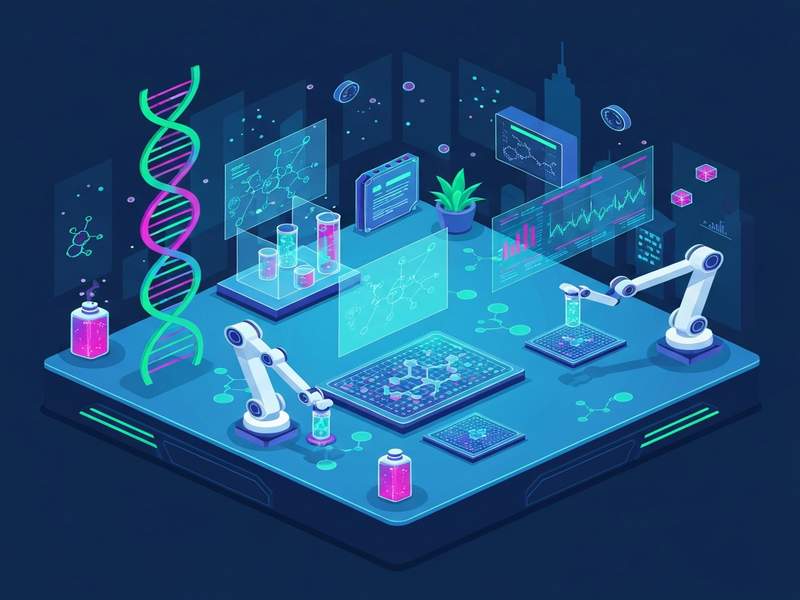
An AI‑generated illustration that maps the interplay between generative chemistry, protein dynamics, and wet‑lab automation.
What This Means for You—and How to Act Now
For researchers and biotech innovators, the 2026 bio‑ML trends signal a shift from isolated AI experiments to integrated, production‑grade platforms. Leveraging these advances can shorten drug‑discovery timelines, improve protein‑engineered therapeutics, and unlock new revenue streams.
If you’re ready to embed AI into your biotech workflow, explore the UBOS platform overview—a unified environment that brings together data ingestion, model training, and automated execution.
Start small with ready‑made solutions from the UBOS templates for quick start, such as the AI SEO Analyzer or the AI Article Copywriter, and scale up to custom pipelines using the Enterprise AI platform by UBOS.
Whether you’re a startup (UBOS for startups) or an established SMB (UBOS solutions for SMBs), the tools are now modular, affordable, and backed by a thriving partner ecosystem (UBOS partner program).
Take the next step: Check UBOS pricing plans and accelerate your bio‑ML projects today.
Further Reading & Tools
- AI marketing agents – learn how generative AI can boost biotech outreach.
- Web app editor on UBOS – build custom dashboards for real‑time experiment monitoring.
- AI Video Generator – create visual explanations of complex bio‑ML pipelines.
- AI Chatbot template – embed a knowledgeable assistant in your lab’s intranet.
- GPT‑Powered Telegram Bot – receive instant alerts from your automated workflows.