

- Updated: March 11, 2026
- 6 min read
SWE‑bench Study Reveals AI‑Generated PRs Often Rejected by Maintainers
AI‑generated pull requests that pass the SWE‑bench automated grader are merged by human maintainers only about half as often, revealing a sizable gap between benchmark scores and real‑world code‑review outcomes.
SWE‑bench Findings: A Quick Overview
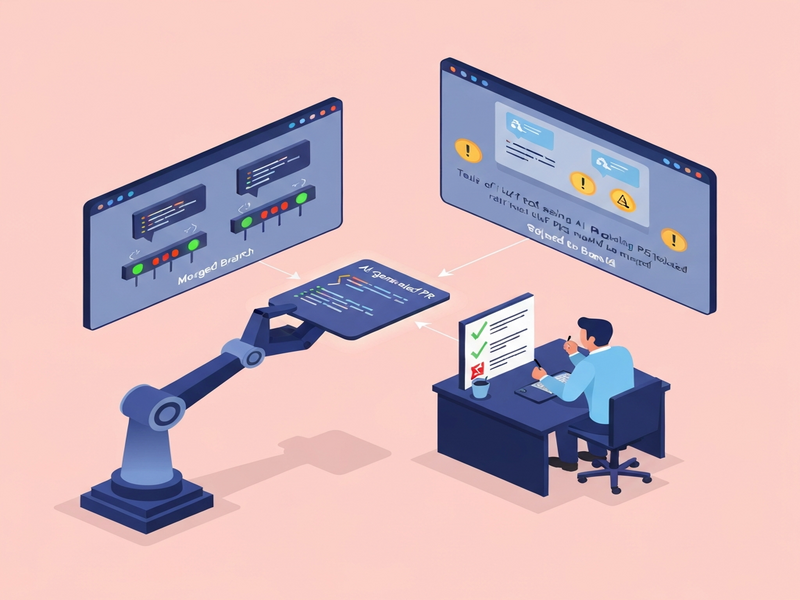
The recent original METR research note examined 296 AI‑generated pull requests (PRs) that passed the SWE‑bench “Verified” automated tests. When four active maintainers from three popular open‑source projects (scikit‑learn, Sphinx, and pytest) reviewed these PRs, the average merge rate dropped by roughly 24 percentage points compared with the automated grader’s pass rate. In plain terms, a PR that looks perfect to a machine often fails to convince a human reviewer.
Methodology: From Automated Grader to Human Review
To keep the analysis MECE (Mutually Exclusive, Collectively Exhaustive), the study split the workflow into three distinct stages:
- Automated Grading: SWE‑bench runs unit‑test suites on each PR and assigns a “Verified” pass/fail label.
- Human Maintainer Review: Four maintainers, blind to the PR source, evaluated whether each PR should be merged, requested changes, or rejected outright.
- Golden Baseline Calibration: A set of 47 human‑written PRs (the “golden patches”) that were already merged served as a reference point for normalizing scores.
The study also recorded the primary reason for each rejection—code‑quality issues, breaking other code, or core‑functionality failures—providing granular insight into where AI falls short.
Key Results: Numbers That Matter
Pass‑Rate Gap
Figure 1 (reproduced in the METR note) shows a consistent 24‑point gap across all models. For example, Claude 4.5 Sonnet achieved a 68 % automated pass rate but only a 44 % maintainer merge rate after baseline adjustment.
Trend Over Time
When plotting yearly improvement, the automated grader’s scores rose at ~9.6 pp/yr faster than maintainer merges. Although the trend is statistically weaker (p ≈ 0.1), it hints that raw benchmark gains may not translate linearly into developer‑friendly code.
Reasons for Rejection
Rejection categories followed a clear hierarchy:
- Core‑functionality failures (the patch does not solve the issue).
- Breaking other code (introducing regressions).
- Code‑quality problems (style, documentation, repo conventions).
- Other/undocumented failures.
Even when the automated tests passed, 38 % of PRs were flagged for core‑functionality issues, underscoring that test suites alone cannot capture all correctness dimensions.
Why Do Many Test‑Passing PRs Remain Unmerged?
The gap is not a simple “AI can’t code.” Several nuanced factors contribute:
- Lack of Iterative Feedback: Unlike human developers, the agents submitted a single PR without a chance to refine based on reviewer comments.
- Repository Standards: Open‑source projects enforce strict style guides, documentation, and testing policies that AI often overlooks.
- Hidden Dependencies: Automated tests run in isolation; maintainers consider integration impact, performance, and backward compatibility.
- Human Subjectivity: Even with a “golden baseline,” maintainers differ on what constitutes “merge‑ready” code, especially for borderline cases.
These observations align with METR’s earlier finding that AI tools can paradoxically slow down developers when the generated code requires extensive manual cleanup.
Implications for AI Code‑Generation Benchmarks
Benchmarks like SWE‑bench remain valuable, but their scores should be interpreted with caution:
“A naive reading of benchmark percentages can overstate real‑world usefulness; human review adds a critical layer of validation.” – METR research team
Practical takeaways for researchers and product teams include:
- Incorporate Human‑In‑The‑Loop (HITL) Evaluation: Pair automated grading with a sample of maintainer reviews to calibrate scores.
- Measure Iterative Success: Track how many feedback cycles an AI needs before a PR is merge‑ready.
- Expand Test Suites: Include integration, performance, and style checks to narrow the gap between test‑pass and merge‑ready.
- Report “Progress” Metrics: As METR did, capture the percentage of PRs that are ≥80 % towards a mergeable state.
How UBOS Helps Bridge the Gap
Developers looking to integrate AI‑generated code into production pipelines can leverage UBOS’s ecosystem to automate many of the missing steps highlighted above.
Workflow Automation Studio
Design end‑to‑end pipelines that automatically run style linters, security scans, and integration tests on every AI‑generated PR.
AI Marketing Agents
Deploy AI marketing agents that can auto‑generate documentation and release notes, reducing the manual overhead of PR polishing.
UBOS also offers ready‑made integrations that directly address the shortcomings identified in the SWE‑bench study:
- ChatGPT and Telegram integration enables real‑time feedback loops between developers and AI agents.
- OpenAI ChatGPT integration brings conversational code review capabilities into your CI/CD pipeline.
- Chroma DB integration stores vector embeddings of code changes, allowing semantic similarity checks before merging.
- ElevenLabs AI voice integration can read PR summaries aloud, helping maintainers quickly assess intent.
For teams that need a quick start, the UBOS templates for quick start include pre‑configured “AI‑assisted PR reviewer” workflows that combine the above tools.
Template Marketplace Highlights
UBOS’s marketplace offers dozens of community‑curated apps that directly tackle the pain points revealed by the SWE‑bench analysis. Below are a few that align with the study’s findings:
AI Code Review Automation
Automates the initial review stage, flagging style and security issues before a human maintainer sees the PR.
AI Article Copywriter
Generates clear documentation and changelogs for each PR, satisfying repository documentation standards.
AI Survey Generator
Creates post‑merge surveys to capture maintainer feedback, feeding it back into the AI model for future improvements.
AI SEO Analyzer
Ensures that generated documentation and comments are SEO‑friendly, improving discoverability of open‑source projects.
Future Research Directions
Building on the SWE‑bench study, several research avenues could further narrow the AI‑human gap:
- Iterative Prompting Frameworks: Allow agents to receive maintainer comments and automatically generate follow‑up patches.
- Hybrid Benchmarks: Combine unit‑test pass rates with human‑review scores to produce a composite “merge‑readiness” metric.
- Cross‑Repository Generalization: Test agents on a broader set of repos (beyond the 3 studied) to assess scalability.
- Explainability Layers: Require AI to output a rationale for each code change, helping maintainers trust the patch.
Take the Next Step with UBOS
If you’re a software engineer, AI researcher, or product manager eager to turn benchmark scores into production‑ready code, explore the UBOS platform overview. Our pricing plans are designed for startups, SMBs, and enterprises alike.
Ready to see AI‑generated PRs that actually get merged? Join the UBOS partner program today and start building smarter, faster, and more reliable development pipelines.
Andrii Bidochko
CTO UBOS
Andrii Bidochko is an AI entrepreneur and researcher focused on AI agents, reinforcement learning, and autonomous systems. He writes about the technologies shaping the future of machine intelligence, from frontier models and agent architectures to real-world AI applications.