

- Updated: March 26, 2026
- 6 min read
AI Regulation Push: Bernie Sanders and AOC Call for Ban on Large Data Centers in Congress
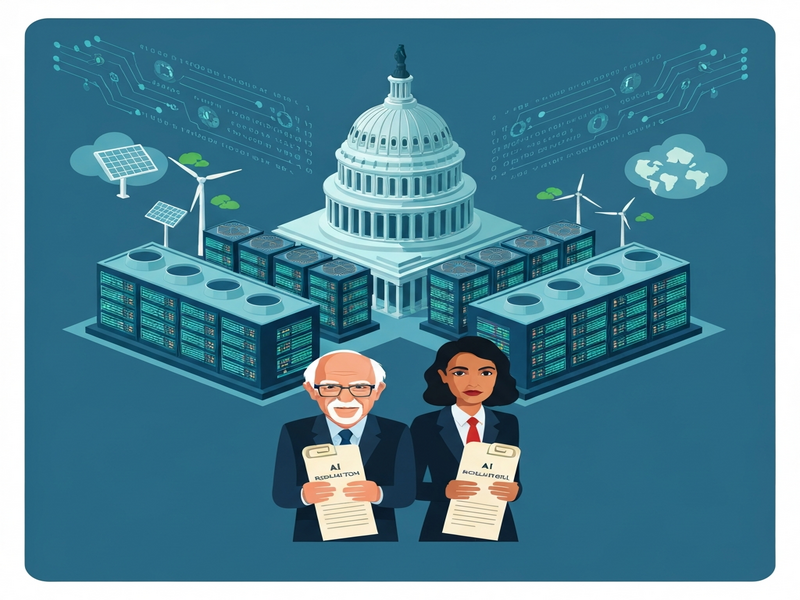
Bernie Sanders & AOC Push Ban on Mega‑Power Data Centers Until AI Regulation Passes
Answer: The Senate and House are considering companion bills that would halt any new U.S. data center with a peak load over 20 MW until Congress adopts a comprehensive AI‑regulation framework.
Why This Proposal Matters Now
The rapid expansion of AI‑driven workloads has turned data centers into the most energy‑intensive infrastructure in the United States. UBOS data‑center energy research shows that a single 20 MW facility can consume as much electricity as a small city, driving up carbon emissions and straining the power grid. By linking construction permits to a pending AI‑policy bill, Senators Bernie Sanders and Representative Alexandria Ocasio‑Cortez (AOC) aim to force the industry to address safety, climate, and labor concerns before further expansion.
Background: The Growing AI Regulation Debate
Over the past two years, tech leaders—from Elon Musk to OpenAI’s Sam Altman—have warned that unchecked AI development could outpace societal safeguards. A March Pew Research poll found that 62 % of Americans feel “more concerned than excited” about AI, while only 10 % say excitement outweighs worry. This public sentiment has pushed lawmakers to consider stricter oversight, echoing the Enterprise AI platform by UBOS that emphasizes responsible AI deployment.
The Sanders‑AOC Legislation: Key Provisions
- Construction Freeze: No new data center exceeding 20 MW may be built until Congress passes a comprehensive AI‑regulation bill.
- Model Certification: All AI models must be reviewed and certified by a federal AI Safety Board before commercial release.
- Labor Standards: New data‑center projects must use union labor and provide a living‑wage guarantee.
- Export Controls: Advanced AI chips cannot be exported to countries lacking comparable safety regulations.
- Environmental Safeguards: Projects must submit a carbon‑impact assessment and commit to renewable‑energy sourcing.
The bills also propose a UBOS partner program‑style framework for AI developers, encouraging open‑source safety tools and shared best practices.
Motivations Behind the Ban
AI Safety and Ethical Risks
Proponents argue that without a regulatory baseline, powerful generative models could be misused for disinformation, deepfakes, or autonomous weaponization. By pausing infrastructure growth, the legislation creates a “regulatory window” for drafting standards that align with the About UBOS mission of trustworthy AI.
Climate and Energy Concerns
Data centers now account for roughly 2 % of U.S. electricity consumption. A 20 MW facility can emit over 30,000 tons of CO₂ annually if powered by fossil fuels. The ban forces developers to adopt renewable‑energy contracts, mirroring the UBOS AI regulation guidelines that prioritize low‑carbon AI pipelines.
Labor and Economic Equity
Union labor requirements aim to counter the “gig‑economy” model that dominates many tech construction projects. By guaranteeing fair wages and benefits, the legislation hopes to create middle‑class jobs in regions that host data‑center clusters.
Industry & Stakeholder Reactions
Tech Giants: Companies like Microsoft, Google, and Amazon have issued cautious statements, emphasizing the need for “balanced regulation” that does not stifle innovation. Their public relations teams reference the Web app editor on UBOS as an example of rapid, low‑cost AI deployment that could be hampered by a construction freeze.
Start‑ups: Emerging AI firms see the ban as a double‑edged sword. While it could raise barriers to scaling, it also levels the playing field by preventing megacorp‑driven data‑center monopolies. The UBOS for startups program offers cloud‑native AI tools that could help smaller players comply with new standards.
Investors: Environment‑focused funds are applauding the climate angle, whereas venture capitalists warn that delayed infrastructure could slow ROI on AI‑driven products. A recent analysis from UBOS portfolio examples shows that companies leveraging AI‑optimized workloads can achieve up to 30 % cost savings—savings that may be jeopardized if construction stalls.
Political & Geopolitical Implications
If passed, the legislation would be the first U.S. law to directly tie AI policy to physical infrastructure. It could set a precedent for other nations grappling with AI‑energy trade‑offs, such as the EU’s Digital Services Act. Moreover, export‑control provisions may intensify the tech rivalry with China, where AI chips are already a strategic asset.
Environmental Impact: A Quantitative Look
| Metric | Typical 20 MW Data Center | Potential Reduction with Ban |
|---|---|---|
| Annual Electricity Use | ≈ 175 GWh | 0 GWh (construction halted) |
| CO₂ Emissions (grid mix) | ≈ 30,000 t | ≈ 30,000 t avoided |
| Water Consumption (cooling) | ≈ 1.2 M gal | 0 gal |
These figures illustrate why the legislation frames data‑center construction as a lever for climate mitigation, aligning with the UBOS AI regulation roadmap that integrates sustainability metrics into AI project lifecycles.
What This Means for Policy‑Focused Tech Professionals
- Monitor the progress of the UBOS partner program for emerging compliance tools.
- Evaluate your organization’s data‑center footprint against the 20 MW threshold.
- Consider integrating AI marketing agents that run on existing, certified infrastructure.
- Leverage UBOS templates for quick start to prototype AI workloads without new hardware.
- Stay informed on the upcoming UBOS pricing plans that may include carbon‑offset bundles.
Related UBOS Solutions You Can Deploy Today
If your team needs to pivot away from new data‑center builds, UBOS offers a suite of cloud‑native services that can run on existing infrastructure:
- AI YouTube Comment Analysis tool – leverages existing compute for sentiment mining.
- AI SEO Analyzer – improves content visibility without extra hardware.
- AI Article Copywriter – generates marketing copy on demand.
- AI Video Generator – creates short videos using GPU‑efficient models.
- AI Chatbot template – deployable on shared servers.
External Perspective
For a full rundown of the legislative text and early reactions, see the original TechCrunch coverage: TechCrunch – AI regulation and data‑center ban.
Conclusion: A Turning Point for AI, Energy, and Policy
The Sanders‑AOC proposal places AI safety, climate stewardship, and labor equity at the heart of America’s digital infrastructure strategy. Whether the bills survive the Senate‑House gauntlet will shape the next decade of AI innovation, investment flows, and carbon footprints. For tech leaders and environmentally‑aware investors, the message is clear: align your AI roadmap with emerging regulatory expectations now, or risk being left behind when the construction freeze takes effect.
Stay ahead of the curve with UBOS’s Enterprise AI platform, and explore how responsible AI can power growth without compromising the planet.
Andrii Bidochko
CTO UBOS
Andrii Bidochko is an AI entrepreneur and researcher focused on AI agents, reinforcement learning, and autonomous systems. He writes about the technologies shaping the future of machine intelligence, from frontier models and agent architectures to real-world AI applications.