

- Updated: March 27, 2026
- 5 min read
Meta and YouTube Found Negligent in Addictive Platform Designs – UBOS News
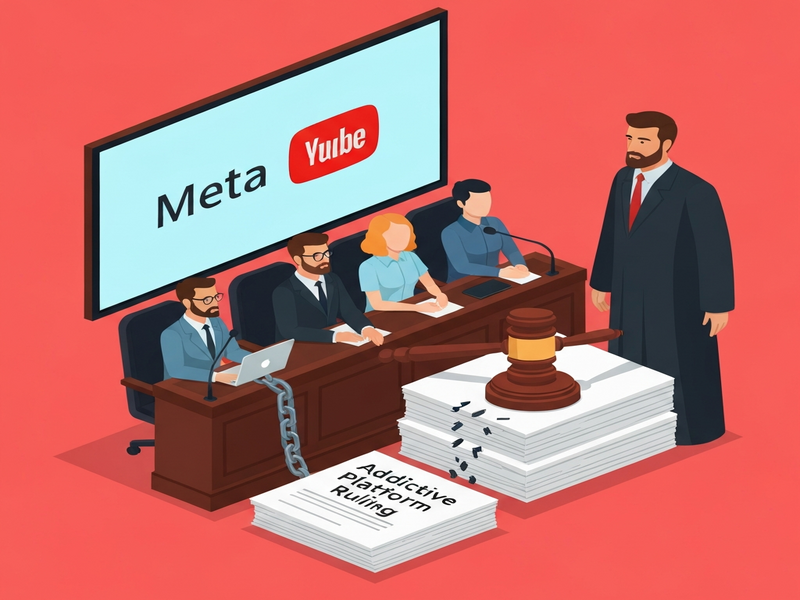
Juries have found Meta and YouTube negligent for the addictive design of their platforms, delivering the first U.S. verdicts that hold social‑media companies liable for the way their products keep users hooked.
Meta & YouTube Found Negligent in Groundbreaking Social‑Media Addiction Lawsuits
In a week that could reshape the legal landscape for the world’s biggest social‑media platforms, juries in two separate federal cases ruled that Meta (owner of Facebook, Instagram, and WhatsApp) and YouTube were negligent in the design and structure of their services, contributing to user addiction and mental‑health harms. The decisions, announced on March 26 and 27, 2026, are the first instances where a court has held platforms accountable not for a single piece of content, but for the underlying architecture that keeps users scrolling, watching, and engaging for hours on end.
The verdicts sidestep the traditional Section 230 shield by treating the platforms as “digital products” whose design choices can be deemed unsafe—a legal theory that could open the floodgates for future product‑liability claims across the tech industry.
Core Verdict Facts
| Platform | Court | Verdict | Damages Awarded* | Key Reasoning |
|---|---|---|---|---|
| Meta | U.S. District Court, Northern District of California | Negligent – failed to warn about addictive algorithmic feed | $1.2 billion (pre‑judgment interest pending) | Internal research linked “infinite scroll” & personalized recommendations to increased screen time and mental‑health issues. |
| YouTube | U.S. District Court, Eastern District of New York | Negligent – designed “autoplay” & “shorts” to maximize watch time without safety warnings | $950 million (subject to settlement) | Evidence showed YouTube knowingly promoted binge‑watching, especially among minors, despite internal warnings. |
*Damages are subject to post‑verdict motions and potential appeals; figures reflect the jury’s initial award.
Legal Context & Nuances
- Beyond Section 230: Both cases avoided the traditional “platform immunity” shield by focusing on design rather than content. The juries accepted that the platforms themselves engineered addictive experiences.
- Product‑liability framework: Plaintiffs framed the platforms as “digital products” whose design could be unsafe—a novel approach that has never before succeeded in U.S. tech litigation.
- Parallel lawsuits: The verdicts arrive amid a wave of upcoming trials, including a class‑action against TikTok for similar claims and a federal probe into Snapchat’s “Snap Map” feature.
- Regulatory ripple effects: Lawmakers on both sides of the aisle cite the rulings as evidence that federal regulation of algorithmic design may be inevitable. The FTC has already hinted at drafting “digital‑wellbeing” guidelines.
- Industry reaction: Meta’s CEO Mark Zuckerberg called the verdict “a misinterpretation of how our products work,” while YouTube’s chief product officer emphasized ongoing “safety‑first” initiatives. Both companies have filed motions to remand for a new trial.
What This Means for Users & the Tech Ecosystem
- Increased transparency: Expect more prominent “addiction risk” disclosures during app onboarding and in settings menus.
- Design overhauls: Platforms may roll back or redesign features like infinite scroll, autoplay, and algorithmic “suggested” feeds to mitigate legal exposure.
- Investor impact: Shares of Meta and Alphabet (YouTube’s parent) dipped 3‑5 % in after‑hours trading following the announcements.
- Future litigation: The product‑liability angle could open the door for similar suits against emerging “super‑app” ecosystems, VR social spaces, and AI‑driven recommendation engines.
Expert Takeaways
“These verdicts signal the first real crack in the Section 230 fortress. If courts continue to view platform design as a ‘product,’ we could see a cascade of liability claims that force the industry to prioritize user wellbeing over engagement metrics.” – Prof. Elena Ramirez, Stanford Law School
Why This Matters for AI‑Powered SaaS Platforms
The verdicts underscore a growing expectation that technology providers—especially those built on AI and automation—must embed ethical safeguards directly into product design. Companies using the UBOS platform overview can leverage built‑in compliance tools to avoid similar pitfalls.
For instance, UBOS’s Workflow automation studio lets developers create transparent user‑flow checkpoints, while the Web app editor on UBOS includes UI components that surface “time‑spent” metrics and optional “wellbeing prompts.”
Moreover, the AI marketing agents can be programmed to respect user‑frequency caps, ensuring that outreach campaigns do not become intrusive or addictive.
Actionable Checklist for SaaS Founders
- Conduct a design‑risk audit using UBOS’s UBOS templates for quick start to map out features that could encourage compulsive use.
- Implement transparent disclosures at onboarding—UBOS’s pricing plans include a “compliance” tier that adds legal‑review widgets.
- Leverage AI‑driven monitoring (e.g., the AI SEO Analyzer can be repurposed to flag content that may trigger excessive engagement).
- Enable user‑controlled limits—UBOS’s Enterprise AI platform by UBOS offers role‑based access controls for feature toggles.
- Adopt a continuous‑feedback loop with in‑app surveys; the AI Survey Generator makes it easy to collect wellbeing data.
Explore More UBOS Resources
Whether you’re a startup, an SMB, or an enterprise, UBOS offers a suite of tools to help you build responsible AI‑driven products:
- UBOS homepage – Overview of the ecosystem.
- UBOS for startups – Fast‑track your MVP with compliance baked in.
- UBOS solutions for SMBs – Scalable AI tools without the legal headache.
- UBOS partner program – Co‑sell and co‑develop responsible AI services.
- UBOS portfolio examples – Real‑world case studies of ethical AI deployments.
Source
For the full original reporting, see the Verge’s episode recap: Meta’s court losses could be just the beginning – The Vergecast.
Stay informed with UBOS – where AI innovation meets ethical responsibility.
Andrii Bidochko
CTO UBOS
Andrii Bidochko is an AI entrepreneur and researcher focused on AI agents, reinforcement learning, and autonomous systems. He writes about the technologies shaping the future of machine intelligence, from frontier models and agent architectures to real-world AI applications.