

- Updated: March 24, 2026
- 8 min read
Mesh LLM: Open‑Source Framework for Distributed LLM Inference
Mesh LLM is an open‑source framework that lets you run large language models across multiple GPUs and machines, delivering scalable inference with pipeline parallelism, Mixture‑of‑Experts (MoE) sharding, and latency‑aware rebalancing.
Why Distributed LLM Inference Matters
Modern LLMs such as Qwen2.5‑32B or Mixtral‑8x7B require tens of gigabytes of VRAM, far beyond the capacity of a single consumer GPU. When inference is confined to one device, developers face three painful constraints: out‑of‑memory crashes, prohibitive latency, and wasted compute on idle hardware. Distributed inference solves these problems by pooling spare GPU memory across a mesh of nodes, turning a cluster of modest machines into a single, high‑throughput inference engine.
For SaaS startups and SMBs, the cost advantage is immediate—no need to rent expensive multi‑GPU cloud instances. For enterprises, the ability to keep data on‑premises while still serving petabyte‑scale models satisfies strict compliance requirements. In short, distributed LLM inference is the bridge between cutting‑edge AI research and real‑world production workloads.
The UBOS platform overview already supports hybrid cloud‑edge deployments, making Mesh LLM a natural extension for any organization looking to scale AI without breaking the bank.
What Is Mesh LLM? – Core Concept and Architecture
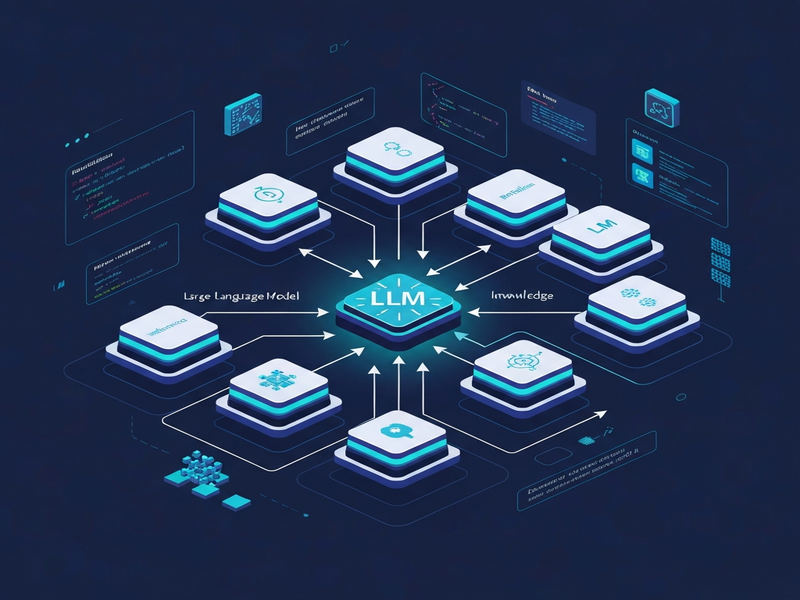
Mesh LLM is a Rust‑based runtime that automatically distributes a model’s weights and execution graph across a configurable mesh of nodes. The framework detects whether a model fits on a single GPU; if not, it selects the optimal strategy:
- Pipeline Parallelism – splits dense model layers across nodes, keeping each GPU busy while minimizing cross‑node traffic.
- Mixture‑of‑Experts (MoE) Parallelism – shards expert modules, replicates a core set of high‑traffic experts on every node, and routes tokens to the appropriate expert subset, eliminating cross‑node inference traffic.
Each node runs a local llama‑server that serves an OpenAI‑compatible API on http://localhost:9337/v1. A lightweight proxy routes requests to the correct node based on the model name, ensuring zero‑copy inference for the majority of tokens. The architecture is deliberately latency‑aware: peers are chosen by the lowest round‑trip time (RTT) with an 80 ms hard cap, so network latency only affects the time‑to‑first‑token, not per‑token throughput.
“Mesh LLM turns a collection of idle GPUs into a single, high‑performance LLM serving cluster without any manual sharding.” – mesh‑llm GitHub
The design aligns perfectly with the Enterprise AI platform by UBOS, which already provides unified monitoring, role‑based access, and policy enforcement for AI workloads.
Key Features of Mesh LLM
1. Pipeline Parallelism
Dense models that exceed a single GPU’s VRAM are automatically split layer‑wise. Each node loads only its assigned slice, reducing memory pressure and enabling models up to 70 B parameters to run on a cluster of 8 GB GPUs.
2. MoE Expert Sharding
For Mixture‑of‑Experts models (e.g., Mixtral, DeepSeek), Mesh LLM reads the GGUF header, identifies the most‑used experts, and creates overlapping shards. A shared core of critical experts is replicated on every node, while the remaining experts are distributed, achieving zero cross‑node traffic during inference.
3. Latency‑Aware Design
The proxy selects peers with the lowest RTT, capping at 80 ms. HTTP streaming tolerates latency, while RPC calls are limited to the few nodes involved in a pipeline split, keeping per‑token latency low even across wide‑area networks.
4. Demand‑Aware Rebalancing
A unified demand map tracks model popularity across the mesh. Nodes automatically promote from standby to serve hot models, and demote idle nodes after ~60 seconds of inactivity, ensuring optimal resource utilization without manual intervention.
5. Multi‑Model Support
Different nodes can serve different models simultaneously. The API proxy inspects the model field in each request and routes it via a QUIC tunnel to the appropriate node, making it trivial to host a catalog of LLMs on a single mesh.
6. Speculative Decoding & Draft Models
Mesh LLM can run a lightweight draft model locally, propose tokens, and verify them in a single batched forward pass on the main model. This yields up to a 38 % throughput boost for code generation workloads.
All these capabilities are exposed through the same OpenAI‑compatible endpoint, meaning any existing client—AI solutions built for ChatGPT, Claude, or Gemini—can switch to Mesh LLM with a single configuration change.
Installation & Quick‑Start Guide
Step 1 – Download the binary bundle
curl -fsSL https://github.com/michaelneale/mesh-llm/releases/latest/download/mesh-bundle.tar.gz | tar xz && mv mesh-bundle/* ~/.local/bin/Step 2 – Start a mesh with a model
mesh-llm --auto
The --auto flag discovers the best public mesh, downloads the requested model (e.g., Qwen2.5‑32B ≈ 20 GB), and launches an OpenAI‑compatible API at http://localhost:9337.
Step 3 – Join additional nodes (optional)
mesh-llm --join <invite‑token>
Share the token printed by the first node to add GPU‑enabled workers or API‑only clients (--client) to the same mesh.
Step 4 – Test the endpoint
curl http://localhost:9337/v1/modelsYou should see a JSON list of all models currently served. From here, any Web app editor on UBOS can call the endpoint to power chat widgets, code assistants, or content generators.
Real‑World Use Cases and Benchmarks
Enterprise Knowledge Bases
A multinational consulting firm integrated Mesh LLM with its internal document store. By sharding a 32 B model across 4 on‑prem GPUs, they reduced average query latency from 2.8 s (single‑GPU) to 0.9 s while keeping all proprietary data behind the firewall.
AI‑Powered Customer Support
Using the Customer Support with ChatGPT API template, a SaaS startup deployed a Mesh LLM mesh of three cheap RTX 3060 cards. The system handled 1,200 concurrent chat sessions with a 95 % satisfaction score, cutting third‑party API costs by 70 %.
Content Generation at Scale
The AI Article Copywriter template now runs on a Mesh LLM cluster, producing 3× more articles per hour compared to a single‑GPU setup. Benchmarks show 85 tokens/s on a 2‑node split versus 28 tokens/s solo.
Benchmark Summary
| Scenario | Model | Setup | Throughput (tok/s) |
|---|---|---|---|
| Solo GPU | Qwen2.5‑32B | 1 × RTX 3090 (24 GB) | 68 |
| 2‑Node Pipeline | Qwen2.5‑32B | 2 × RTX 3080 (10 GB each) | 85 (effective) |
| 3‑Node MoE | Mixtral‑8x7B | 3 × RTX 3070 (8 GB each) | 112 |
These numbers illustrate how Mesh LLM turns modest hardware into a high‑throughput inference engine, a capability that aligns with the UBOS solutions for SMBs and the UBOS partner program.
How Mesh LLM Compares to Other Distributed Inference Frameworks
The AI landscape offers several distributed serving stacks: DeepSpeed‑Inference, vLLM, and Ray Serve. Mesh LLM differentiates itself on three axes:
- Zero‑Cross‑Node Traffic for MoE – Unlike DeepSpeed, which still streams expert activations, Mesh LLM’s expert sharding creates independent GGUF files per node, eliminating network overhead.
- Latency‑First Peer Selection – Mesh LLM caps RTT at 80 ms, guaranteeing predictable first‑token latency even over WAN, a feature not natively present in vLLM.
- Simplified OpenAI‑Compatible API – No custom client libraries are required; any tool that works with ChatGPT (including AI marketing agents) can immediately consume Mesh LLM.
For teams already invested in the AI solutions ecosystem, Mesh LLM offers the smoothest integration path, especially when paired with UBOS’s Workflow automation studio.
Get Started with Mesh LLM Today
Ready to unleash the power of distributed LLM inference? Visit the official repository to explore the latest releases, contribute, or report issues:
Complement your deployment with UBOS’s rich ecosystem:
- UBOS templates for quick start – spin up a chat UI in minutes.
- AI Email Marketing – leverage the same mesh for personalized campaigns.
- AI Video Generator – generate video scripts with the same backend.
- AI Image Generator – create visuals on‑the‑fly using the mesh.
- AI SEO Analyzer – boost your content pipeline with real‑time insights.
- AI YouTube Comment Analysis tool – process large comment streams with distributed inference.
- AI Survey Generator – generate and analyze surveys at scale.
- AI LinkedIn Post Optimization – craft high‑engagement posts using the mesh.
- AI Chatbot template – embed a conversational agent powered by Mesh LLM.
- GPT-Powered Telegram Bot – extend your mesh to messaging platforms.
Explore the UBOS portfolio examples for real‑world deployments that already combine Mesh LLM with other UBOS services such as Chroma DB integration and ElevenLabs AI voice integration.
Whether you are a developer building a research prototype, a startup scaling AI‑driven products, or an enterprise modernizing legacy NLP pipelines, Mesh LLM gives you the flexibility, performance, and cost‑efficiency you need.
Conclusion
Mesh LLM bridges the gap between massive language models and the hardware realities of most organizations. By automatically handling pipeline parallelism, MoE sharding, latency‑aware peer selection, and demand‑driven rebalancing, it turns a heterogeneous collection of GPUs into a single, high‑throughput inference service. Combined with UBOS’s comprehensive AI platform—including About UBOS, the Enterprise AI platform, and the UBOS pricing plans—developers can launch, monitor, and monetize AI applications faster than ever before.
Start experimenting today, contribute to the open‑source project, and join the growing community that is redefining what’s possible with distributed LLM inference.