

- Updated: March 17, 2026
- 5 min read
SEC Proposes Semi‑Annual Earnings Reports – What It Means for Companies
The U.S. Securities and Exchange Commission (SEC) has proposed to replace the mandatory quarterly earnings
reports with a semi‑annual filing requirement, aiming to lower compliance costs and potentially encourage more
companies to go public.
Why the SEC’s Semi‑Annual Proposal Matters Now
Investors, analysts, and corporate finance professionals have long debated the value of quarterly earnings
disclosures. A recent TechCrunch article highlighted the SEC’s
intention to make the 50‑year‑old quarterly rule optional. If adopted, the shift could reshape capital‑raising
strategies, reporting workloads, and market transparency across the United States.
What the SEC Is Proposing
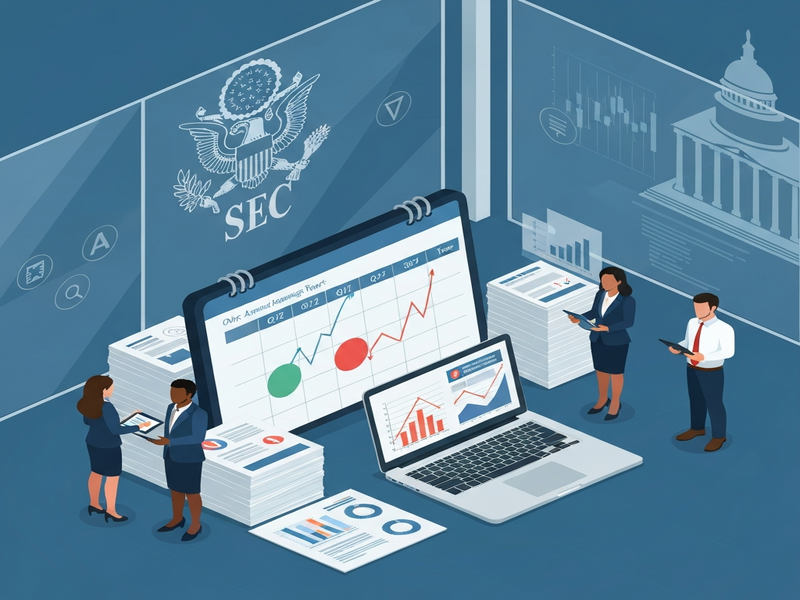
- Public companies would file Form 10‑Q (or an equivalent) twice a year instead of every three months.
- The proposal retains the annual Form 10‑K, preserving a full‑year snapshot for shareholders.
- Companies could still opt for quarterly reporting if they believe it adds market value.
- The SEC plans a 60‑day public comment period followed by a formal rule‑making vote.
The move mirrors regulatory changes already implemented in the European Union and the United Kingdom, where
mandatory quarterly filings were abandoned a decade ago. Those markets now rely on semi‑annual disclosures as the
default, while many firms voluntarily continue quarterly updates.
Implications for Companies and Investors
Cost and Resource Savings
Preparing quarterly reports demands significant finance‑team bandwidth, external auditor time, and legal review.
A semi‑annual cadence could cut these expenses by an estimated 30‑40%, freeing resources for product development
and strategic initiatives.
Impact on IPO Timing
One argument for the change is that the quarterly burden discourages private firms from going public. By reducing
reporting frequency, the SEC hopes to lower the “cost of being public,” potentially accelerating IPO pipelines,
especially for high‑growth startups that currently stay private to avoid the reporting grind.
Investor Information Flow
Critics warn that less frequent data could increase information asymmetry, making it harder for analysts to spot
emerging trends. However, modern data‑analytics platforms—such as the Enterprise AI platform by UBOS—can ingest alternative data sources,
providing near‑real‑time insights that may offset the reduced filing schedule.
Strategic Flexibility
Companies will retain the option to file quarterly if they believe it benefits their stock price or stakeholder
communication. This hybrid approach mirrors the flexibility seen in the EU, where firms can voluntarily adopt
quarterly updates.
How the U.S. Proposal Stacks Up Against EU and UK Rules
| Region | Default Reporting Frequency | Optional Quarterly Reporting |
|---|---|---|
| United States (proposed) | Semi‑annual | Yes |
| European Union | Semi‑annual | Yes |
| United Kingdom | Semi‑annual | Yes |
The EU and UK models have demonstrated that markets can thrive without mandatory quarterly filings. Companies
such as Siemens and Unilever continue to issue quarterly updates voluntarily, but the baseline requirement is
semi‑annual, reducing regulatory overhead while preserving investor confidence.
Potential Benefits and Criticisms
Benefits
- Reduced compliance costs for public companies.
- Lower risk of “earnings‑management” manipulation driven by short‑term pressure.
- Greater focus on long‑term strategic initiatives.
- Potential acceleration of IPO activity among high‑growth startups.
- Alignment with global best practices, simplifying cross‑border reporting.
Criticisms
- Investors may receive less timely information, increasing uncertainty.
- Analysts could rely more heavily on non‑GAAP metrics, which vary in quality.
- Potential for reduced market liquidity if earnings surprises become less frequent.
- Smaller firms might still face high fixed costs for the semi‑annual filing process.
What Should You Do Next?
Whether you are an investor tracking earnings trends or a CFO preparing for a possible rule change, staying
ahead of the regulatory curve is essential. Leverage modern AI‑driven analytics to supplement the reduced
reporting cadence and keep your decision‑making sharp.
Explore how the UBOS platform overview
can integrate alternative data feeds, automate workflow creation with the
Workflow automation studio,
and accelerate app development using the Web app editor on UBOS.
If you’re a startup eyeing an IPO, consider the UBOS for startups
program, which offers templates like the
AI SEO Analyzer and the
AI Article Copywriter to boost visibility while you prepare for public markets.
SMBs can benefit from the UBOS solutions for SMBs,
especially the AI Chatbot template and the
GPT‑Powered Telegram Bot, which streamline customer engagement without heavy reporting overhead.
For enterprises seeking deeper AI integration, the
Enterprise AI platform by UBOS
offers advanced modules such as the
OpenAI ChatGPT integration,
Chroma DB integration,
and the ElevenLabs AI voice integration.
Ready to explore AI‑enhanced financial analysis? Try the
AI Video Generator for dynamic earnings briefings, or the
AI YouTube Comment Analysis tool to gauge market sentiment.
Stay informed, adapt your reporting strategy, and leverage AI tools to maintain a competitive edge in the evolving
regulatory landscape.
Andrii Bidochko
CTO UBOS
Andrii Bidochko is an AI entrepreneur and researcher focused on AI agents, reinforcement learning, and autonomous systems. He writes about the technologies shaping the future of machine intelligence, from frontier models and agent architectures to real-world AI applications.