

- Updated: February 23, 2026
- 5 min read
Waymo vs Tesla: Who Leads the Autonomous Driving Race?
Waymo vs Tesla: The Autonomous Driving Showdown in 2026
Answer: Waymo is already delivering fully driverless rides in mapped cities, whereas Tesla relies on a camera‑only, vision‑first strategy that scales across millions of consumer vehicles but has yet to achieve true Level 5 autonomy.
The rivalry between Waymo and Tesla has become the headline act of the autonomous‑driving arena, drawing the attention of tech enthusiasts, investors, and automotive professionals alike. For a deep dive into the original analysis, see the Neural Foundry Substack post that sparked this conversation.
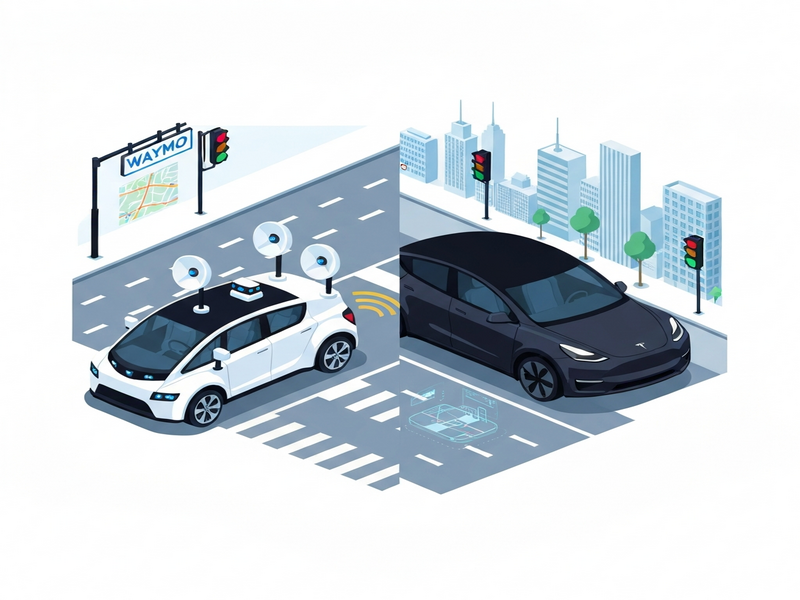
Waymo’s Sensor‑Heavy, Mapped‑City Strategy
Waymo builds its autonomous stack around a dense sensor suite: high‑resolution LiDAR, radar, and a suite of cameras. This hardware redundancy creates a 360° perception field that can detect objects at ranges beyond 200 meters, even in adverse weather.
Key components of Waymo’s approach include:
- High‑definition maps: Pre‑scanned city blocks with centimeter‑level accuracy.
- Sensor fusion algorithms: Real‑time merging of LiDAR point clouds, radar returns, and visual data.
- Safety‑first software layers: Redundant decision‑making pipelines that can hand over control to a remote operator if needed.
Because the system operates within a geofenced environment, Waymo can guarantee a consistent performance baseline, which translates into a lower disengagement rate—currently under 0.02 % per mile in Phoenix and San Francisco.
For companies looking to replicate such a data‑intensive architecture, the UBOS platform overview offers a modular AI stack that supports sensor data ingestion, real‑time analytics, and secure model deployment.
Tesla’s Camera‑Only, Scalable Vision Strategy
Tesla’s Autopilot and Full Self‑Driving (FSD) software relies exclusively on a suite of eight surround cameras, a forward‑facing radar (phased out in 2023), and a powerful onboard GPU. The company’s philosophy is simple: “vision is enough.”
Advantages of this approach:
- Cost efficiency: Eliminates expensive LiDAR hardware, keeping vehicle price competitive.
- Massive data pool: Over 3 billion miles of real‑world driving data collected from the Tesla fleet.
- Rapid iteration: OTA updates allow Tesla to push new neural‑network models to every car instantly.
However, the camera‑only model faces challenges in low‑light conditions, adverse weather, and complex urban scenarios where depth perception is critical. Tesla’s current FSD beta still requires driver supervision, and regulatory approval for Level 5 autonomy remains pending.
Developers interested in building vision‑centric AI can explore the OpenAI ChatGPT integration, which provides a powerful language‑vision model for interpreting visual data.
Head‑to‑Head: Technology, Safety, and Market Traction
Technology Stack
| Aspect | Waymo | Tesla |
|---|---|---|
| Sensors | LiDAR + Radar + 360° Cameras | 8 Cameras (no LiDAR) |
| Mapping | HD pre‑mapped city blocks | Dynamic map built from fleet data |
| AI Model | Hybrid perception + rule‑based planning | End‑to‑end neural network |
Safety Record
Waymo’s safety metrics are publicly audited. In 2025, the company reported a disengagement rate of 0.018 % per mile, the lowest among commercial pilots. Tesla’s FSD beta, by contrast, shows a disengagement rate of roughly 0.12 % per mile, with several high‑profile incidents reported in 2025.
Market Traction
Waymo operates a paid robotaxi service in Phoenix and San Francisco, serving over 150,000 rides in 2025. Tesla’s advantage lies in its massive installed base—over 2 million vehicles with Autopilot hardware—providing a ready platform for future upgrades.
Businesses looking to capitalize on the data generated by autonomous fleets can leverage AI marketing agents to personalize outreach based on real‑time mobility patterns.
Implications for the Autonomous‑Driving Market and Investors
Investors must weigh two distinct risk‑reward profiles:
- Waymo’s “premium” model: Higher upfront CAPEX for sensors and mapping, but a clear path to regulated, revenue‑generating robotaxi services.
- Tesla’s “scale‑first” model: Lower hardware costs and a massive addressable market, yet regulatory uncertainty and safety concerns could delay full autonomy.
Recent fund flows illustrate this split. In Q4 2025, Waymo secured $1.2 billion in Series D financing, earmarked for expanding its city coverage. Tesla’s stock, while volatile, continues to attract growth‑oriented capital betting on the eventual rollout of Level 5 across its fleet.
Startups aiming to enter the autonomous‑vehicle ecosystem can accelerate development through the UBOS partner program, which offers co‑selling, technical support, and access to pre‑built AI modules.
Future Outlook and Concluding Thoughts
By 2028, both companies are expected to converge on a hybrid model: Waymo may adopt more cost‑effective camera arrays for peripheral sensing, while Tesla could integrate selective LiDAR to bolster depth perception. The ultimate winner will likely be the firm that balances safety, scalability, and regulatory compliance.
For readers who want to experiment with autonomous‑driving concepts, the UBOS templates for quick start include a “Self‑Driving Simulation” kit that integrates sensor data pipelines with AI decision engines.
Take Action: Explore UBOS Solutions for Autonomous Innovation
Whether you’re a developer, a startup founder, or an investor, UBOS provides the tools to prototype, test, and launch AI‑driven mobility solutions.
- Visit the UBOS homepage for a full product catalog.
- Check out the Enterprise AI platform by UBOS for large‑scale deployments.
- Explore the Web app editor on UBOS to build custom dashboards for fleet monitoring.
- Automate data pipelines with the Workflow automation studio.
- Leverage the UBOS pricing plans to find a tier that matches your budget.
- Get inspiration from the UBOS portfolio examples of AI‑powered products.
- For early‑stage innovators, the UBOS for startups page outlines special support programs.
- SMBs can benefit from the UBOS solutions for SMBs, which include pre‑configured AI modules.
Ready to accelerate your autonomous‑driving projects? Dive into the AI SEO Analyzer to ensure your product pages rank as high as Waymo’s robotaxi listings. Or try the AI Article Copywriter to generate technical documentation at scale.
Stay ahead of the curve—subscribe to our newsletter, explore the AI Video Generator for dynamic demos, and watch the autonomous future unfold.
Andrii Bidochko
CTO UBOS
Andrii Bidochko is an AI entrepreneur and researcher focused on AI agents, reinforcement learning, and autonomous systems. He writes about the technologies shaping the future of machine intelligence, from frontier models and agent architectures to real-world AI applications.