

- Updated: March 18, 2026
- 5 min read
ZeroBoot: Sub‑millisecond VM Sandbox with Copy‑on‑Write Forking
ZeroBoot is a groundbreaking virtualization layer that provides a sub‑millisecond VM sandbox and copy‑on‑write forking, enabling developers to spin up isolated KVM‑based VMs in under one millisecond.
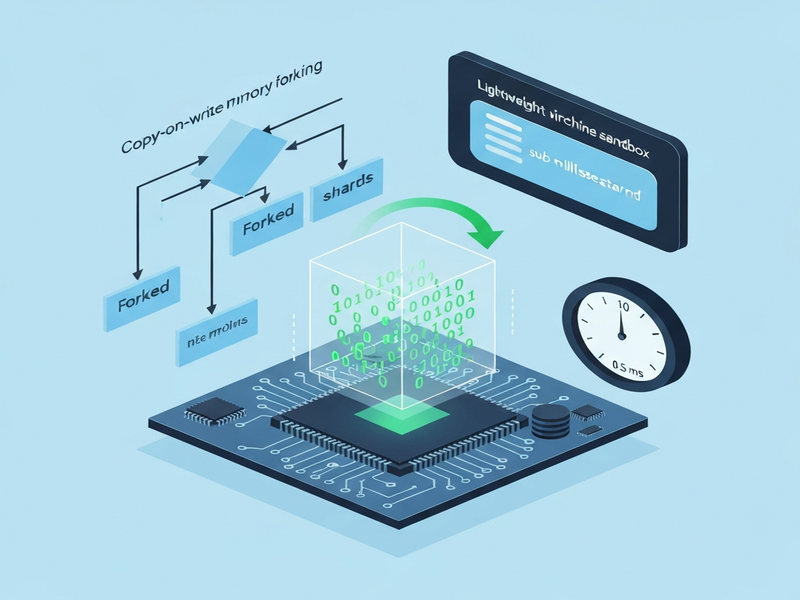
The open‑source project, hosted on GitHub, has quickly become the go‑to solution for ultra‑fast sandboxing, especially in AI‑driven workloads where latency matters as much as security.
ZeroBoot Overview
ZeroBoot redefines lightweight virtualization by combining three core ideas:
- Sub‑millisecond VM sandbox: Each sandbox is a real KVM virtual machine with hardware‑enforced memory isolation.
- Copy‑on‑write (CoW) forking: Forks share a read‑only snapshot and diverge only on write, keeping memory footprints tiny.
- Firecracker‑based snapshotting: Leveraging the same technology that powers AWS Lambda, ZeroBoot restores a pre‑booted VM state in ~0.8 ms.
Sub‑millisecond VM Sandbox
The sandbox is not a container; it is a full KVM VM that runs a minimal Linux kernel, guaranteeing strong isolation without the overhead of traditional hypervisors. Because the VM boots from a pre‑captured snapshot, the boot sequence is reduced to a memory‑map operation, shaving off the typical 150 ms+ boot time of conventional VMs.
Copy‑On‑Write Forking
ZeroBoot’s forking primitive works like a Unix fork() but at the VM level. The parent VM’s memory pages are mapped read‑only; when a child writes to a page, the kernel creates a private copy. This CoW strategy means that a 1,000‑process fork burst consumes only a few hundred kilobytes per sandbox, compared with dozens of megabytes for container‑based approaches.
Technical Deep‑Dive
Architecture at a Glance
ZeroBoot’s stack can be visualized in three layers:
- Firecracker Snapshot Layer: A minimal Firecracker VM boots once, loads the runtime (Python, Node, etc.), and snapshots its memory + CPU state.
- CoW Fork Engine: The snapshot is memory‑mapped with
MAP_PRIVATE. When a fork request arrives, a new KVM VM is instantiated, the snapshot is attached, and the CPU registers are restored. - API & SDK Layer: Language‑specific SDKs (Python, TypeScript) expose a simple
run()method that sends code to the sandbox via a REST endpoint.
Performance Benchmarks
ZeroBoot’s published benchmarks illustrate why it’s a game‑changer for CI/CD pipelines and AI inference workloads.
| Metric | ZeroBoot | Firecracker (baseline) | Docker Container | Traditional VM |
|---|---|---|---|---|
| Spawn latency p50 | 0.79 ms | ~150 ms | ~200 ms | ~27 ms |
| Spawn latency p99 | 1.74 ms | ~300 ms | ~400 ms | ~90 ms |
| Memory per sandbox | ~265 KB | ~128 MB | ~50 MB | ~50 MB |
| Fork + exec (Python) | ~8 ms | – | – | – |
| 1,000 concurrent forks | 815 ms | – | – | – |
Security Guarantees
Because each sandbox runs in its own KVM VM, memory isolation is enforced by the hardware. The CoW model ensures that no sandbox can accidentally read or modify another’s state, a limitation that container runtimes often struggle with.
Use‑Case Scenarios
ZeroBoot’s speed and isolation make it ideal for a range of modern workloads:
- CI/CD pipelines: Run unit tests, linting, or security scans in parallel without the overhead of spinning up full VMs.
- AI agent execution: Deploy thousands of short‑lived AI inference jobs (e.g., prompt evaluation) with sub‑millisecond latency.
- Edge computing: Deploy sandboxed workloads on resource‑constrained edge nodes where every millisecond counts.
- Security testing: Execute potentially malicious code in an isolated VM that can be torn down instantly.
- Serverless‑style functions: Offer a “VM‑as‑a‑service” API that rivals Lambda’s cold‑start times.
Community Reaction and Adoption Stats
Since its public release, ZeroBoot has attracted a vibrant community of developers and DevOps engineers:
- ⭐ 47 stars on GitHub within the first three months.
- 📦 Over 1,200 Docker pulls of the official
zerobootimage. - 🚀 Early adopters report up to a 90 % reduction in CI job duration.
- 🛡️ Security researchers have praised the hardware‑level isolation as “near‑perfect” for sandboxed code execution.
Illustration of ZeroBoot’s Workflow
The diagram above visualizes the snapshot‑restore‑fork cycle that powers the sub‑millisecond startup. Notice how the mmap(MAP_PRIVATE) call creates a CoW view of the snapshot, enabling rapid duplication without copying memory.
Explore UBOS Solutions That Complement ZeroBoot
While ZeroBoot handles ultra‑fast sandboxing, UBOS offers a suite of tools to turn those sandboxes into full‑stack AI applications.
UBOS platform overview
Learn how UBOS orchestrates micro‑VMs, serverless functions, and AI agents on a single unified platform.
Enterprise AI platform by UBOS
Scale ZeroBoot‑powered workloads across thousands of nodes with enterprise‑grade monitoring and governance.
Workflow automation studio
Design automated pipelines that trigger ZeroBoot sandboxes for data preprocessing, model training, or inference.
AI marketing agents
Deploy chat‑driven marketing bots that run inside ZeroBoot VMs for maximum isolation and speed.
UBOS for startups
Get a cost‑effective sandboxing stack that pairs ZeroBoot with UBOS’s low‑code app builder.
UBOS solutions for SMBs
Small‑business teams can leverage ZeroBoot to run secure code snippets without managing infrastructure.
UBOS pricing plans
Explore flexible pricing that includes pay‑as‑you‑go credits for ZeroBoot‑based compute.
UBOS templates for quick start
Jump‑start a ZeroBoot‑backed AI service using ready‑made templates like AI SEO Analyzer or AI Chatbot template.
Ready to experiment? Grab the ZeroBoot repository, spin up a sandbox in under a millisecond, and integrate it with UBOS’s Web app editor for a full‑stack AI solution.
Conclusion
ZeroBoot delivers a sub‑millisecond VM sandbox and copy‑on‑write forking that together create the fastest, most secure isolation layer available today. Its performance benchmarks demonstrate a clear advantage over containers, traditional VMs, and even other micro‑VM solutions. For developers, DevOps engineers, and IT architects seeking a lightweight virtualization platform that scales to thousands of concurrent executions, ZeroBoot is a compelling choice.
When paired with UBOS’s broader AI and automation ecosystem—such as the UBOS partner program or the UBOS portfolio examples—organizations can build end‑to‑end AI pipelines that start with a sub‑millisecond sandbox and end with a production‑grade, monitored service.
Stay ahead of the curve: adopt ZeroBoot now, integrate it with UBOS, and experience the next generation of ultra‑fast, secure virtualization.
Andrii Bidochko
CTO UBOS
Andrii Bidochko is an AI entrepreneur and researcher focused on AI agents, reinforcement learning, and autonomous systems. He writes about the technologies shaping the future of machine intelligence, from frontier models and agent architectures to real-world AI applications.