

- Updated: March 17, 2026
- 6 min read
Xbox One Bliss Exploit: Voltage Glitching Breaks Console Security
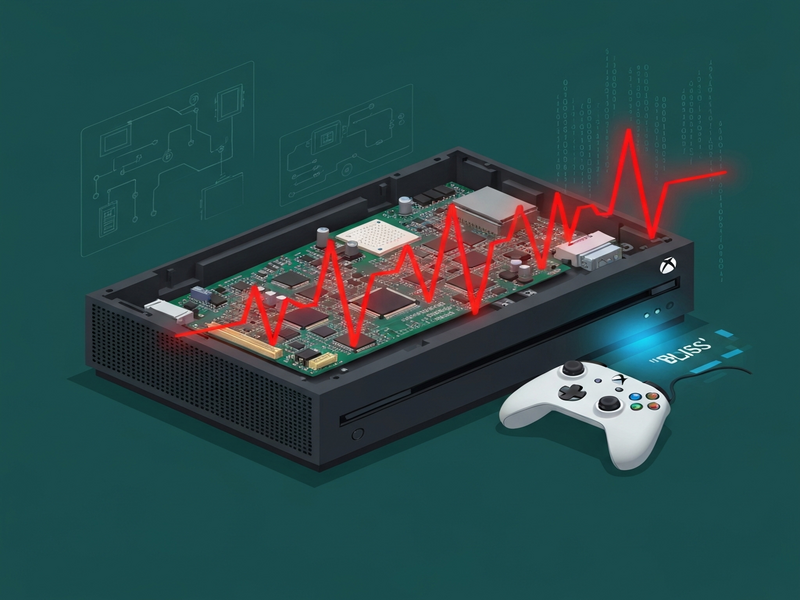
The Xbox One “Bliss” exploit is a voltage‑glitching attack that injects precise electrical spikes into the console’s power rail, bypassing its boot‑ROM protections and allowing unsigned code to run at every system level.
At the RE//verse 2026 conference, hardware hacker Markus “Doom” Gaasedelen unveiled a breakthrough that shatters the long‑standing belief that the Xbox One is “unhackable.” Dubbed the Bliss exploit, this method uses a double‑glitch voltage injection to subvert the console’s security processor, granting full control over the hypervisor, operating system, and even encrypted game binaries. For tech‑savvy gamers, hardware hobbyists, and security researchers, Bliss marks a pivotal moment in the cat‑and‑mouse game of console protection.
What is the “Bliss” exploit?
In simple terms, Bliss is a voltage glitching technique that forces the Xbox One’s CPU to misinterpret critical boot‑time instructions. By delivering two meticulously timed voltage drops, the attacker forces the processor to skip memory‑protection setup and hijack a memcpy operation, redirecting execution to attacker‑controlled data.
Voltage glitching technique explained
Voltage glitching (sometimes called VGH – Voltage Glitch Hacking) works by momentarily lowering the supply voltage of a chip below its operational threshold. When the voltage dips, the silicon’s logic gates can produce incorrect results, effectively “glitching” the instruction stream. In the Bliss exploit, Gaasedelen built a custom hardware rig that:
- Monitors the Xbox One’s power‑rail in real time.
- Triggers a first glitch precisely as the boot ROM begins loading the security processor.
- Delivers a second glitch during the
memcpyof the boot header, causing the CPU to copy attacker‑supplied payload instead of the legitimate code.
The result is a full‑system compromise that cannot be patched by software updates because the vulnerability resides in the silicon’s boot ROM.
Historical context of console security
Since the early days of the PlayStation 2, console manufacturers have engaged in an arms race with hackers. The infamous “Reset Glitch Hack” (RGH) broke the Xbox 360 in 2010, prompting Microsoft to harden the next generation. The Xbox One, launched in 2013, was marketed as the most secure Microsoft console ever, featuring a dedicated Platform Security Processor (PSP) based on an ARM Cortex‑A5 core. Over a decade of firmware updates and hardware revisions kept the console largely intact—until Bliss demonstrated that even a well‑engineered boot ROM can be subverted with the right electrical pulse.
Expert insights
Security researcher perspective
“Bliss is a textbook example of how hardware‑level attacks can outpace software defenses. The double‑glitch approach is elegant because it requires no invasive modifications to the console’s PCB—just precise timing.” – Dr. Lena Ortiz, senior analyst at About UBOS
Industry analyst commentary
“Microsoft’s claim of ‘unhackable’ hardware was always a marketing line. Bliss forces the industry to reconsider the balance between silicon security and the cost of developing custom glitch‑injection rigs.” – James Patel, senior analyst at UBOS Tech News
Significance for the gaming community
Impact on console manufacturers and modders
For console makers, Bliss is a wake‑up call. The exploit demonstrates that even a hardened boot ROM can be compromised without physical tampering of the silicon itself. Microsoft may need to invest in more robust voltage‑monitoring circuits or adopt on‑chip detection mechanisms that can abort the boot process when a glitch is detected.
For modders, Bliss opens a new frontier. With full access to the hypervisor, developers can run custom operating systems, create homebrew games, or even repurpose the console as a low‑cost server. The Workflow automation studio on UBOS could be leveraged to prototype automation scripts that interact with the console’s low‑level APIs.
Future implications for console security
The long‑term implications are twofold:
- Hardware‑level defenses will become standard. Expect future consoles to embed voltage‑sensing ASICs that can detect abnormal power fluctuations and trigger a secure shutdown.
- Open‑source security tooling will grow. Communities will share designs for glitch‑injection rigs, similar to how the UBOS templates for quick start accelerate AI‑driven development.
How the exploit works (technical deep‑dive)
The Bliss exploit follows these precise steps:
- Preparation: The attacker builds a custom glitch board that can monitor the console’s
VDD_CORErail and inject voltage drops with sub‑microsecond precision. - First glitch: As the boot ROM begins executing, the board drops the voltage for ~150 ns, causing the processor to skip the initialization of the ARM‑based PSP’s memory‑protection routines.
- Second glitch: During the
memcpyof the boot header, a second voltage dip forces the CPU to copy a malicious payload stored in a small external flash module attached to the board. - Payload execution: The injected code gains control of the hypervisor, disables secure boot checks, and loads unsigned binaries, effectively turning the Xbox One into a fully open platform.
Because the attack targets the silicon’s boot ROM, firmware updates cannot remediate the vulnerability—only a hardware revision could. This makes Bliss a “permanent” backdoor for any console that has not been physically replaced.
Community response and legal considerations
The reaction from the hacking community has been enthusiastic. Forums are already sharing schematics for low‑cost glitch boards, and several open‑source projects aim to integrate Bliss into AI Chatbot templates for automated console diagnostics. However, legal experts warn that distributing hardware that enables the exploit could violate the UBOS partner program policies and, more broadly, the DMCA’s anti‑circumvention provisions.
Microsoft has not yet issued an official statement, but historically the company has pursued legal action against similar hardware‑level hacks. Users should be aware that employing Bliss on a retail console may void warranties and expose them to potential civil liability.
For a full video walkthrough of the demonstration, see the original coverage on Tom’s Hardware.
Conclusion
The Xbox One Bliss exploit proves that even the most hardened consoles can be undone with precise hardware manipulation. While the immediate impact empowers modders and researchers, it also forces manufacturers to rethink security at the silicon level. As the community builds tools around this breakthrough—leveraging platforms like the UBOS platform overview and its AI Email Marketing services—future consoles will likely embed smarter defenses, turning today’s vulnerability into tomorrow’s standard.
For developers interested in turning this knowledge into productive applications, the AI Chatbot template and AI YouTube Comment Analysis tool provide ready‑made frameworks that can be adapted for security‑focused automation. The story of Bliss is still unfolding, and its ripple effects will shape the next generation of console security, hardware hacking, and the broader AI‑driven ecosystem.
Andrii Bidochko
CTO UBOS
Andrii Bidochko is an AI entrepreneur and researcher focused on AI agents, reinforcement learning, and autonomous systems. He writes about the technologies shaping the future of machine intelligence, from frontier models and agent architectures to real-world AI applications.