

- Updated: February 19, 2026
- 6 min read
Why Elixir/BEAM Is the Ideal Foundation for AI Agent Orchestrators
Why the BEAM Runtime Is the Secret Weapon for Modern AI Agent Orchestrators
The BEAM virtual machine, the heart of Elixir and Erlang, provides built‑in lightweight processes, pre‑emptive scheduling, fault‑tolerant supervision trees, hot code swapping, and seamless distributed communication—features that make it the most reliable foundation for AI agent orchestration today.
If you’ve ever tried to scale a chatbot or a multi‑agent workflow with Python’s asyncio or Node.js’s event loop, you know the pain of “one‑thread‑to‑rule‑them‑all” bottlenecks, fragile error handling, and painful deployments. A recent industry analysis titled
“Your Agent Framework Is Just a Bad Clone of Elixir”
highlighted exactly these shortcomings and reminded us why telecom engineers built the BEAM 40 years ago to handle millions of concurrent phone calls with five‑nines uptime. This article distills those lessons for AI developers and product managers who are building the next generation of AI agents.
Key Takeaways from the Original Analysis
- The actor model introduced by Erlang in 1986 is the exact abstraction AI agents need today.
- Traditional web frameworks (Rails, Django, Laravel) assume sub‑100 ms request cycles, while AI agents often hold connections for 5‑30 seconds.
- BEAM processes are ~2 KB, can be spawned by the millions, and are pre‑emptively scheduled, eliminating CPU starvation.
- Supervision trees enable “let it crash” philosophy, automatically restarting failed agents without affecting others.
- Hot code swapping lets you update agent logic without dropping active sessions.
- Other runtimes (Node.js, Python) replicate parts of this model but miss critical runtime guarantees such as per‑process garbage collection and built‑in distribution.
Elixir/BEAM vs. Node.js & Python: A Technical Comparison
BEAM (Elixir/Erlang)
- Lightweight processes: ~2 KB each, millions can run concurrently.
- Pre‑emptive scheduling: Every 4 000 reductions a process yields, preventing CPU hogs.
- Isolation: Crashes are confined to the offending process.
- Per‑process GC: Incremental, stop‑the‑world pauses are negligible.
- Built‑in distribution: Nodes communicate transparently across machines.
- Hot code swapping: Deploy new logic without dropping connections.
Node.js & Python (Asyncio)
- Single‑threaded event loop: CPU‑intensive tasks block all agents.
- Cooperative scheduling: A misbehaving coroutine can starve others.
- Shared memory: One uncaught exception can crash the whole process.
- Global GC pauses: Stop‑the‑world can stall thousands of connections.
- External clustering: Requires Redis, RabbitMQ, or custom solutions for distribution.
- No hot swapping: Code updates typically require a restart, dropping sessions.
Why AI Agents Thrive on the BEAM
AI agents are inherently stateful, long‑running, and error‑prone. The BEAM’s design aligns perfectly with these characteristics:
- Message‑Driven Architecture: Agents communicate via immutable messages, mirroring LLM prompt/response cycles.
- Supervision Trees for Reliability: A failed LLM call simply crashes its process; the supervisor restarts it, preserving overall system health.
- Hot Code Reloading: When you refine prompts or add a new tool, you push the change instantly—no user‑visible downtime.
- Scalable Real‑Time Connections: Phoenix Channels (the web layer of Elixir) can sustain >100 k concurrent WebSocket connections, ideal for chat‑based agents.
- Distributed Agent Networks: Built‑in node clustering lets you spread workloads across a fleet without extra orchestration layers.
What the Header Image Shows
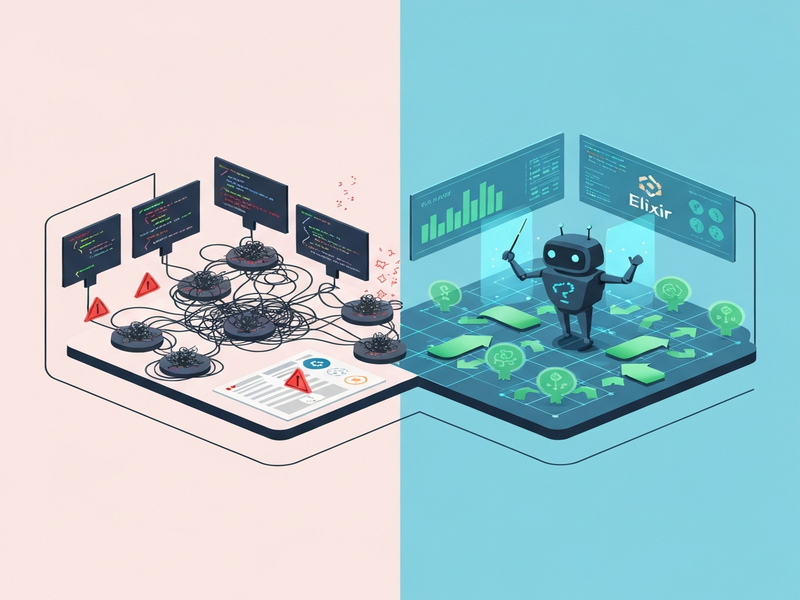
The illustration above visualizes a cluster of BEAM processes (tiny circles) handling independent AI conversations. Each circle represents an isolated agent that can crash, restart, and receive live code updates—all while staying connected to the same user through a persistent WebSocket channel.
How UBOS Leverages the BEAM for AI Innovation
UBOS builds its entire AI stack on top of the BEAM, offering developers a ready‑made ecosystem for agent orchestration, data pipelines, and UI integration.
- Explore the UBOS platform overview to see how the runtime is abstracted for rapid development.
- Start fast with UBOS templates for quick start, including pre‑configured agent pipelines.
- For startups, the UBOS for startups program provides credits and dedicated support.
- SMBs can benefit from UBOS solutions for SMBs, which bundle AI marketing agents and workflow automation.
- Enterprise teams looking for scale should review the Enterprise AI platform by UBOS.
- Design interactive front‑ends with the Web app editor on UBOS.
- Automate complex sequences using the Workflow automation studio.
- Learn how AI agents can boost your marketing funnel via AI marketing agents.
- Join the UBOS partner program to co‑sell AI solutions built on the BEAM.
- Check out real‑world implementations in the UBOS portfolio examples.
- Need pricing details? The UBOS pricing plans are transparent and usage‑based.
Ready‑Made Templates That Harness BEAM Power
UBOS’s marketplace offers dozens of plug‑and‑play AI apps that already run on the BEAM, letting you focus on business logic instead of infrastructure.
Fault Tolerance: Let‑It‑Crash in Action
Consider a customer‑support agent that calls an LLM, then a third‑party knowledge base. If the knowledge‑base request times out, the process crashes. The supervisor instantly restarts it, preserving the conversation context in a lightweight ETS table. The user never notices a hiccup.
defmodule SupportAgent do
  use GenServer

  def handle_call({:query, msg}, _from, state) do
    # LLM call – may raise
    answer = LLM.chat(msg)
    # Knowledge‑base call – may raise
    kb = KnowledgeBase.fetch(answer)
    {:reply, kb, state}
  end
end

defmodule AgentSupervisor do
  use Supervisor
  def init(_) do
    children = [{SupportAgent, name: :support_agent}]
    Supervisor.init(children, strategy: :one_for_one)
  end
end
The code above contains no try/catch. The BEAM handles any crash, restarts the SupportAgent, and the rest of the system stays alive.
Zero‑Downtime Updates with Hot Code Swapping
Suppose you discover that a prompt needs a new instruction. Deploy the new module version; existing processes finish their current turn with the old code, then automatically switch to the new version on the next message. No reload, no lost sessions.
“You can’t ask a million callers to hold while you push a software update. The BEAM lets you do exactly that for AI agents.” – George Guimarães
Take the Next Step with UBOS
The convergence of AI and the actor model is no coincidence; it’s a proven engineering pattern that has powered telecom for four decades. By adopting the BEAM through UBOS, you inherit battle‑tested concurrency, fault tolerance, and hot‑swap capabilities without reinventing the wheel.
Ready to future‑proof your AI agent platform? Visit the UBOS homepage, explore the About UBOS page for our mission, and start a free trial today. Your agents deserve a runtime that can keep up with their imagination.
Andrii Bidochko
CTO UBOS
Andrii Bidochko is an AI entrepreneur and researcher focused on AI agents, reinforcement learning, and autonomous systems. He writes about the technologies shaping the future of machine intelligence, from frontier models and agent architectures to real-world AI applications.