

- Updated: February 28, 2026
- 6 min read
Werld Project Unveils AI Agent Civilization – A New Frontier for Generative and Autonomous Agents
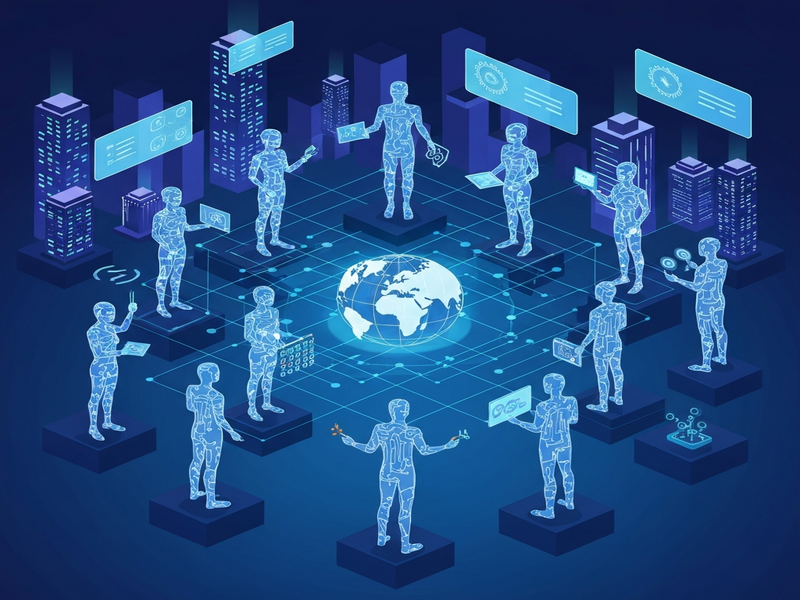
Werld is an open‑source, pure‑Python simulation that lets autonomous AI agents evolve on a small‑world graph, creating a living “agent civilization” without any cloud dependencies.
The project, now featured on Show HN, showcases cutting‑edge generative AI, NEAT‑style brains, and natural selection to explore how AI agents can self‑organize, communicate, and adapt in a fully local environment.
Project Overview: What Is Werld?
Werld was launched by nocodemf on GitHub as a sandbox for researchers and developers who want to experiment with autonomous agents in a controlled, reproducible setting. The core idea is simple yet powerful: drop a population of agents into a Watts‑Strogatz small‑world network and let evolution run its course.
The simulation runs entirely on the local machine—no cloud services, no API keys, no hidden costs. It uses only the Python standard library, making it instantly portable to any environment that supports Python 3.10+. A companion Next.js dashboard visualizes the ecosystem in real time, offering insights into population dynamics, brain complexity, and emergent social structures.
Key goals of Werld include:
- Demonstrate open‑ended evolution of AI agents without hard‑coded rules.
- Provide a testbed for generative AI research, especially neuro‑evolutionary approaches.
- Encourage community contributions that extend the agent “genome” and environmental parameters.
The Agent Civilization Concept
In Werld, each agent is a digital organism equipped with a genome that encodes a NEAT‑style neural network, sensory gains, and behavioral traits. Over successive generations, agents compete for resources, share information via pheromones, and adapt to seasonal changes.
This process mirrors a miniature civilization:
- Birth & Death: Agents are born from successful parents and removed when fitness drops below a threshold.
- Communication: Pheromone trails act as a primitive language, allowing agents to signal food sources or danger.
- Memory & Learning: Internal state variables let agents remember past actions, enabling rudimentary learning.
- Social Structures: Clusters of agents with similar genomes often form “tribes,” exhibiting emergent cooperation.
The term “agent civilization” captures this layered complexity—agents are not isolated bots; they form a dynamic, evolving society that can be observed, measured, and steered.
Technical Foundations: AI Agents, Generative AI, and Autonomous Agents
AI Agents Powered by NEAT
Each Werld agent houses a NEAT (NeuroEvolution of Augmenting Topologies) brain that can grow new connections, prune unused ones, and mutate activation functions. This neuro‑evolutionary approach is a hallmark of modern generative AI research, allowing the network architecture itself to evolve alongside weights.
Key attributes of the agents’ brains include:
- Dynamic topology: Networks start simple and become more complex as needed.
- Fitness‑driven selection: Agents with higher survival scores reproduce more often.
- Modular sensory inputs: Vision, pheromone detection, and internal state are all configurable.
Generative AI at the Core
Werld’s genome encodes not only the neural topology but also 29 distinct traits that influence behavior—ranging from sensory gain to motor speed. By treating these traits as a generative space, developers can experiment with “what‑if” scenarios without rewriting code.
Because the simulation is deterministic (given a random seed), researchers can reproduce experiments, a critical requirement for scientific rigor in generative AI studies.
Fully Autonomous Agents
Werld agents operate without any external controller. Their decision‑making loop runs locally, reading sensor data, feeding it through the evolving brain, and issuing actions such as movement, pheromone deposition, or reproduction. This autonomy mirrors the vision of autonomous agents that can adapt to changing environments without human intervention.
Because the entire stack is written in pure Python, developers can plug in custom modules—like a reinforcement‑learning wrapper or a language model—for hybrid experiments that blend neuro‑evolution with modern large‑model techniques.
Implications for the AI Community and Show HN Exposure
The release of Werld on Show HN sparked a lively discussion among AI developers, evolutionary biologists, and hobbyist programmers. The project’s open‑source nature invites rapid iteration and cross‑disciplinary collaboration.
Key takeaways for the community include:
- Reproducible Evolutionary Benchmarks: Researchers can now benchmark new neuro‑evolution algorithms against a shared baseline.
- Low‑Barrier Entry: Since Werld requires only the Python standard library, students can spin up a full agent civilization on a laptop in minutes.
- Bridge to Large‑Model Agents: The modular design makes it straightforward to replace the NEAT brain with a transformer‑based policy, opening pathways to hybrid AI agents that combine symbolic evolution with deep learning.
Show HN’s spotlight also amplified visibility, driving traffic to the GitHub repo and encouraging contributions ranging from new sensory modalities to visual dashboards. The buzz demonstrates that the AI community is hungry for platforms that let agents “live” and evolve, not just solve static benchmarks.
How Werld Stands Against Other Agent Platforms
Several frameworks claim to support multi‑agent simulations, but Werld differentiates itself on three fronts:
| Feature | Werld | OpenAI Gym / PettingZoo | Unity ML‑Agents |
|---|---|---|---|
| Local‑Only Execution | ✅ Pure‑Python, no cloud | ✅ Local, but often requires extra dependencies | ❌ Requires Unity runtime |
| Neuro‑Evolution Core | ✅ Built‑in NEAT brain | ❌ Primarily RL‑focused | ❌ No native neuro‑evolution |
| Visualization Dashboard | ✅ Next.js UI with real‑time metrics | ❌ Minimal UI, command‑line only | ✅ Rich 3D visualizer (but heavy) |
| Extensibility | ✅ Plug‑in genome traits, custom sensors | ✅ Flexible API, but less evolutionary focus | ✅ High‑fidelity graphics, steep learning curve |
For teams that prioritize rapid prototyping of autonomous agents and want a lightweight, evolution‑centric environment, Werld offers a uniquely balanced mix of simplicity and depth.
Why You Should Explore Werld Today
Werld is more than a curiosity; it is a practical sandbox for anyone building the next generation of AI agents. Whether you are a startup founder looking to prototype an autonomous customer‑service bot, a researcher testing new neuro‑evolution strategies, or a developer eager to blend generative AI with emergent behavior, Werld gives you a ready‑made ecosystem.
Ready to dive in? Start by cloning the repository, run python main.py, and open the dashboard to watch your agents evolve in real time. Then, consider extending the platform with UBOS tools to accelerate your AI product development:
- UBOS homepage – a one‑stop hub for AI‑powered SaaS solutions.
- UBOS platform overview – learn how to host, scale, and monitor AI services.
- AI marketing agents – turn your autonomous agents into revenue‑generating bots.
- UBOS partner program – collaborate with a network of AI innovators.
- Enterprise AI platform by UBOS – scale your agent civilization to millions of users.
- UBOS templates for quick start – bootstrap new AI projects in minutes.
- AI SEO Analyzer – ensure your AI‑driven content ranks high.
- AI Video Generator – create visual demos of your evolving agents.
- AI Chatbot template – integrate conversational interfaces with your agents.
- AI Image Generator – produce custom graphics for dashboards.
By combining Werld’s evolutionary sandbox with UBOS’s production‑grade AI infrastructure, you can move from experimental simulations to market‑ready autonomous agents faster than ever.
Take the first step: clone Werld, explore the agent civilization, and let your imagination drive the next wave of generative AI breakthroughs.
Andrii Bidochko
CTO UBOS
Andrii Bidochko is an AI entrepreneur and researcher focused on AI agents, reinforcement learning, and autonomous systems. He writes about the technologies shaping the future of machine intelligence, from frontier models and agent architectures to real-world AI applications.