

- Updated: January 30, 2026
- 6 min read
Waymo Under NTSB Investigation for Illegal School Bus Passings: Implications for Autonomous Vehicles
NTSB Probes Waymo for Illegal School‑Bus Passes – What It Means for Autonomous Vehicles
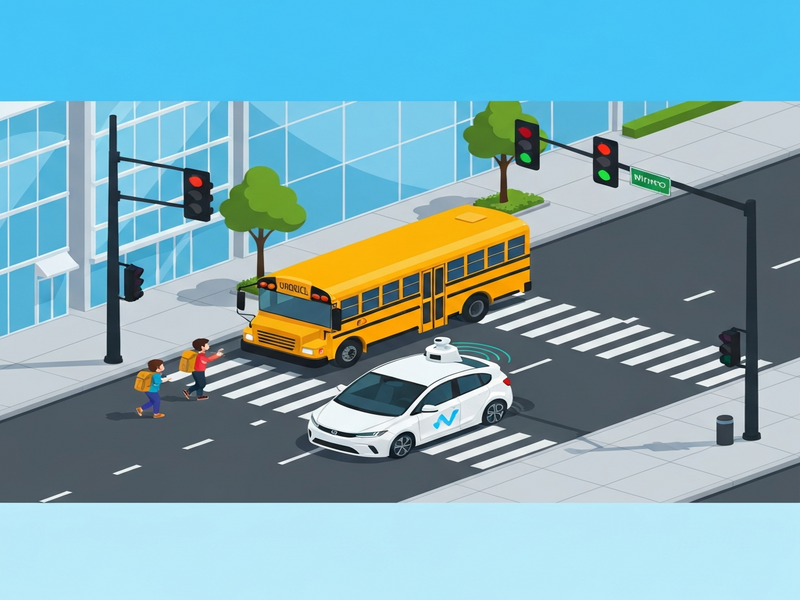
The U.S. National Transportation Safety Board (NTSB) has opened a formal investigation into Waymo after its driverless robotaxis were captured illegally passing stopped school buses in multiple states, raising fresh regulatory scrutiny for the autonomous‑vehicle industry.
The story broke on TechCrunch, which reported that the NTSB is focusing on more than 20 documented incidents, primarily in Austin, Texas, where Waymo’s robotaxis allegedly ignored flashing school‑bus lights and stop signs. This marks the first time the safety board has formally investigated Waymo, adding to an ongoing probe by the National Highway Traffic Safety Administration (NHTSA) that began in October 2025.
Why This Investigation Matters
School‑bus safety is a litmus test for any autonomous‑driving system because it involves complex visual cues, unpredictable pedestrian behavior, and strict legal obligations. An NTSB investigation signals that the issue has risen beyond routine compliance checks and now warrants a deep, independent safety analysis.
Details of the NTSB Investigation
Scope and Timeline
- Focus on >20 incidents captured between September 2024 and December 2025.
- Primary geographic focus: Austin, Texas, with additional reports from Atlanta, Georgia.
- Preliminary findings expected within 30 days; a comprehensive final report due in 12‑24 months.
Key Investigation Questions
- Did the Waymo Driver correctly interpret flashing red lights and stop-arm signals?
- What sensor data (LiDAR, camera, radar) was available at the moment of each alleged violation?
- Were software updates or configuration changes responsible for the failures?
- How does Waymo’s safety performance compare to human‑driver baselines in similar scenarios?
Investigation Process
NTSB investigators will travel to Austin to collect raw sensor logs, interview Waymo engineers, and review dash‑cam footage from both the robotaxis and the school buses. The board will also coordinate with the Texas Department of Transportation and local school districts to obtain additional eyewitness accounts.
“The NTSB’s mandate is to uncover root causes, not to assign blame. Our goal is to ensure that autonomous technology can safely coexist with vulnerable road users, especially children.” – NTSB spokesperson
Waymo’s Response and Historical Context
Official Statement
Waymo’s Chief Safety Officer, Mauricio Peña, emphasized that the company “has safely navigated thousands of school‑bus encounters weekly across the United States” and that “no collisions occurred in the reported events.” He framed the NTSB probe as an opportunity for transparency, pledging full cooperation and the release of detailed safety data.
Previous Safety Actions
This is not Waymo’s first brush with school‑bus safety. In October 2025, the NHTSA opened a defect investigation after similar incidents surfaced in Atlanta. Waymo responded with a software recall that adjusted the perception algorithm for stop‑arm detection. However, the recent Austin footage suggests that the fix did not fully address edge‑case scenarios.
Operational Footprint
Despite the controversy, Waymo continues to expand its robotaxi service to new markets, including Miami, Phoenix, and the San Francisco Bay Area. The company argues that its overall safety record remains superior to human drivers, citing internal metrics that show a 99.9% compliance rate for traffic signals and stop signs.
Impact on the Autonomous‑Vehicle Landscape
Regulatory Scrutiny Intensifies
The NTSB investigation adds pressure on federal and state regulators to tighten testing standards for autonomous systems. Lawmakers in Texas have already proposed legislation that would require real‑time reporting of any traffic‑law violations by driverless cars.
Industry Reaction
- Competitors: Companies like Cruise and Aurora have publicly reiterated their commitment to school‑bus safety, citing separate internal audits.
- Insurance: Underwriters are revisiting risk models for autonomous fleets, potentially raising premiums for companies with higher incident counts.
- Public Perception: Parents and advocacy groups are demanding clearer communication about how autonomous vehicles handle school‑bus scenarios.
Technological Implications
The incidents highlight a persistent challenge: reliably detecting and interpreting flashing red lights and stop‑arm extensions under varying lighting conditions. Researchers are accelerating work on multimodal sensor fusion, where LiDAR, radar, and high‑resolution cameras collaborate to create a more robust perception stack.
For developers building AI‑driven transport solutions, the Waymo case underscores the importance of rigorous simulation testing and real‑world validation. Platforms that streamline this workflow, such as the Workflow automation studio and the Web app editor on UBOS, can accelerate safety‑critical iteration cycles.
How UBOS Supports the Future of Safe Autonomous Transport
Companies navigating the evolving regulatory landscape can leverage UBOS’s suite of AI tools to build, test, and deploy compliant autonomous solutions. Below are key resources that align with the challenges highlighted by the NTSB probe.
- UBOS AI vehicles – A modular framework for integrating advanced perception stacks, including LiDAR‑camera fusion, into any autonomous platform.
- Autonomous transport solutions – End‑to‑end pipelines that cover route planning, safety validation, and real‑time compliance reporting.
- UBOS platform overview – Learn how the low‑code environment accelerates AI model deployment while maintaining audit trails required by regulators.
- Enterprise AI platform by UBOS – Scalable infrastructure for large fleets, offering centralized monitoring of sensor health and incident logging.
- UBOS AI vehicles (used again for emphasis on vehicle‑level safety features).
- UBOS partner program – Collaborate with UBOS to co‑develop safety‑critical modules and gain early access to compliance‑ready components.
- AI marketing agents – While not directly related to safety, these agents can help communicate safety milestones to the public and regulators.
- UBOS pricing plans – Transparent pricing models that scale with fleet size, ensuring cost‑effective compliance.
- UBOS portfolio examples – Case studies of companies that have successfully integrated safety‑first AI into autonomous fleets.
- UBOS templates for quick start – Pre‑built templates for sensor data pipelines, incident reporting dashboards, and regulatory audit logs.
By leveraging these resources, autonomous‑vehicle developers can reduce time‑to‑market while embedding the rigorous safety checks that regulators like the NTSB now demand.
Conclusion
The NTSB’s investigation into Waymo’s school‑bus violations serves as a watershed moment for the autonomous‑vehicle sector. It underscores that even industry leaders must continuously refine perception algorithms, maintain transparent safety reporting, and engage proactively with regulators. As the industry evolves, platforms such as UBOS that provide modular, audit‑ready AI components will become essential allies in meeting the heightened safety expectations.
Stakeholders—from fleet operators to policymakers—should monitor the forthcoming NTSB reports closely. The findings will likely shape future federal guidelines, influence insurance underwriting, and set new benchmarks for what constitutes “safe” autonomous driving around our most vulnerable road users.