

- Updated: March 29, 2026
- 5 min read
UK Electric Cars: Road to Electric – Accelerating EV Adoption
The United Kingdom is on a fast‑track to electric mobility, with more than 2.2 million zero‑emission vehicles already on the road and the number of public charging points expected to exceed 50 000 by the end of 2026, according to the RAC “Road to Electric” guide.
The UK government’s 2030 ban on new petrol and diesel cars, combined with a legally binding Zero‑Emission Vehicle (ZEV) mandate, has turned electric cars from a niche choice into a mainstream necessity. Tech‑savvy motorists aged 25‑45 are leading the charge, attracted by lower running costs, cleaner air, and a growing network of fast chargers. This article distils the latest RAC data, highlights the real‑world benefits and hurdles for drivers, and shows how the RAC’s specialised services can smooth the transition.
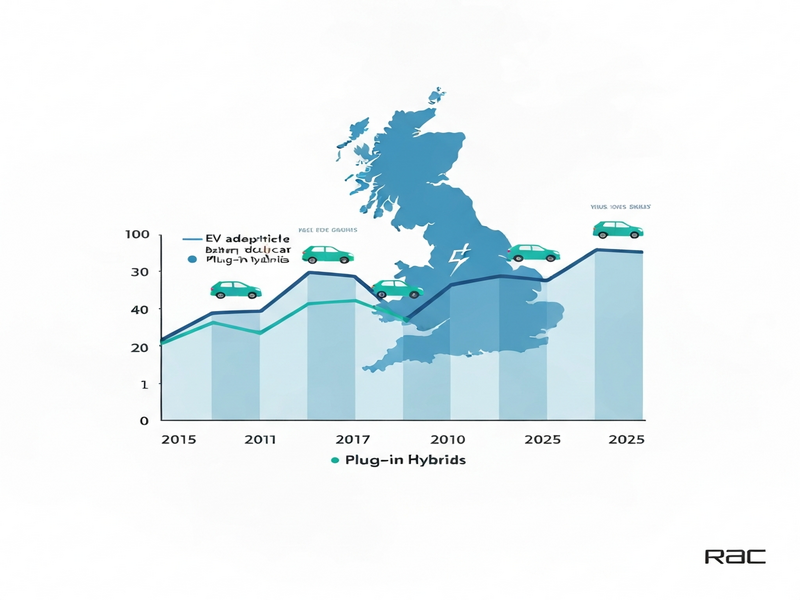
Key Statistics from the RAC “Road to Electric” Guide
Fleet Size & Growth
- ≈ 2.2 million zero‑emission Battery Electric Vehicles (BEVs) on UK roads (2024).
- ≈ 777 000 Plug‑in Hybrid Electric Vehicles (PHEVs) registered.
- Annual EV registrations grew from 3 % of new car sales in 2019 to 28 % in 2023.
- Projected to reach 5 million EVs by 2030 if current trends continue.
Sales Trends & ZEV Mandate
- 2024 ZEV quota: 22 % of all new car sales must be pure electric.
- Quota rises to 40 % by 2026 and 100 % by 2035.
- Manufacturers face fines of £2,500 per non‑compliant vehicle.
- BEV market share grew 12 pp year‑on‑year in 2023.
Charging Infrastructure
- ≈ 45 000 public charging points (2024), a 30 % increase YoY.
- Fast‑charging (≥ 50 kW) stations now represent 55 % of the network.
- Home‑based chargers cover 70 % of EV owners, reducing reliance on public points.
- Projected 80 000 public chargers by 2027, with ultra‑rapid (> 150 kW) sites expanding in motorways.
Cost & Range Insights
- Average new BEV range: 236 miles (SMMT, May 2024).
- Typical UK household electricity cost: £0.34 /kWh (2024).
- Average cost per 100 km: £3.20 for a BEV vs. £7.80 for a petrol car.
- Charging time: 30 min for 80 % charge on a 150 kW rapid charger.
Benefits and Challenges for UK Drivers
Why Drivers Are Switching
- Lower Running Costs: Electricity is cheaper per mile, and maintenance intervals are longer due to fewer moving parts.
- Environmental Impact: Zero tailpipe emissions cut local air pollution, supporting city clean‑air zones.
- Performance Gains: Instant torque delivers smoother acceleration and quieter cabins.
- Government Incentives: Grants up to £2 500 for eligible models and reduced vehicle tax.
Key Hurdles Still Faced
- Range Anxiety: Although average ranges exceed typical daily trips, long‑distance travel still requires careful planning.
- Charging Access: Urban renters without off‑street parking rely on public chargers, which can be congested during peak hours.
- Up‑front Price: EVs carry a premium, though total cost of ownership evens out over 3‑5 years.
- Battery Degradation: Real‑world degradation is modest (< 15 % after 8 years), but resale values can be uncertain.
RAC Services and Advice for EV Owners
The RAC has built a suite of EV‑focused products that address the challenges above, making the switch less intimidating for new owners.
- EV Boost Mobile Charger: Patrol vans equipped with a portable 22 kW charger can give a stranded vehicle enough power to reach the nearest public point.
- All‑Wheels‑Up Recovery: Flat‑bed recovery is replaced by a low‑impact lift system that avoids damaging battery packs.
- RAC Charge Watch: A real‑time dashboard that tracks electricity prices, optimal charging times, and estimated cost per mile.
- Dedicated EV Breakdown Cover: Plans start at £5.29 per month, with 4‑out‑of‑5 breakdowns resolved on‑site.
- Home‑Charging Guidance: Step‑by‑step advice on selecting a 7‑10 kW wallbox, applying for the OLEV grant, and complying with building regulations.
For a deeper dive into the RAC’s EV toolkit, visit the RAC “Road to Electric” guide.
How UBOS Can Accelerate Your EV Business Journey
If you are a startup or an SMB looking to build AI‑enhanced services around electric mobility—such as predictive charging optimisation, fleet‑wide health monitoring, or personalised driver assistance—UBOS offers a low‑code platform that speeds development without sacrificing scalability.
- Explore the UBOS platform overview to see how its modular architecture supports real‑time data ingestion from vehicle telematics.
- Leverage AI marketing agents to automatically generate targeted campaigns for EV owners, highlighting charging‑station discounts or battery‑health alerts.
- Choose a plan that fits your growth stage via the UBOS pricing plans, which include a free tier for prototype projects and enterprise‑grade options for large fleets.
UBOS also hosts a rich UBOS templates for quick start, including pre‑built dashboards for EV fleet analytics and chatbot assistants that can answer driver queries about nearest chargers or optimal routes.
Conclusion – The Road Ahead Is Electric
The RAC’s data makes it clear: the UK’s electric vehicle market is no longer a future scenario—it is a present reality accelerating toward 2030. With robust government mandates, expanding charging infrastructure, and cost advantages that are hard to ignore, the momentum is unstoppable.
For tech‑savvy motorists, the next step is to choose the right EV, plan charging logistics, and tap into specialist services like those offered by the RAC. For entrepreneurs, platforms such as UBOS provide the tools to build the next generation of EV‑centric AI solutions.
Ready to make the switch or launch an EV‑focused AI product? Visit the UBOS homepage today and start driving the future.
Andrii Bidochko
CTO UBOS
Andrii Bidochko is an AI entrepreneur and researcher focused on AI agents, reinforcement learning, and autonomous systems. He writes about the technologies shaping the future of machine intelligence, from frontier models and agent architectures to real-world AI applications.