

- Updated: May 4, 2025
- 4 min read
The Transformative Role of AI in Healthcare: Google’s AMIE and Gemini 2.0
Revolutionizing Healthcare: The Role of AI in Diagnostic Advancements
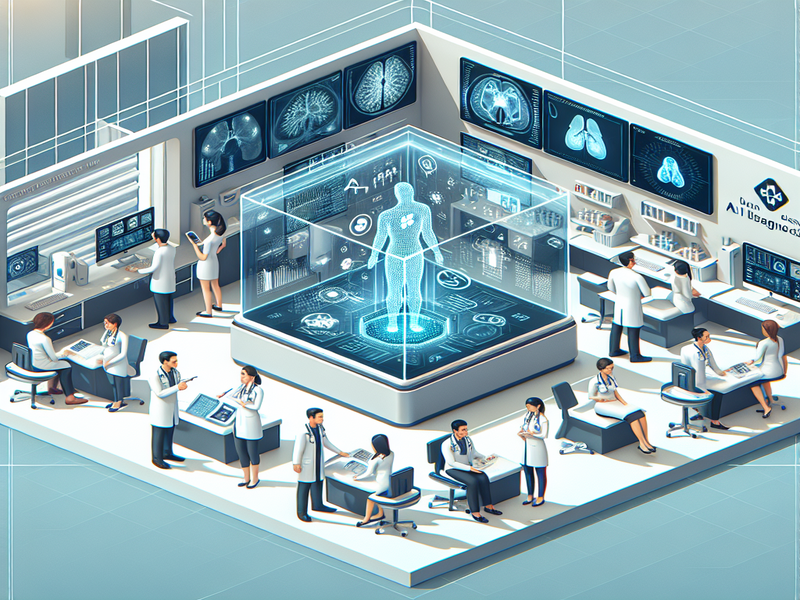
Artificial Intelligence (AI) is transforming the healthcare industry by enhancing diagnostic accuracy and efficiency. With the integration of advanced AI models, healthcare professionals can now rely on technology to assist in diagnosing complex medical conditions. Google’s recent advancements with AMIE and Gemini 2.0 are at the forefront of this revolution, showcasing the potential of AI in healthcare.
Advancements in Diagnostic AI: Google’s AMIE and Gemini 2.0
Google has made significant strides in diagnostic AI with the introduction of AMIE and Gemini 2.0. These AI models are designed to improve diagnostic accuracy through multimodal reasoning, a capability that allows AI to analyze and interpret data from multiple sources. This advancement is a game-changer in the field of diagnostic AI, providing healthcare professionals with a powerful tool to assist in medical evaluations.
AMIE, in particular, leverages sophisticated algorithms to enhance diagnostic precision. By integrating various data inputs, AMIE can offer insights that were previously unattainable through traditional diagnostic methods. This innovation underscores the importance of AI in healthcare, paving the way for more accurate and timely diagnoses.
Multimodal Reasoning: A New Era in AI Communication
One of the key features of Google’s diagnostic AI advancements is the integration of multimodal reasoning capabilities. This innovation allows AI systems to process and interpret data from diverse modalities, such as text, images, and audio. By doing so, AI can provide a more comprehensive analysis, leading to improved diagnostic outcomes.
Multimodal reasoning is not only enhancing diagnostic accuracy but also transforming how AI communicates with healthcare professionals. Systems like AMIE are designed to facilitate seamless interaction between AI and human users, ensuring that the insights provided are both actionable and easy to understand. This capability is crucial in bridging the gap between AI technology and real-world medical applications.
Comparing AI with Primary Care Physicians
As AI continues to evolve, there is an ongoing debate about its role in comparison to primary care physicians. While AI offers unparalleled data processing capabilities, it is essential to recognize that it serves as a complementary tool rather than a replacement for human expertise. AI can assist physicians by providing data-driven insights, but the human touch remains irreplaceable in patient care.
AI’s ability to analyze vast amounts of data quickly and accurately is its primary advantage over traditional diagnostic methods. However, the empathetic and personalized approach of primary care physicians is vital in delivering holistic patient care. The integration of AI in healthcare should be viewed as a collaborative effort, where technology enhances the capabilities of medical professionals.
Implications for the Future of Healthcare
The advancements in diagnostic AI, particularly with Google’s AMIE and Gemini 2.0, have far-reaching implications for the future of healthcare. As AI technology continues to evolve, it has the potential to revolutionize how medical diagnoses are conducted, leading to more accurate and timely interventions.
Moreover, the integration of AI in healthcare opens up new possibilities for personalized medicine. By analyzing individual patient data, AI can tailor treatment plans to suit specific needs, improving patient outcomes. This shift towards personalized healthcare is a significant step forward in the medical field, offering a more targeted approach to treatment.
For healthcare professionals and organizations looking to stay ahead in this rapidly evolving landscape, exploring AI solutions is crucial. Platforms like UBOS offer a range of AI integration options, enabling healthcare providers to harness the power of AI in their practice.
Conclusion: Embracing AI for a Healthier Future
In conclusion, the advancements in diagnostic AI, spearheaded by Google’s AMIE and Gemini 2.0, are transforming the healthcare industry. The integration of multimodal reasoning capabilities and AI’s ability to complement primary care physicians highlight the potential of AI in enhancing medical diagnostics.
As we look to the future, embracing AI in healthcare is essential for improving patient outcomes and driving innovation. Healthcare professionals, AI researchers, and technology enthusiasts are encouraged to explore platforms like OpenAI ChatGPT integration and Enterprise AI platform by UBOS for cutting-edge AI solutions.
For those interested in learning more about AI advancements and their applications in healthcare, AI-powered chatbot solutions and AI in stock market trading offer valuable insights into the transformative potential of AI across various sectors.
By staying informed and embracing AI technology, healthcare professionals can ensure they are well-equipped to navigate the future of medicine. Explore the UBOS platform overview for a comprehensive look at the AI solutions available to enhance healthcare practices.
Andrii Bidochko
CTO UBOS
Andrii Bidochko is an AI entrepreneur and researcher focused on AI agents, reinforcement learning, and autonomous systems. He writes about the technologies shaping the future of machine intelligence, from frontier models and agent architectures to real-world AI applications.