

- Updated: February 16, 2026
- 6 min read
Teen Innovator Uses Origami to Design Emergency Shelters
A 14‑year‑old New York student has turned a simple Miura‑ori origami fold into a prototype for ultra‑light, ultra‑strong emergency shelters that can support up to 10,000 times their own weight.
Origami Meets Disaster Relief: A New Hope for Emergency Shelters
When natural disasters strike, speed, affordability, and durability become the three pillars of effective relief. A breakthrough from an unexpected source—paper folding—promises to satisfy all three. In February 2026, the Smithsonian reported on a teenage innovator whose origami emergency shelter design could reshape how humanitarian agencies deploy temporary housing.
Who Is Miles Wu? The Young Visionary Behind the Fold
Miles Wu, a ninth‑grader at Hunter College High School in New York City, has been fascinated by origami since he was eight. Over six years, he moved from hobbyist paper art to rigorous engineering experiments. His curiosity was sparked by a simple observation: a sheet of paper folded in the Miura‑ori pattern could bear astonishing loads.
Motivated by the devastation of Hurricane Helene and the wildfires that ravaged California in 2024, Wu asked a critical question: Could the same fold be scaled into a shelter that is sturdy, cheap, and instantly deployable? The answer, he discovered, was a resounding yes.
The Science of Miura‑ori: From Spacecraft to Shelters
The Miura‑ori fold, invented by Japanese astrophysicist Koryo Miura, consists of a tessellation of parallelograms that can be unfolded or folded in a single motion. Its geometry gives it two key mechanical properties:
- High strength‑to‑weight ratio: The interlocking angles distribute loads evenly, allowing the structure to support massive forces relative to its mass.
- Compact deployability: A large surface can be collapsed into a thin sheet, ideal for transport and rapid assembly.
Originally used for solar panel arrays on satellites, the fold’s ability to transition from flat to volumetric form makes it a perfect candidate for deployable structures in disaster zones.
From Living‑Room Lab to Record‑Breaking Strength
Wu transformed his family’s living room into a makeshift laboratory. Over 250 hours, he designed, folded, and stress‑tested 54 variations of the Miura‑ori using three paper grades: copy paper, light cardstock, and heavy cardstock. Each test followed a strict protocol:
- Computer‑generated geometry defined cell size and fold angles.
- Patterns were precisely scored with a folding machine to eliminate human error.
- Each 64‑square‑inch sheet was placed between guardrails 5 inches apart.
- Incremental weights (books, cast‑iron pans, then 50‑lb exercise plates) were added until failure.
The strongest variant, a heavy‑cardstock Miura‑ori with a 30° fold angle, withstood more than 200 lb—equivalent to over 10,000 times its own weight**. To put that in perspective, a single sheet could theoretically support the weight of a New York City taxi loaded with four thousand elephants.
These results were documented in a detailed data table, which later informed his competition submission and caught the attention of engineers at Princeton University.
Winning the Thermo Fisher Scientific Junior Innovators Challenge
Wu entered the 2025 Thermo Fisher Scientific Junior Innovators Challenge, a national STEM competition that awards $25,000 to the most impactful project. Among 30 finalists, his origami shelter prototype stood out for three reasons:
- Scientific rigor: Over 100 controlled experiments with reproducible data.
- Social relevance: Direct response to recent natural disasters.
- Scalability potential: Clear pathway from paper prototype to full‑scale shelter.
Judge Maya Ajmera praised Wu’s “creativity and leadership,” noting that his work bridges centuries‑old art with modern engineering challenges. The award not only provided financial support but also opened doors to mentorship from leading researchers.
From Prototype to Global Impact: How Origami Shelters Could Change Disaster Relief
The implications of Wu’s design extend far beyond a school project. Below are three concrete pathways for real‑world deployment:
1. Rapid‑Deploy Field Kits
Flat‑packed kits could be shipped in standard containers, then unfolded on‑site by a single responder. The low material cost (paper‑based composites or recycled polymers) keeps budgets low for NGOs.
2. Hybrid Structures with Smart Materials
Integrating Chroma DB integration and sensor networks could enable real‑time monitoring of structural integrity, alerting teams to potential failures during aftershocks.
3. Community‑Driven Manufacturing
Local workshops could produce shelter panels using 3‑D‑printed biodegradable sheets, empowering affected communities to rebuild autonomously.
Academic collaborators, such as Princeton’s Dr. Glaucio Paulino, stress that scaling up will require attention to joint design, buckling resistance, and multi‑directional load handling. Wu’s next milestone is a full‑scale prototype that incorporates reinforced edges and modular connectors.
Leveraging UBOS Tools to Accelerate Shelter Development
UBOS offers a suite of low‑code tools that can streamline the path from concept to field‑ready product:
- UBOS platform overview – provides a unified environment for simulation, data management, and rapid prototyping.
- Workflow automation studio – automates testing pipelines, logging each fold iteration and its performance metrics.
- Web app editor on UBOS – lets developers build a dashboard for field teams to monitor shelter health in real time.
- AI marketing agents – can generate outreach campaigns to NGOs and government agencies, highlighting the shelter’s benefits.
- UBOS templates for quick start – include pre‑built data models for material stress analysis.
For example, by pairing the OpenAI ChatGPT integration with the ChatGPT and Telegram integration, field operators could receive instant AI‑driven guidance on shelter assembly via a Telegram bot.
A Glimpse of the Fold: The Prototype in Action
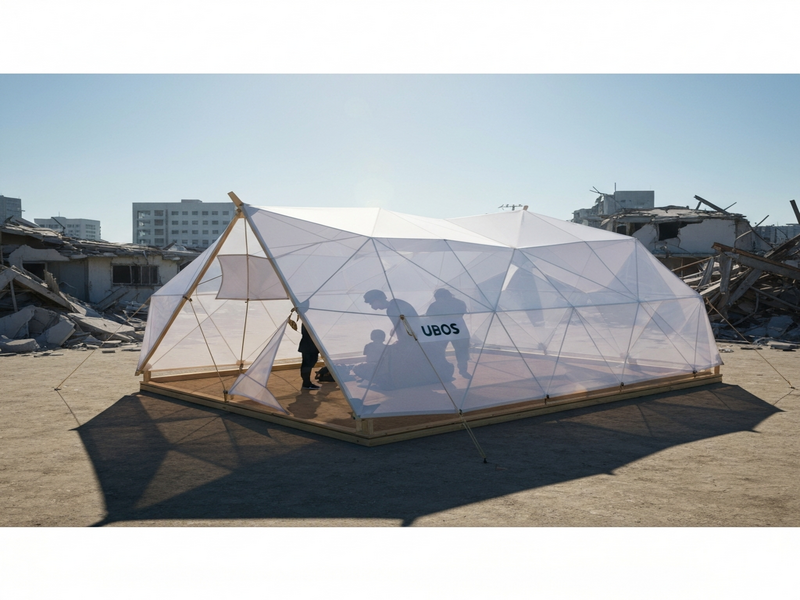
Figure 1: Miles Wu’s Miura‑ori shelter prototype, folded from a single sheet of reinforced paper.
Read the Full Story on Smithsonian Magazine
For a deeper dive into Miles Wu’s journey, see the original coverage in Smithsonian Magazine. The article details his experimental setup, personal motivations, and the broader implications for sustainable disaster relief.
Explore Related UBOS Solutions for Innovation and Resilience
If you’re interested in building AI‑enhanced tools around this technology, UBOS offers a range of ready‑made applications:
- AI SEO Analyzer – optimize your project’s online visibility.
- AI Image Generator – create custom visual assets for shelter marketing.
- AI Video Generator – produce instructional videos for rapid deployment.
- AI Chatbot template – build a support bot for field technicians.
- AI Email Marketing – reach donors and partners with personalized campaigns.
- AI YouTube Comment Analysis tool – gauge public response to shelter initiatives.
- AI Article Copywriter – generate press releases and case studies.
- AI Survey Generator – collect feedback from disaster‑relief teams.
- AI LinkedIn Post Optimization – amplify professional outreach.
- AI Voice Assistant – hands‑free guidance for shelter assembly.
Conclusion: Folding the Future of Humanitarian Aid
Miles Wu’s Miura‑ori emergency shelter demonstrates that groundbreaking solutions can emerge from the simplest of materials when paired with scientific curiosity and disciplined experimentation. By leveraging UBOS’s low‑code platform and AI integrations, developers, NGOs, and governments can accelerate the transition from paper prototype to field‑ready, scalable shelter systems.
As climate change intensifies the frequency of extreme events, the need for cost‑efficient, quickly deployable, and resilient structures has never been more urgent. Origami, once a pastime, is now poised to become a cornerstone of sustainable disaster relief—one fold at a time.
Ready to prototype your own disaster‑relief solution? Explore the UBOS for startups program and start building with our UBOS pricing plans today.