

- Updated: March 29, 2026
- 5 min read
Stop Publishing Garbage Data – Why Data Quality Matters
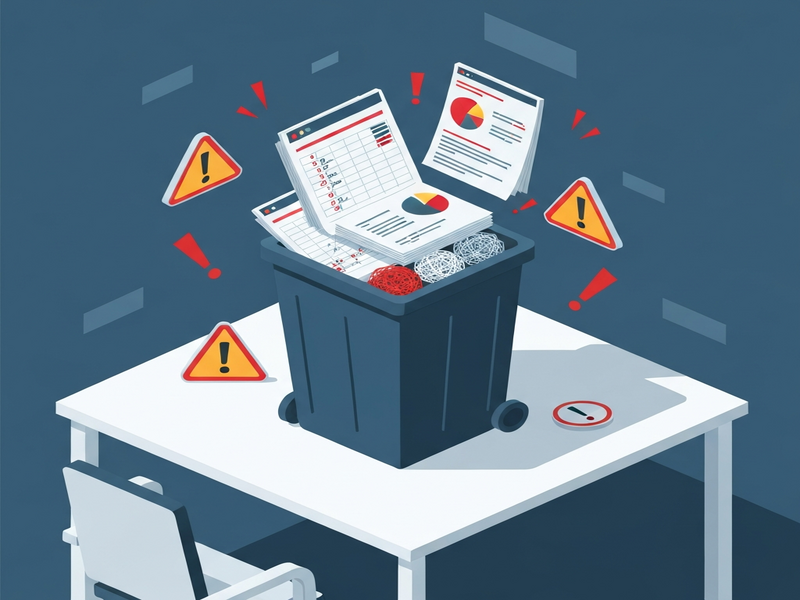
Publishing garbage data erodes digital trust, contaminates AI training sets, and drives costly, misguided business decisions.
Stop Publishing Garbage Data: Why Data Quality Matters Now More Than Ever
In the age of generative AI, a single erroneous row can ripple through countless models, dashboards, and strategic plans. Recent mishaps—like the UK government’s fuel‑finder CSV and the RAC’s electric‑car report—show how quickly “bad data” becomes a public embarrassment and a hidden risk for every data‑driven organization.
What Went Wrong? A Quick Recap of the Recent Data Mishaps
The original news piece highlighted two glaring examples:
- Fuel‑finder CSV: Latitude/longitude pairs placed UK stations in the Indian Ocean, and price columns showed a 1,538‑to‑1 ratio between cheapest and most expensive fuel—a clear sign of swapped fields and missing validation.
- RAC electric‑car report: A graph suggested a drop from 1.4 million to 1,700 electric vehicles overnight, likely caused by a misplaced decimal point.
Both cases share a common thread: data was collected from external contributors, but the publishing bodies failed to run even the most basic sanity checks before releasing the files to the public.
The Real Cost of Garbage Data
When data quality slips, the fallout is rarely limited to a single spreadsheet. Below are the three pillars that suffer the most:
1. Digital Trust
Stakeholders—whether citizens, investors, or internal teams—rely on published data to make informed choices. Repeated errors erode confidence, prompting users to seek alternative sources or, worse, to distrust the entire organization.
2. AI Training & Model Integrity
Generative models ingest massive datasets. If “garbage” slips in, the model learns false patterns, leading to hallucinations, biased outputs, and costly model retraining cycles. As the original article warned, a “slop‑apocalypse” could emerge when LLMs amplify unchecked errors.
3. Business Decision‑Making
Analytics pipelines built on flawed data produce misleading insights. Marketing budgets may be misallocated, supply‑chain forecasts become unreliable, and compliance reports risk regulatory penalties.
“Data is the new oil, but like oil, if it’s contaminated, it can poison the entire engine.” – Data Quality Advocate
How to Stop Publishing Garbage Data: Actionable Best Practices
Below is a MECE‑structured checklist that data teams, product managers, and SEO specialists can adopt immediately.
A. Automated Validation Pipelines
- Schema Enforcement: Use JSON Schema or Avro to define required fields, data types, and value ranges. Reject rows that violate the schema before they hit the data lake.
- Geospatial Checks: For location data, verify that latitude falls between –90 and 90 and longitude between –180 and 180. Flag outliers that fall outside national boundaries.
- Statistical Anomalies: Implement percentile‑based alerts (e.g., price values beyond 99.9th percentile trigger a review).
B. Human‑In‑The‑Loop Review
- Assign data stewards to audit a random sample of incoming records weekly.
- Use collaborative tools (e.g., Web app editor on UBOS) to let domain experts correct anomalies in real time.
- Document correction decisions in a version‑controlled changelog.
C. Governance & Documentation
Clear data‑ownership policies prevent “orphan” datasets. Publish a data‑dictionary that explains each column, its source, and acceptable ranges. The Data Quality hub on UBOS offers templates for such dictionaries.
D. Leverage AI‑Assisted Quality Tools
Modern AI platforms can spot patterns humans miss. For instance, the AI SEO Analyzer not only audits on‑page SEO but also flags duplicate or nonsensical content that could indicate data corruption.
E. Publish with Transparency
- Include a “Data Quality Statement” with each release, summarizing validation steps taken.
- Provide a downloadable
README.mdthat lists known limitations and contact information for feedback. - Adopt open‑source licensing where possible to invite community scrutiny.
Why Investing in Data Quality Pays Off – A Bottom‑Line View
High‑quality data fuels accurate SEO insights, reliable AI training, and confident decision‑making. Companies that embed rigorous validation into their pipelines see up to a 30% reduction in costly rework and a measurable boost in stakeholder trust.
Ready to upgrade your data workflow? Explore the UBOS platform overview for end‑to‑end data orchestration, or try the Workflow automation studio to automate validation steps without writing code.
Startups can accelerate their data strategy with UBOS for startups, while SMBs benefit from UBOS solutions for SMBs. For enterprises seeking a scalable AI backbone, the Enterprise AI platform by UBOS delivers governance, security, and performance at scale.
Need quick wins? Browse the UBOS templates for quick start—including the AI Article Copywriter template that can generate clean, SEO‑optimized copy while enforcing data‑quality rules.
For deeper insights on how clean data fuels better SEO, check out our SEO best practices guide. And if you’re curious about real‑world implementations, the UBOS portfolio examples showcase companies that turned data chaos into competitive advantage.
Finally, if you’re looking for a partner who can help you embed data quality into every layer of your stack, consider joining the UBOS partner program. Together, we can ensure that the data powering tomorrow’s AI is clean, trustworthy, and future‑proof.
Takeaway
Publishing garbage data is no longer a harmless slip—it’s a strategic liability. By instituting automated validation, human oversight, transparent governance, and AI‑assisted tools, organizations can safeguard trust, improve AI outcomes, and make smarter business decisions.
Stay ahead of the data‑quality curve. Visit the UBOS homepage to explore how our platform can help you build a resilient, high‑quality data foundation today.
Andrii Bidochko
CTO UBOS
Andrii Bidochko is an AI entrepreneur and researcher focused on AI agents, reinforcement learning, and autonomous systems. He writes about the technologies shaping the future of machine intelligence, from frontier models and agent architectures to real-world AI applications.