

- Updated: February 16, 2026
- 5 min read
Stateful AI Tutor with Long‑Term Memory and Adaptive Practice Generation – A New UBOS Innovation
Answer: A stateful AI tutor with long‑term memory and adaptive practice generation continuously records a learner’s interactions, semantically recalls relevant past knowledge, and automatically creates personalized exercises that evolve as the student improves.
Stateful AI Tutor Agent: Long‑Term Memory & Adaptive Practice Generation Redefine E‑Learning
Educators, AI developers, and e‑learning platform managers are witnessing a paradigm shift: tutoring agents are no longer limited to single‑turn conversations. The original MarkTechPost article highlighted a groundbreaking tutorial that builds a fully stateful personal tutor. Today, we explore how that architecture translates into real‑world products, why long‑term memory and semantic recall matter, and how UBOS homepage already offers the building blocks to create such intelligent tutors.
1. Architecture of a Stateful AI Tutor
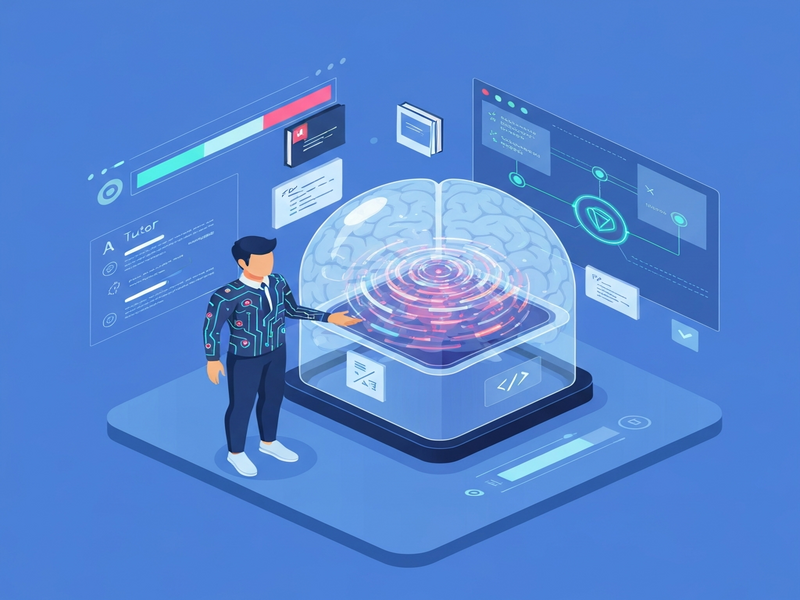
The core of a stateful tutor consists of three tightly coupled layers:
- Persistent Storage Layer – A durable database (e.g., SQLite) stores raw events, extracted memories, and weak‑topic signals across sessions.
- Semantic Vector Index – Embeddings generated by models like
sentence‑transformers/all‑MiniLM‑L6‑v2are indexed with FAISS, enabling fast similarity search for relevant past interactions. - Adaptive Prompt Engine – The LLM receives a concise context package (recalled memories + identified weak topics) and produces tailored explanations or practice problems.
This three‑tier design follows the MECE principle: each component addresses a distinct responsibility without overlap, making the system both scalable and maintainable.
2. Long‑Term Memory and Semantic Recall Explained
Traditional chatbots suffer from “goldfish memory” – they forget everything after the current turn. A stateful tutor solves this by:
- Extracting Structured Memories: User utterances are parsed into
MemoryItemobjects (e.g., preferences, misconceptions). - Storing with Importance Scores: Each memory receives an importance weight (0‑1) that influences recall ranking.
- Semantic Retrieval: When a new question arrives, the system embeds the query, searches the FAISS index, and returns the top‑k most relevant memories, weighted by similarity and importance.
Semantic recall also supports semantic recall across domains, allowing the tutor to surface related concepts even if the learner uses different terminology. This mimics how human teachers retrieve prior knowledge based on meaning rather than exact phrasing.
3. Adaptive Practice Generation Mechanics
Once weak topics are identified (e.g., “recursion” with low mastery), the prompt engine automatically crafts practice sets. The process includes:
- Weak‑Topic Snapshot: A query to the
weak_topicstable returns the five lowest‑mastery subjects. - Dynamic Prompt Construction: The LLM receives a JSON payload containing recalled memories and weak topics, then is instructed to “generate_practice”.
- Personalized Exercise Output: The model produces step‑by‑step tasks, mini‑quizzes, and hints that directly address the learner’s gaps.
This loop runs after every interaction, ensuring the tutor continuously evolves its curriculum without manual re‑authoring.
4. Why Educators and Learners Should Care
Stateful tutoring delivers concrete advantages:
| Stakeholder | Benefit |
|---|---|
| Teachers | Off‑load repetitive drill creation; focus on higher‑order instruction. |
| Course Designers | Plug‑and‑play memory modules reduce development time. |
| Students | Receive exercises that match their exact knowledge gaps, boosting retention. |
| Administrators | Data‑driven insights into cohort‑wide weak areas for curriculum improvement. |
5. How UBOS Implements Similar Solutions
UBOS provides a full‑stack environment that abstracts the heavy lifting of memory management, vector search, and workflow orchestration. Below are key UBOS components you can combine to build a stateful tutor:
- Memory Management – Handles durable storage of events, memories, and weak‑topic signals with built‑in versioning.
- Semantic Recall – Offers out‑of‑the‑box FAISS integration and embedding pipelines.
- UBOS partner program – Gives developers access to premium LLM APIs and dedicated support.
- Workflow Automation Studio – Lets you visually design the extraction‑store‑recall‑prompt loop without writing boilerplate code.
- Web App Editor on UBOS – Quickly prototype a learner‑facing UI that calls the tutor backend.
For rapid prototyping, UBOS also hosts a UBOS templates for quick start. Among the marketplace, the following templates are especially relevant:
- AI Article Copywriter – Demonstrates how to feed structured prompts to an LLM.
- AI Chatbot template – Provides a ready‑made conversational interface that can be extended with memory hooks.
- GPT-Powered Telegram Bot – Shows integration with messaging platforms, useful for delivering practice reminders.
- AI SEO Analyzer – Illustrates how to parse user input, extract entities, and store them for later recall.
- AI YouTube Comment Analysis tool – Example of semantic retrieval across large unstructured datasets.
By stitching these modules together, you can launch a production‑grade tutor in days rather than months.
6. Real‑World Use Cases
Below are three scenarios where a stateful AI tutor shines:
a) University Intro‑Programming Courses
Students often stumble on recursion, loops, and pointer concepts. The tutor records each error, recalls the exact code snippet that caused trouble, and generates a progressive set of exercises that gradually increase difficulty.
b) Corporate Compliance Training
Employees must retain policy details over years. The system logs quiz attempts, surfaces forgotten sections via semantic recall, and creates scenario‑based drills that keep knowledge fresh.
c) Language Learning Platforms
Vocabulary retention is boosted when practice aligns with the learner’s recent mistakes. The tutor remembers mispronounced words, re‑presents them in new contexts, and adapts difficulty based on mastery scores.
“A stateful AI tutor transforms static content into a living, breathing mentor that grows with every interaction.”
7. Get Started with UBOS Today
If you’re ready to embed a stateful tutor into your platform, explore the Enterprise AI platform by UBOS for enterprise‑scale deployments, or try the UBOS for startups plan to prototype quickly. Review the UBOS pricing plans to find a tier that matches your budget.
Need inspiration? Browse the UBOS portfolio examples to see how other innovators have leveraged memory‑aware agents for education, support, and marketing.
Finally, join the About UBOS community, contribute to the AI tutor ecosystem, and stay ahead of the AI education curve.
Ready to empower learners with a tutor that never forgets? Visit UBOS now and start building your stateful AI tutor today.