

- Updated: March 16, 2026
- 6 min read
Shopify Leverages AI Shopping Agents to Transform E‑commerce
Shopify Prepares for AI Shopping Agents: A New Era for Online Retail
Shopify is rolling out AI shopping agents that will act as personal shoppers, instantly personalising product discovery and purchase flows for millions of online shoppers.
Why AI Agents Matter Now
At the Upfront Summit in Los Angeles, Shopify President Harley Finklestein announced a bold shift toward “agentic shopping,” a vision that promises to turn every conversation, search, or social‑media interaction into a seamless buying experience. The announcement was covered in detail by TechCrunch, which highlighted the strategic urgency of AI‑driven personal shoppers in a market where only 18 % of U.S. retail purchases currently happen online.
For e‑commerce business owners, this signals a new front door—one that bypasses traditional search engines and brings context, preference, and intent directly to the checkout. In the next sections we break down what Shopify is building, how it will reshape the e‑commerce landscape, and why you should start preparing today.
Shopify’s Agentic Shopping Blueprint
Shopify’s AI shopping agents are designed to be “personal shoppers” that understand a shopper’s brand affinity, price tolerance, and even style nuances. Unlike generic search results that rank by popularity, these agents rank by merit—matching the shopper’s unique profile with the most relevant products.
- Context‑aware product discovery that learns from past purchases and real‑time interactions.
- Dynamic price comparison across merchants on the Shopify ecosystem.
- Seamless hand‑off to checkout, reducing friction and cart abandonment.
- Built‑in support for multi‑modal inputs (text, voice, and image).
The rollout will be phased, starting with a limited beta for high‑volume merchants before expanding to the entire Shopify network. This cautious approach ensures that the underlying AI models can be fine‑tuned with real‑world data while protecting merchant brand integrity.
Inside Shopify’s New AI Toolbox
Sidekick: The Merchant‑Facing Assistant
Sidekick is Shopify’s internal AI assistant that helps merchants manage inventory, craft product descriptions, and even generate ad copy. Powered by large‑language models, Sidekick can:
- Suggest SEO‑optimized titles and meta descriptions in seconds.
- Auto‑populate product attributes from supplier feeds.
- Provide real‑time analytics on agent‑driven sales performance.
Customer‑Support Agent
A dedicated support agent will field common shopper queries, triage returns, and even upsell complementary items—all without human intervention. By integrating directly with Shopify’s order‑management APIs, the agent can pull order status, issue refunds, or schedule deliveries on the fly.
Data‑Fusion Protocol
To make the agents truly “agentic,” Shopify is building a protocol that ingests product catalogs, merchant‑specific promotions, and shopper behaviour signals into a unified knowledge graph. This graph powers the merit‑based ranking engine that differentiates Shopify’s agents from generic search.
Strategic Implications for Merchants
The arrival of AI shopping agents will force merchants to rethink three core pillars of their online strategy:
1. Product Discovery & SEO
Traditional keyword‑centric SEO will give way to “agent‑centric” optimisation. Merchants must expose rich, structured product data (e.g., schema.org) so agents can accurately assess relevance.
2. Personalisation at Scale
AI agents will continuously learn shopper preferences, meaning merchants should invest in dynamic pricing, inventory segmentation, and real‑time recommendation engines.
3. Brand Storytelling
Since agents will surface products based on merit, compelling brand narratives and authentic reviews become critical differentiators.
4. Operational Efficiency
Automated support agents reduce human workload, allowing teams to focus on creative growth initiatives rather than repetitive queries.
For SMBs and startups, the democratization of AI agents levels the playing field. Even a niche brand can appear in front of a shopper who has explicitly expressed interest in that product category, bypassing the “first‑page‑only” bias of traditional search.
What Industry Leaders Are Saying
“Agentic shopping is fundamentally merit‑based. When my AI knows I love On running shoes, it surfaces the best options from On, not the generic listings from a mass retailer.” – Harley Finklestein, President, Shopify
“The biggest challenge for merchants today is discovery. AI agents will surface hidden gems, giving long‑tail brands a real chance to compete.” – Linda Zhao, VP of Product, Shopify
Analysts at Gartner predict that AI‑driven personal shoppers could increase online conversion rates by up to 30 % within the next two years, especially for categories with high involvement such as fashion, electronics, and home décor.
Connecting the Dots: UBOS & Shopify’s AI Future
While Shopify builds the front‑end agents, AI agents on the UBOS platform empower developers to create custom workflows that plug directly into Shopify’s data‑fusion protocol. Whether you need a bespoke recommendation engine or an automated post‑purchase follow‑up, UBOS provides the low‑code environment to accelerate development.
Our e‑commerce trends hub tracks the adoption curve of agentic shopping, offering benchmarks, case studies, and best‑practice guides. By aligning your roadmap with these insights, you can future‑proof your store against the rapid shift toward AI‑first commerce.
In addition, UBOS’s AI marketing agents can automatically generate personalized email campaigns based on the shopper profiles that Shopify’s agents create, closing the loop between discovery and conversion.
For teams looking for rapid prototyping, the UBOS templates for quick start include pre‑built “Shopify Agent Connector” modules that require minimal configuration.
A Visual Snapshot of the Agentic Flow
The diagram below illustrates how a shopper’s query travels from a messaging app, through Shopify’s AI agent, into the merchant’s product graph, and back as a curated list of purchase‑ready items.
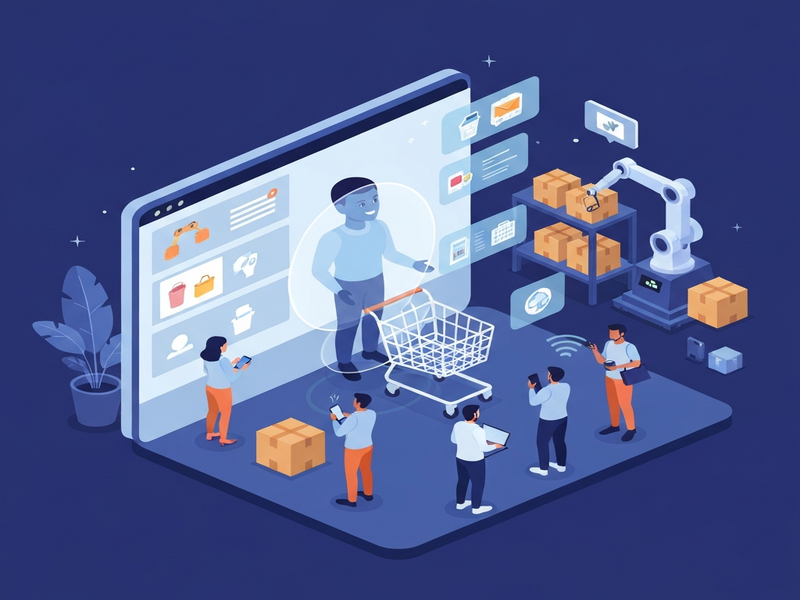
*Illustration generated by UBOS AI to depict the end‑to‑end journey of an AI‑driven shopping interaction.
What’s Next for Your Store?
The AI shopping agent era is arriving faster than most retailers anticipate. To stay ahead, start by:
- Auditing your product data for completeness and schema markup.
- Experimenting with UBOS’s AI agent connectors to prototype personalized experiences.
- Monitoring the e‑commerce trends dashboard for early adoption signals.
- Signing up for Shopify’s Sidekick beta to get early access to merchant‑focused AI tools.
By aligning your strategy with Shopify’s agentic vision and leveraging UBOS’s flexible AI platform, you can turn every conversation into a revenue‑generating opportunity. Ready to make AI your new salesforce? Explore UBOS pricing plans and start building today.
Andrii Bidochko
CTO UBOS
Andrii Bidochko is an AI entrepreneur and researcher focused on AI agents, reinforcement learning, and autonomous systems. He writes about the technologies shaping the future of machine intelligence, from frontier models and agent architectures to real-world AI applications.