

- Updated: March 4, 2026
- 7 min read
Secret AI Conference in New Orleans Unites Political Leaders, Unions and Faith Groups – Pro‑Human AI Declaration
The secret AI conference held in New Orleans produced the Pro‑Human AI Declaration, a five‑point charter signed by a diverse coalition of labor unions, religious leaders, progressive politicians, and even former MAGA strategists, demanding that artificial intelligence be developed with humanity’s safety, agency, and equity at the forefront.
1. Overview of the New Orleans AI Summit
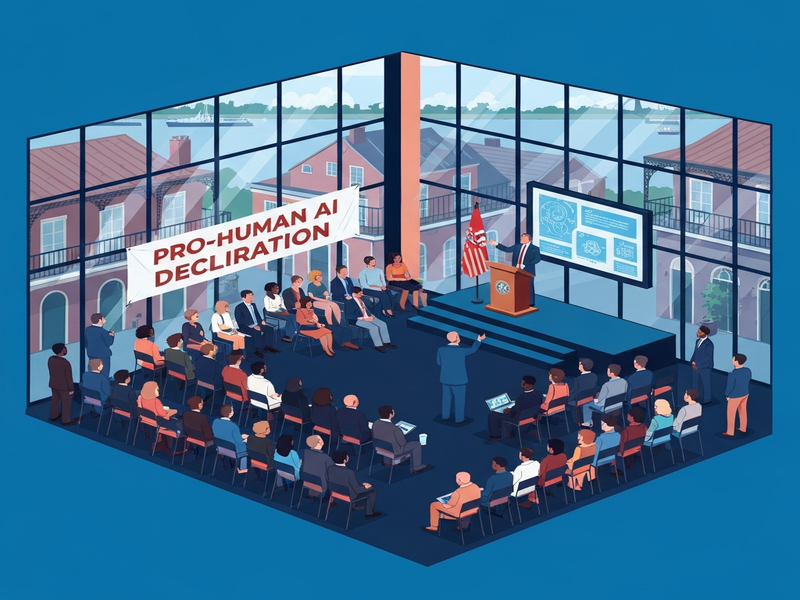
In early January 2026, a discreet gathering of roughly 90 influencers, policymakers, and civil‑society leaders convened at a Marriott hotel in New Orleans. The event was organized under UBOS AI conferences guidelines that emphasize privacy and cross‑ideological dialogue. Attendees were bound by Chatham House Rules, meaning the guest list remained confidential until the declaration was released.
The summit’s primary goal was to forge a unified stance on AI governance that transcended partisan divides. Organizers invited representatives from labor, faith‑based groups, progressive think‑tanks, and even former Trump‑era media personalities, hoping that the shared urgency of AI risks would outweigh political friction.
2. Who Showed Up? A Mosaic of Signatories
The roster of participants read like a political kaleidoscope:
- Labor unions: AFL‑CIO, American Federation of Teachers, Screen Writers Guild.
- Religious coalitions: Congress of Christian Leaders, G20 Interfaith Forum Association.
- Progressive political groups: Progressive Democrats of America, the team that drafted Bernie Sanders’ 2016 campaign.
- Conservative voices: Institute for Family Studies, former War Room strategist Steve Bannon.
- Individual influencers: Ralph Nader, Sir Richard Branson, former National Security Advisor Susan Rice, and AI‑ethics champion Meredith Whittaker.
Each signatory brought a distinct perspective on how AI could impact their constituencies, yet all converged on five core principles.
3. The Pro‑Human AI Declaration: Five Guiding Principles
- Human‑Centric Control: AI systems must remain under human oversight, especially in high‑stakes domains such as autonomous weapons.
- Child & Family Safeguards: No AI product may exploit children’s emotional attachment for profit or manipulate family dynamics.
- Anti‑Monopoly Stance: Concentration of AI power in a handful of corporations is prohibited; open‑source and competitive ecosystems are encouraged.
- Preserve Agency & Liberty: AI must not erode personal autonomy, privacy, or democratic participation.
- Legal Personhood Rejection: AI entities shall not be granted legal personhood that could dilute human accountability.
Even the most contentious point—rejecting AI legal personhood—received 94% approval, underscoring the coalition’s consensus.
4. Reactions Across the Spectrum
Labor & Education Leaders
Randi Weingarten, president of the American Federation of Teachers, praised the declaration as “the missing guardrails for classrooms and workplaces.” She highlighted that the document aligns with the union’s “common‑sense guardrails” for AI use in schools, echoing the Future of Life Institute’s (FLI) safety framework.
Faith‑Based Communities
Leaders from the Congress of Christian Leaders emphasized the moral imperative to protect families from AI‑driven manipulation. They cited biblical stewardship principles, arguing that technology must serve humanity, not dominate it.
Progressive Politicians
Alan Minsky, head of the Progressive Democrats of America, warned that unchecked AI could exacerbate wealth inequality and erode democratic norms. He called the declaration “a blueprint for a pro‑human political movement.”
Conservative Commentators
Steve Bannon, despite his reputation, expressed surprise at the common ground, noting that “protecting children and preventing monopolies are values that cross party lines.” His endorsement added a surprising bipartisan sheen to the document.
5. Visual Insight: The Declaration in One Image
6. How This Impacts AI Policy Development
The declaration is already shaping policy conversations at the federal level. Lawmakers cite its language when drafting bills on AI transparency, data privacy, and autonomous weapons. Moreover, the UBOS AI policy framework has incorporated the five principles as baseline compliance checks for any AI solution built on the platform.
7. Why the Tech Industry Was Not Invited
Organizers deliberately excluded major AI corporations—such as OpenAI, Google, and Microsoft—from the guest list. As Emilia Javorsky of FLI explained, “Corporate interests tend to dominate the narrative when present; we wanted a pure civil‑society perspective.” This decision amplified the declaration’s credibility among skeptics who fear industry capture.
8. The Role of UBOS in Enabling Pro‑Human AI Solutions
UBOS, a low‑code AI platform, has positioned itself as a practical conduit for the declaration’s principles. Developers can now leverage the UBOS platform overview to build applications that automatically enforce human‑centric controls, child‑safety filters, and anti‑monopoly safeguards.
For startups seeking to align with the new standards, the UBOS for startups program offers pre‑configured templates that embed the five principles at the code level.
SMBs can also benefit from UBOS solutions for SMBs, which include built‑in compliance dashboards that flag any deviation from the Pro‑Human guidelines.
9. Ready‑Made Templates That Accelerate Compliance
UBOS’s Template Marketplace hosts several ready‑made solutions that directly map to the declaration’s points:
- AI SEO Analyzer – ensures AI‑generated content respects user intent and avoids manipulative tactics.
- AI Article Copywriter – embeds child‑safety language and avoids sensationalism.
- AI Survey Generator – automatically anonymizes respondent data, preserving privacy.
- AI Chatbot template – includes human‑in‑the‑loop escalation for high‑risk queries.
- AI Video Generator – enforces watermarking and consent checks for generated media.
10. Pricing and Adoption Pathways
UBOS offers transparent pricing plans that scale from hobbyist to enterprise. The “Pro‑Human” tier includes automated policy audits, real‑time alerts for non‑compliant AI behavior, and a dedicated compliance liaison.
11. Real‑World Examples of Pro‑Human AI in Action
Several portfolio projects illustrate the declaration’s impact:
- UBOS portfolio examples showcase a child‑friendly tutoring bot that refuses to collect personal data beyond what is legally required.
- A healthcare scheduling assistant built with the Web app editor on UBOS automatically flags any request to share patient data with third‑party advertisers.
- The Workflow automation studio has been used to create a compliance pipeline that audits AI model updates against the five Pro‑Human principles before deployment.
12. External Coverage and Further Reading
The original investigative piece appeared on The Verge, providing an in‑depth look at the behind‑the‑scenes negotiations.
13. Future Outlook: From Declaration to Global Standard
Signatories plan to circulate the declaration to international bodies such as the OECD and the UN’s AI governance forum. If adopted globally, the five principles could become the de‑facto baseline for AI regulation, much like the GDPR did for data privacy.
Meanwhile, UBOS is expanding its About UBOS narrative to position the platform as the “engine for pro‑human AI,” inviting developers worldwide to embed these safeguards from day one.
14. Call to Action for Tech‑Savvy Professionals
If you are a developer, policy maker, or AI enthusiast, consider the following steps:
- Review the UBOS AI policy checklist against your current projects.
- Adopt one of the compliance‑ready templates from the UBOS marketplace.
- Join the UBOS partner program to collaborate on building pro‑human AI solutions.
- Advocate for the Pro‑Human AI Declaration within your organization and industry groups.
Conclusion
The secret New Orleans AI summit proved that even the most polarized factions can unite around a shared vision of responsible technology. The Pro‑Human AI Declaration, backed by an unprecedented coalition, offers a concrete roadmap for safeguarding humanity while still harnessing AI’s transformative power. As platforms like UBOS embed these principles into their core, the tech ecosystem moves closer to a future where AI serves people—not the other way around.
Andrii Bidochko
CTO UBOS
Andrii Bidochko is an AI entrepreneur and researcher focused on AI agents, reinforcement learning, and autonomous systems. He writes about the technologies shaping the future of machine intelligence, from frontier models and agent architectures to real-world AI applications.