

- Updated: February 4, 2026
- 8 min read
Sam Altman Slams Anthropic’s Super Bowl Ad Amid Growing AI Competition
Sam Altman Slams Anthropic’s Super Bowl Ad as “Clearly Dishonest” – What It Means for the AI Wars
Sam Altman, CEO of OpenAI, labeled Anthropic’s Super Bowl commercial “clearly dishonest,” defending OpenAI’s upcoming ad‑testing program and highlighting the broader rivalry between the two AI powerhouses.
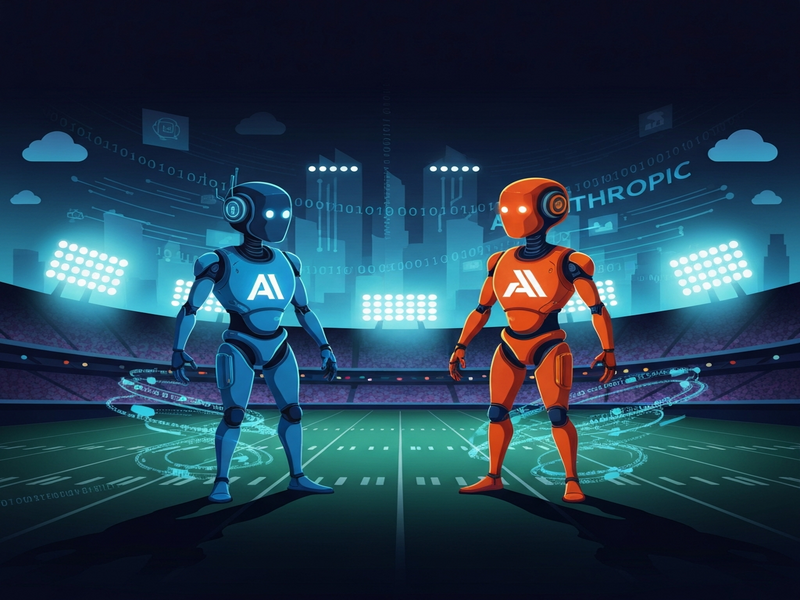
Context: AI Companies Enter the Advertising Arena
The AI industry, once dominated by research papers and developer conferences, is now spilling onto mainstream media channels. In February 2026, Anthropic—a startup founded by former OpenAI researchers—aired a Super Bowl spot that claimed its chatbot Claude would remain ad‑free, contrasting it with OpenAI’s plan to test ads in ChatGPT. The commercial sparked a flurry of commentary across tech blogs, social media, and industry newsletters.
OpenAI, the creator of ChatGPT, announced a pilot program that would display clearly labeled advertisements to free‑tier users. While the company insists that ads will never influence the model’s responses, the move marks a significant shift toward monetization strategies that could reshape user expectations and competitive dynamics.
Anthropic’s Super Bowl Message: “No Sponsored Links, No Influence”
The 30‑second spot, aired during the Super Bowl, featured a calm narrator stating, “Our users won’t see ‘sponsored’ links adjacent to their conversations with Claude; nor will Claude’s responses be influenced by advertisers or include third‑party product placements we didn’t ask for.” The ad deliberately avoided naming OpenAI or ChatGPT, but the contrast was unmistakable.
Anthropic’s positioning leans heavily on the promise of a “pure” user experience, a narrative that resonates with privacy‑concerned consumers and enterprises wary of commercial bias in AI outputs. By framing the ad‑free claim as a competitive advantage, Anthropic hopes to differentiate Claude in a market where OpenAI’s brand recognition is already massive.
The commercial also hinted at Anthropic’s broader product strategy: premium subscriptions for businesses, a focus on safety‑first model training, and a commitment to keeping the core chatbot experience untouched by external monetization pressures.
Sam Altman’s Response and OpenAI’s Advertising Policy
Within hours of the Super Bowl, Altman took to X (formerly Twitter) to address the ad. He wrote, “First, the good part of the Anthropic ads: they are funny, and I laughed. But I wonder why Anthropic would go for something so clearly dishonest.” He continued, emphasizing that OpenAI would “never run ads in the way Anthropic depicts them” and that “we are not stupid and we know our users would reject that.”
Altman also clarified OpenAI’s ad policy: ads will appear only for logged‑in users on free or ChatGPT Go accounts, will be clearly labeled, and will never affect the model’s answer generation. “Answers are optimized based on what’s most helpful to you. Ads are always separate and clearly labeled,” he asserted.
The OpenAI CEO framed the debate as a matter of user agency. “We believe everyone deserves to use AI, and we are committed to free access because access creates agency,” Altman said, noting that “more Texans use ChatGPT for free than total people use Claude in the US.” He contrasted this with Anthropic’s “expensive product to rich people” positioning, arguing that OpenAI’s tiered model—free, Plus, Pro—offers broader reach.
Altman’s remarks also touched on governance. He warned that “Anthropic wants to control what people do with AI—they block companies they don’t like from using their coding product… and now they also want to tell other companies what their business models can be.” He positioned OpenAI as a champion of “broad, democratic decision making” and a “resilient ecosystem for advanced AI.”
For a deeper dive into OpenAI’s ad rollout, see our latest AI news coverage.
The Wider AI Competition Landscape
Altman’s public sparring with Anthropic is emblematic of a larger contest among AI firms to capture both developer mindshare and consumer wallets. The key players include:
- OpenAI: Leveraging ChatGPT’s massive user base, a tiered subscription model, and now a modest ad‑supported tier.
- Anthropic: Emphasizing safety, a “Claude‑only” ad‑free experience, and targeting enterprise customers willing to pay a premium.
- Google DeepMind: Continuing to integrate Gemini models across its ecosystem while experimenting with AI‑enhanced search.
- Microsoft: Embedding OpenAI models in Azure and Office, while also investing in its own research labs.
- Meta: Pushing Llama models and focusing on open‑source collaborations.
The competition is no longer just about model performance; it now hinges on monetization strategies, data privacy, and regulatory compliance. Companies must balance revenue generation with the trust of users who fear that ads could bias AI outputs.
Monetization Models: Ads vs. Subscriptions vs. Enterprise Licensing
OpenAI’s ad pilot reflects a hybrid approach: free users see non‑intrusive, clearly labeled ads, while paying subscribers enjoy an ad‑free experience. This mirrors the “freemium” model popularized by consumer software, but applied to generative AI. Anthropic, by contrast, has opted for a pure subscription model, positioning itself as a premium, privacy‑first alternative.
Enterprise licensing remains a lucrative avenue for both firms. Companies like Enterprise AI platform by UBOS illustrate how large organizations are integrating AI into internal workflows, demanding robust security, compliance, and customizability—features that both OpenAI and Anthropic are racing to provide.
Safety and Governance: The New Competitive Edge
Anthropic’s brand narrative leans heavily on safety research, a stance that resonates with regulators and risk‑averse enterprises. OpenAI counters with its own safety initiatives, including the About UBOS page’s emphasis on responsible AI development. The debate over “ad‑free” versus “ad‑supported” also raises governance questions: can an AI model remain unbiased when revenue is tied to advertisers?
Developer Ecosystem and Tooling
Both companies are courting developers with APIs, SDKs, and plug‑in marketplaces. For instance, the Workflow automation studio enables rapid integration of AI services into business processes, while the Web app editor on UBOS simplifies building custom AI‑driven interfaces. These tools lower the barrier to entry, making the competition not just about the core model but also about the surrounding ecosystem.
Stay updated on Anthropic’s strategic moves in our Anthropic updates feed.
Future Outlook: What Comes Next for AI Advertising?
The next few quarters will likely reveal whether OpenAI’s ad experiment gains traction or faces backlash. Key indicators to watch include:
- User engagement metrics on ad‑supported ChatGPT sessions.
- Advertiser demand for AI‑native placements.
- Regulatory responses concerning AI‑driven advertising.
- Anthropic’s product roadmap—whether it will maintain a strict ad‑free stance or introduce alternative revenue streams.
If OpenAI can demonstrate that ads remain truly separate from model outputs, it may set a precedent for sustainable, large‑scale AI services. Conversely, a misstep could accelerate user migration toward ad‑free alternatives like Claude, especially among privacy‑sensitive segments.
Meanwhile, the broader market is watching how AI agents integrate with other platforms. Recent integrations such as the ChatGPT and Telegram integration and the Chroma DB integration illustrate the expanding ecosystem where AI meets communication, data storage, and voice synthesis. These cross‑platform capabilities could become new battlegrounds for user attention, beyond the traditional chat interface.
For startups looking to leverage AI without heavy upfront costs, the UBOS for startups program offers a low‑friction entry point, while SMBs can explore tailored solutions via UBOS solutions for SMBs. These offerings underscore a market trend: democratizing AI access while experimenting with diversified revenue models.
Implications for AI‑Driven Marketing
Marketers should monitor how ad‑supported AI platforms handle data privacy and brand safety. The rise of AI marketing agents promises hyper‑personalized campaigns, but the underlying ad infrastructure could affect transparency. Companies must weigh the benefits of AI‑generated copy against potential biases introduced by ad revenue streams.
What to Expect from the Next Super Bowl
The 2027 Super Bowl will likely see a new wave of AI‑centric ads, as both OpenAI and Anthropic (and perhaps newcomers) vie for the 30‑second spotlight. Expect more meta‑commentary, humor, and perhaps even interactive elements powered by UBOS templates for quick start that let viewers test AI features in real time.
For the original reporting, read The Verge’s coverage of Altman’s response.
Conclusion: A Battle of Principles and Profit
Sam Altman’s sharp rebuttal to Anthropic’s Super Bowl ad underscores a fundamental tension in the AI industry: how to fund ever‑growing compute costs without compromising the perceived neutrality of the models. OpenAI’s ad‑testing pilot and Anthropic’s ad‑free promise represent two sides of the same coin—each appealing to different user priorities.
As AI becomes woven into everyday tools—from voice assistants powered by ElevenLabs AI voice integration to data indexing via Chroma DB integration—the marketplace will reward the approach that best balances accessibility, transparency, and revenue sustainability.
For professionals, developers, and businesses watching the AI frontier, the takeaway is clear: stay informed, test emerging platforms early, and align your AI strategy with both ethical standards and realistic business models. The next chapter of the AI competition will be written not just in code, but in the ads we see on our screens and the policies that govern them.
Explore more about AI integration possibilities with our OpenAI ChatGPT integration, or discover how to build custom workflows using the UBOS pricing plans that fit your organization’s scale.