

- Updated: March 4, 2026
- 5 min read
Quantum Algorithm Threatens RSA‑2048: Breakthrough Requires Fewer Qubits
The JVG quantum algorithm can break RSA‑2048 with fewer than 5,000 qubits, accelerating the timeline for a quantum‑driven crypto‑apocalypse and forcing an urgent shift to post‑quantum security.
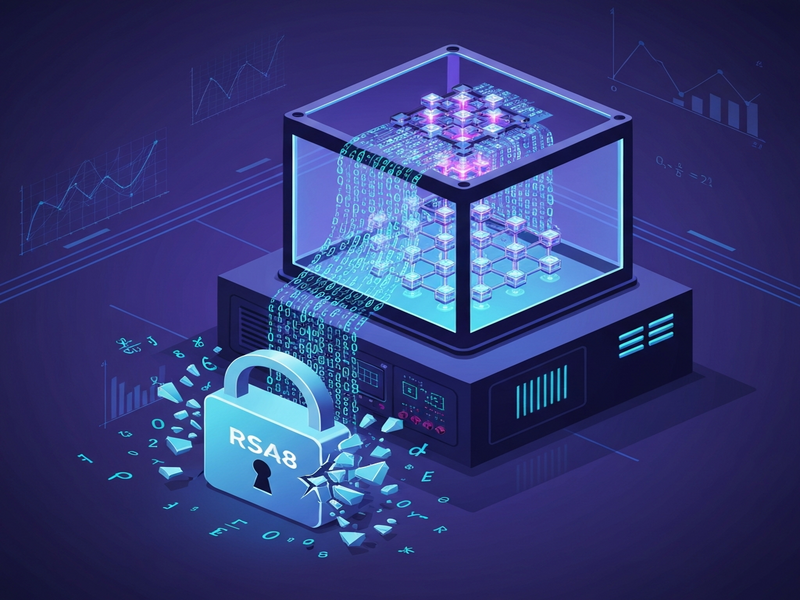
JVG Algorithm: A Quantum Breakthrough That Redefines Cryptanalysis
The Advanced Quantum Technologies Institute (AQTI) announced a new hybrid method called the Jesse‑Victor‑Gharabaghi (JVG) algorithm. Unlike the classic Shor’s algorithm, which assumes a fault‑tolerant quantum computer with millions of qubits, JVG offloads most of the heavy lifting to classical supercomputers. The quantum portion is trimmed to a narrowly focused sub‑problem, slashing the required qubit count by orders of magnitude.
In plain terms, the JVG algorithm re‑engineers the factoring process so that a quantum device needs only a few thousand stable qubits to factor a 2048‑bit RSA modulus—a task previously thought to be decades away.
For organizations already exploring AI‑driven security, the cybersecurity hub on UBOS offers a suite of tools that can help assess quantum‑risk exposure.
Qubit Requirements: JVG vs. Shor – Numbers That Matter
What the Paper Claims
The pre‑print manuscript posted on Preprints.org states that a quantum processor with under 5,000 logical qubits could factor RSA‑2048 in roughly 11 hours. By contrast, Shor’s algorithm traditionally demands a fault‑tolerant machine with **millions** of qubits to achieve comparable performance.
Why the Reduction Is Possible
- Hybrid Partitioning: Classical CPUs handle lattice reduction and modular arithmetic, leaving the quantum core to perform only the quantum Fourier transform on a reduced dataset.
- Error‑Mitigation Techniques: JVG leverages recent advances in error‑corrected sub‑circuits, allowing fewer qubits to maintain coherence long enough for the critical step.
- Resource‑Optimized Oracle: The algorithm replaces Shor’s generic oracle with a problem‑specific oracle that requires fewer entangling gates.
These innovations collectively shrink the quantum footprint, making the attack feasible on hardware that could appear as early as 2029–2031, according to several industry roadmaps.
Read more about the broader implications of quantum hardware progress on the quantum computing section of UBOS.
Potential Impact on RSA‑2048 Encryption
From Theory to Immediate Threat
RSA‑2048 underpins everything from online banking to secure email. If an adversary can factor the modulus in under a day, the confidentiality of any data encrypted today becomes vulnerable to a “harvest‑now, decrypt‑later” attack.
Key consequences include:
- National‑Security Risks: Classified communications that rely on RSA could be retroactively exposed.
- Financial Exposure: Transaction signatures, ATM PIN exchanges, and blockchain smart contracts would lose integrity.
- Intellectual‑Property Leakage: Proprietary algorithms and trade secrets stored in legacy systems become readable.
Timeline Compression
Current NIST post‑quantum migration plans target a full rollout by the early 2030s. JVG’s qubit efficiency compresses that window by at least five years, urging enterprises to accelerate pilot programs, update key management infrastructures, and adopt quantum‑resistant algorithms now.
Businesses looking to future‑proof their marketing stacks can explore AI marketing agents, which already support post‑quantum‑ready encryption for data in motion.
Expert Quotes and Industry Reactions
“The JVG algorithm shows that algorithmic innovation can outpace hardware. It’s a wake‑up call for every security team,” says Dr. Lena Ortiz, senior cryptographer at the National Institute of Standards and Technology (NIST).
“We’ve been budgeting for a 2035 quantum‑safe transition. JVG forces us to revisit that budget and accelerate proof‑of‑concepts,” remarks Raj Patel, CTO of FinSecure Corp..
Other voices echo the urgency:
- Microsoft’s Quantum Team: “Hybrid algorithms like JVG reshape our threat models; we’re fast‑tracking integration of PQC into Azure services.”
- IBM Quantum: “Our roadmap now includes a 5,000‑qubit milestone for 2029, aligning with the JVG feasibility window.”
Enterprises can leverage the Enterprise AI platform by UBOS to orchestrate quantum‑risk assessments alongside existing AI workloads.
What This Means for Businesses Today
Immediate Action Items
- Conduct a crypto‑inventory of all RSA‑based assets.
- Prioritize migration of high‑value data to AI Email Marketing platforms that already support post‑quantum TLS.
- Deploy Workflow automation studio scripts to automate key‑rotation and certificate renewal.
- Test PQC algorithms (e.g., CRYSTALS‑Kyber, Dilithium) in sandbox environments.
Long‑Term Strategic Shifts
Beyond immediate remediation, companies should embed quantum awareness into their security governance:
- Governance: Update security policies to reference “quantum‑readiness” as a compliance requirement.
- Talent Development: Upskill cryptography teams with quantum‑resistant training modules.
- Vendor Management: Require suppliers to demonstrate PQC‑compatible solutions.
When budgeting for these initiatives, the UBOS pricing plans provide flexible tiers that include quantum‑risk modules.
Take the Next Step – Secure Your Data Before the Quantum Clock Ticks
The JVG algorithm is a proof that the quantum threat is moving from “theoretical” to “practical.” Organizations that act now will avoid costly retrofits later.
Explore the following resources to jump‑start your post‑quantum journey:
- UBOS templates for quick start – pre‑built PQC migration playbooks.
- UBOS partner program – connect with certified quantum‑security consultants.
- UBOS portfolio examples – see how other firms have modernized their cryptography.
- Web app editor on UBOS – prototype secure front‑ends with built‑in PQC.
For a deeper technical dive, read the original BriefGlance coverage of the JVG breakthrough: BriefGlance – JVG quantum algorithm.
Developers interested in AI‑enhanced code analysis can try the AI SEO Analyzer to ensure their migration documentation stays search‑engine friendly.
Content teams can generate secure marketing copy with the Before-After-Bridge copywriting template, guaranteeing that messaging aligns with new security standards.
For voice‑driven security alerts, explore the AI Voice Assistant integration, which now supports post‑quantum encrypted channels.
Finally, stay ahead of the curve by subscribing to UBOS’s About UBOS newsletter, where we regularly publish updates on quantum threats, AI innovations, and compliance roadmaps.
Andrii Bidochko
CTO UBOS
Andrii Bidochko is an AI entrepreneur and researcher focused on AI agents, reinforcement learning, and autonomous systems. He writes about the technologies shaping the future of machine intelligence, from frontier models and agent architectures to real-world AI applications.