

- Updated: February 6, 2026
- 5 min read
PC Makers Turn to Chinese DRAM Amid Global Shortage and AI‑Driven Demand
Answer: Facing a severe DRAM shortage driven by soaring AI workloads, PC giants HP, Dell, Acer, and Asus are preparing to source memory chips from Chinese manufacturers for the first time to safeguard their product pipelines.
DRAM Shortage Fuels AI‑Driven Memory Demand – HP, Dell, Acer & Asus Look to Chinese DRAM Suppliers
The global semiconductor market is under unprecedented pressure as artificial‑intelligence applications consume massive amounts of memory. With Micron, Samsung, and SK Hynix prioritising AI‑centric orders, traditional PC makers are scrambling for alternatives. Recent reports indicate that HP, Dell, Acer, and Asus are actively evaluating Chinese DRAM vendors to keep their supply chains afloat, especially for devices destined for non‑U.S. markets.
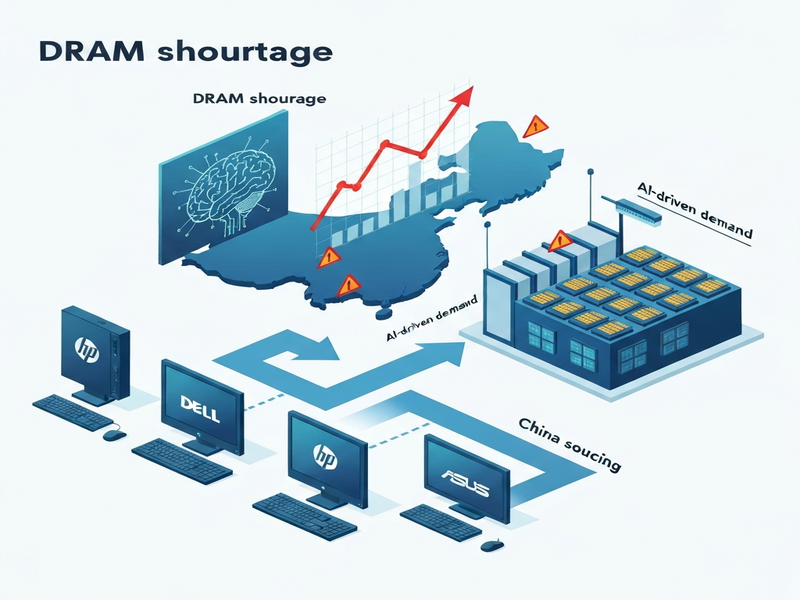
Global DRAM Supply Constraints
DRAM (Dynamic Random‑Access Memory) is the backbone of modern computing, powering everything from laptops to data‑center GPUs. In 2024‑2025, three forces converged to tighten the market:
- Capacity reallocation: Leading fabs in South Korea and the United States have shifted production lines toward high‑bandwidth memory (HBM) and AI‑optimized chips, leaving less capacity for standard DDR4/DDR5 modules.
- Raw‑material bottlenecks: Silicon wafer shortages and limited supply of rare‑earth gases have slowed new fab expansions.
- Geopolitical trade curbs: Export restrictions on advanced semiconductor equipment have reduced the ability of some manufacturers to scale quickly.
These constraints have driven average DRAM prices up by more than 30% year‑over‑year, according to market‑tracker DRAMeXchange. The price surge is especially acute for DDR5, the memory type now required by most new laptops and workstations.
AI‑Driven Demand Is Eating Up Memory Resources
Generative AI models such as OpenAI’s ChatGPT, Anthropic’s Claude, and Google’s Gemini demand massive memory footprints for both training and inference. A single large‑scale model can require dozens of gigabytes of VRAM per GPU, and the supporting system memory (DRAM) must keep pace. This has created a ripple effect:
- Enterprise AI workloads: Companies are deploying AI‑enhanced analytics, image generation, and natural‑language processing across their operations, inflating DRAM consumption in servers and edge devices.
- Consumer AI features: Laptops now ship with AI‑accelerated photo editors, voice assistants, and real‑time translation, all of which rely on larger DRAM buffers.
- Developer tools: Platforms like OpenAI ChatGPT integration and Chroma DB integration enable rapid prototyping, further accelerating demand for high‑capacity memory.
Consequently, the AI boom has turned DRAM from a commodity into a strategic resource, prompting PC manufacturers to diversify their sourcing strategies.
Why HP, Dell, Acer & Asus Are Turning to Chinese DRAM Suppliers
Chinese memory manufacturers, led by companies such as Yangtze Memory Technologies (YMTC) and ChangXin Memory Technologies (CXMT), have expanded capacity in recent years. While historically viewed as secondary‑tier suppliers, they now offer competitive pricing, rapid lead‑times, and compliance with many international standards.
HP’s Approach
HP has begun UBOS partner program collaborations to test Chinese DRAM modules in its business‑class laptops. The company is certifying these chips for markets outside the United States, where regulatory hurdles are lower. HP’s supply‑chain team reports that Chinese DRAM can reduce component lead‑time by up to 25%.
Dell’s Move
Dell’s Global Procurement division is piloting a mixed‑source model that blends traditional Korean‑based DRAM with Chinese‑sourced DDR5. By leveraging the Web app editor on UBOS, Dell engineers can quickly validate firmware compatibility across different memory vendors, accelerating time‑to‑market.
Acer and Asus Considerations
Acer and Asus, both heavily focused on the gaming and creator segments, are evaluating Chinese DRAM for high‑performance graphics cards and VR‑ready laptops. Their strategy hinges on maintaining price competitiveness while meeting the memory bandwidth demands of AI‑enhanced graphics pipelines.
All four manufacturers share a common timeline: if DRAM pricing remains elevated through mid‑2026, they will expand Chinese sourcing to cover up to 30% of their total DRAM bill of materials for non‑U.S. product lines.
Potential Impact on the PC Market and Consumers
Pricing and Availability
By diversifying supply, PC makers hope to stabilize retail prices. Analysts predict that a successful shift to Chinese DRAM could shave $20‑$40 off the MSRP of mid‑range laptops, a relief for cost‑sensitive buyers.
Geopolitical and Quality Concerns
While Chinese DRAM offers cost advantages, it also raises questions about long‑term reliability and data security. Industry watchdogs advise enterprises to verify that memory modules meet Enterprise AI platform by UBOS security standards before deployment.
Regulators in the United States and Europe continue to monitor the situation, but no formal bans have been announced. The key risk remains supply chain volatility if geopolitical tensions flare.
Industry Voices on the Shift
“The AI surge has fundamentally altered memory economics. If PC makers cannot secure affordable DRAM, we’ll see a slowdown in new‑product launches and a possible price correction in the consumer market,” said a senior analyst at a leading market‑research firm, speaking on condition of anonymity.
Explore How AI Is Transforming Memory‑Intensive Workflows
For IT managers and developers looking to automate memory‑heavy processes, UBOS offers a suite of tools that integrate seamlessly with modern AI stacks:
- AI marketing agents that can predict demand spikes and adjust procurement orders in real time.
- Workflow automation studio to orchestrate DRAM inventory checks across multiple suppliers.
- UBOS pricing plans that include scalable compute credits for AI‑driven analytics.
- UBOS templates for quick start such as the “AI SEO Analyzer” and “AI Article Copywriter” that illustrate how memory‑intensive AI models can be deployed efficiently.
Stay Informed and Take Action
Understanding the evolving DRAM landscape is crucial for maintaining competitive advantage. Subscribe to our newsletter for real‑time updates on semiconductor trends, and explore the DRAM market trends article for a deeper analysis.
For the full story and original reporting, read the original Technode article.
© 2026 UBOS. All rights reserved.