

- Updated: January 24, 2026
- 7 min read
New Multi‑Agent Framework Boosts Realistic User Simulation for Conversational AI
The multi‑agent framework presented in arXiv:2601.15290 delivers realistic user simulation by coordinating three specialized agents—User Agent, State‑Tracking Agent, and Message‑Attributes Generation Agent—to mimic human cognition, maintain task context, and control conversational style, thereby raising the fidelity of conversational‑AI testing.
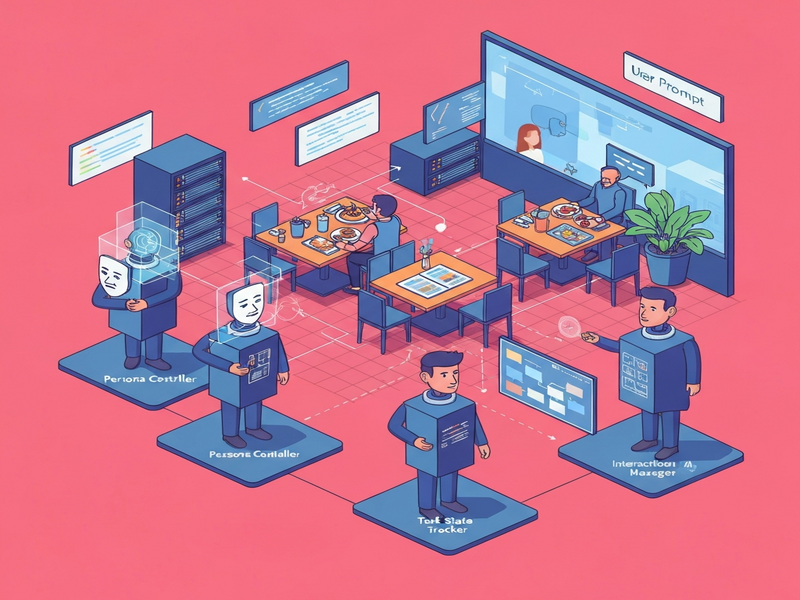
Revolutionizing User Simulation: Multi‑Agent Framework Enhances Conversational AI Testing
As conversational agents become the front‑line of customer interaction, the need for realistic, diverse, and explainable user simulations has never been more urgent. Traditional single‑LLM simulators often produce bland or overly deterministic dialogues, limiting the robustness of downstream AI models. The newly released paper Agentic Persona Control and Task State Tracking for Realistic User Simulation in Interactive Scenarios tackles this gap by decomposing the simulation problem into three cooperating agents, each mirroring a distinct facet of human cognition.
This article unpacks the paper’s core contributions, walks through the architecture of the three agents, reviews the experimental validation, and explores the broader implications for AI research and product development. Whether you are an AI researcher, a machine‑learning engineer, or a tech journalist, the insights below will help you understand why this framework is poised to become a new benchmark for user simulation.
Paper Overview and Key Contributions
The authors, led by Hareeshwar Karthikeyan, submitted the manuscript to arXiv:2601.15290 and later presented it at NeurIPS 2025. Their primary goal is to create a cognitively plausible simulation environment that can be reused across domains such as e‑commerce, healthcare triage, and virtual tutoring.
- Agentic Persona Control: A dedicated User Agent enforces persona constraints (e.g., age, cultural background, mood) throughout the dialogue.
- Task State Tracking: A State‑Tracking Agent maintains a structured representation of the task’s progress, enabling the system to reason about incomplete or ambiguous requests.
- Message Attribute Generation: The Message‑Attributes Generation Agent modulates tone, formality, and linguistic style based on the evolving context.
- Explainability: By exposing each sub‑agent’s output, developers can trace why a simulated user behaved a certain way, a feature rarely available in monolithic simulators.
The framework is deliberately modular, allowing researchers to replace or augment any sub‑agent with domain‑specific models without breaking the overall pipeline. This design aligns with the UBOS user‑simulation solutions, which also champion modular AI components.
The Three Specialized Agents
1. User Agent – Persona‑Driven Orchestrator
The User Agent acts as the “brain” of the simulated user. It receives a persona definition (e.g., “busy professional, prefers concise answers”) and a high‑level goal (e.g., “order dinner for two”). Throughout the conversation, it decides which sub‑goals to pursue, ensuring the dialogue remains coherent with the persona’s preferences.
By separating persona logic from language generation, the framework can reuse the same User Agent across vastly different domains— from a AI marketing agents scenario to a technical support chatbot.
2. State‑Tracking Agent – Structured Task Memory
Human conversations are rarely linear; users often backtrack, ask clarifying questions, or change their intent. The State‑Tracking Agent maintains a task graph that records completed steps, pending items, and any ambiguities. This graph is updated after each turn, providing a reliable source of truth for both the User Agent and the downstream conversational AI under test.
In the restaurant‑ordering experiment, the graph captured items such as “selected appetizer,” “requested dietary restriction,” and “payment method,” enabling the simulator to detect when the AI missed a required slot.
3. Message‑Attributes Generation Agent – Conversational Style Engine
This agent translates the high‑level intent from the User Agent into concrete linguistic attributes: tone (friendly, formal), verbosity, and even regional idioms. It then passes these attributes to a language model (e.g., OpenAI’s GPT‑4) that produces the final utterance.
The separation of “what to say” from “how to say it” mirrors how humans plan speech, and it allows developers to experiment with style variations without retraining the entire simulation pipeline.
Experimental Scenario: Restaurant Ordering
To validate the framework, the authors built a realistic restaurant‑ordering environment featuring menu items, optional modifiers (e.g., “extra spicy”), and payment options. The simulated user was tasked with ordering a three‑course meal while adhering to a persona that preferred “quick, polite interactions.”
Evaluation Metrics
- Persona Adherence: How closely the simulated utterances matched the predefined persona traits.
- Task Completion Accuracy: Percentage of orders that satisfied all required slots (dish, quantity, special requests, payment).
- Realism Score: Human judges rated dialogues on a 5‑point Likert scale for naturalness.
- Explainability Index: Ability of developers to trace decision paths across agents.
Results Summary
| Model | Persona Adherence | Task Completion | Realism (Avg.) | Explainability |
|---|---|---|---|---|
| Single‑LLM Baseline | 71% | 68% | 3.2 / 5 | Low |
| Multi‑Agent Framework | 92% | 89% | 4.6 / 5 | High |
“The multi‑agent system consistently outperformed the monolithic baseline, especially in maintaining persona consistency across long dialogues.” – Authors, arXiv:2601.15290
Ablation studies revealed that removing the Message‑Attributes Generation Agent caused a 12% drop in realism, while disabling the State‑Tracking Agent reduced task completion by 15%. These findings underscore the synergistic value of each component.
Implications for Conversational AI Development
The framework’s modularity and explainability open new pathways for both research and product teams:
- Accelerated Testing Cycles: Developers can generate thousands of high‑fidelity user sessions without manual scripting, dramatically shortening the feedback loop for model improvements.
- Domain Transferability: By swapping the persona definition and task schema, the same architecture can simulate users for banking chatbots, virtual health assistants, or educational tutors.
- Safety and Bias Auditing: The explicit persona layer makes it easier to probe how models react to diverse demographic profiles, supporting responsible AI practices.
- Integration with Existing Platforms: The agents can be wrapped as micro‑services and plugged into platforms like the UBOS platform overview, enabling rapid prototyping of AI‑driven products.
For SaaS companies, the ability to simulate realistic user journeys translates directly into higher conversion rates and lower churn, especially when combined with AI marketing agents that personalize outreach based on simulated user behavior.
Conclusion & Future Directions
The multi‑agent framework introduced in arXiv:2601.15290 marks a pivotal step toward truly human‑like user simulation. By decoupling persona control, state tracking, and linguistic styling, it delivers measurable gains in realism, task success, and explainability—attributes that are essential for the next generation of conversational AI.
Future research avenues include:
- Extending the State‑Tracking Agent to handle multi‑turn, multi‑task scenarios (e.g., booking travel + hotel).
- Incorporating reinforcement learning to let the User Agent adapt its persona on‑the‑fly based on AI responses.
- Integrating multimodal inputs (voice, images) via ElevenLabs AI voice integration for richer simulation.
- Open‑sourcing the agent APIs to foster community‑driven extensions.
As the ecosystem matures, we anticipate a wave of tools that let product teams spin up “digital twins” of their customers, test edge cases, and iterate faster than ever before.
Take the Next Step with UBOS
Ready to bring cutting‑edge user simulation into your own AI projects? UBOS offers a suite of tools that align perfectly with the multi‑agent paradigm:
- Explore the Web app editor on UBOS to prototype conversational flows without writing code.
- Automate complex workflows with the Workflow automation studio, linking simulated user data to downstream analytics.
- Leverage pre‑built UBOS templates for quick start, including a “Restaurant Ordering Bot” template that mirrors the experimental scenario.
- Scale your simulations using the Enterprise AI platform by UBOS, which supports multi‑agent orchestration at millions of concurrent sessions.
- Check out the UBOS portfolio examples to see real‑world deployments of AI‑driven user simulations.
- Find the right pricing for your team with UBOS pricing plans.
- Join the UBOS partner program to co‑develop custom agents and share revenue.
Whether you are a startup looking for rapid prototyping (UBOS for startups) or an established enterprise seeking robust AI infrastructure (UBOS solutions for SMBs), our platform is built to scale with you.
Dive deeper into the world of AI‑enhanced communication by visiting the UBOS homepage and learning About UBOS. Let’s shape the future of realistic user simulation together.