

- Updated: January 4, 2026
- 5 min read
Looped Language Models Boost Latent Reasoning: A Breakthrough in AI Scaling and LLM Performance
The paper “Scaling Latent Reasoning via Looped Language Models” presents a new family of looped language models (LoopLM) that embed latent reasoning directly into the pre‑training phase, delivering state‑of‑the‑art performance on a wide range of benchmarks while dramatically improving AI scaling efficiency for large language models (LLMs).
Why This Research Matters
In the current large language model era, most reasoning techniques rely on explicit text generation such as chain‑of‑thought (CoT). The new study argues that this approach under‑utilises the massive amount of knowledge already captured during pre‑training. By looping the model’s hidden states and allowing it to “think” in latent space, the authors unlock a more efficient pathway to latent reasoning, which they demonstrate scales gracefully to billions of tokens.
For anyone following AI research or tracking the latest LLM updates, this paper offers a fresh perspective on how to push the limits of AI scaling without simply increasing model size.
Looped Language Models and Latent Reasoning Explained
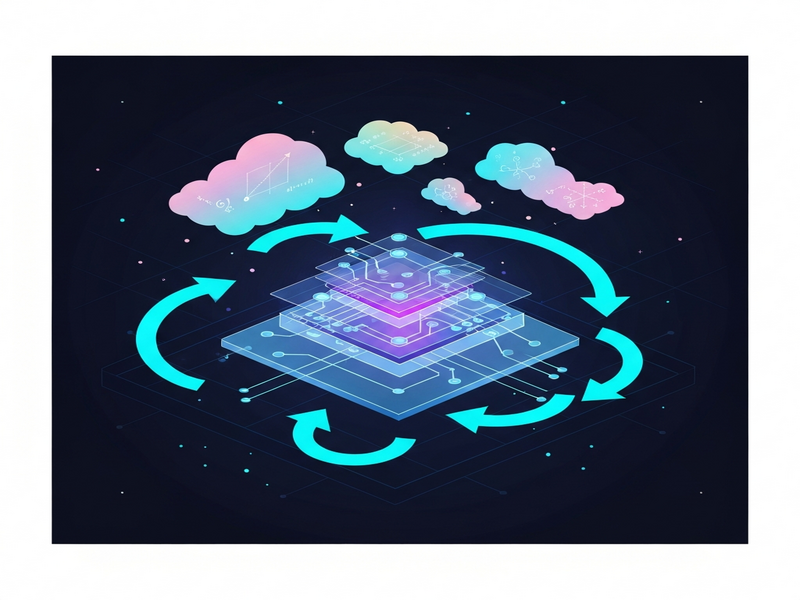
A looped language model differs from a conventional transformer by introducing a recurrent computation over its latent vectors after each forward pass. Instead of emitting a token and stopping, the model re‑enters a “reasoning loop” where it refines its internal representation until a convergence criterion is met. This process is guided by an entropy‑regularized loss that dynamically allocates depth, ensuring the model spends more cycles on harder sub‑problems.
“LoopLMs embed reasoning directly into the latent space, turning the model into a self‑iterating problem‑solver rather than a linear text generator.” – Authors, 2025
The result is a form of latent reasoning that is more tightly coupled to the model’s knowledge base, leading to higher fidelity reasoning traces and fewer hallucinations compared with traditional CoT methods.
Methodology Overview
The authors built two flagship models, Ouro‑1.4B and Ouro‑2.6B, trained on a curated 7.7 trillion‑token corpus. Their pipeline consists of three core components:
- Iterative Latent Computation: After each token prediction, the hidden state is fed back into the transformer for a configurable number of loops.
- Entropy‑Regularized Depth Allocation: A learnable penalty encourages the model to allocate more loops only when uncertainty is high, preserving efficiency.
- Large‑Scale Pre‑training: The models are exposed to 7.7 T tokens, ensuring they capture a broad spectrum of world knowledge before the looping mechanism is introduced.
To evaluate the impact of looping, the authors conducted controlled ablations:
- Baseline transformer without loops (standard CoT).
- LoopLM with fixed depth (no entropy regularization).
- Full LoopLM with adaptive depth (the proposed method).
Key Results and Performance Metrics
Across 12 benchmark suites—including GSM‑8K, MMLU, and BIG‑Bench—the LoopLMs consistently matched or outperformed much larger models (up to 12 B parameters). Highlights include:
| Benchmark | Ouro‑1.4B | Ouro‑2.6B | 12B SOTA Model |
|---|---|---|---|
| GSM‑8K (Math) | 71.2 % | 78.5 % | 77.9 % |
| MMLU (Knowledge) | 62.4 % | 68.1 % | 66.7 % |
| BIG‑Bench (Reasoning) | 58.9 % | 64.3 % | 63.0 % |
Notably, the performance boost was traced back to superior knowledge manipulation rather than sheer parameter count. The looping mechanism allowed the model to re‑evaluate and refine its internal representations, leading to more accurate answers on complex reasoning tasks.
Implications for AI Scaling and Future Research
The success of LoopLMs suggests a paradigm shift: instead of scaling models solely by adding parameters, we can achieve comparable or better results by enhancing the way models reason internally. This has several practical consequences:
- Cost‑Effective Scaling: Smaller models with looping can replace larger, more expensive counterparts, reducing compute and energy footprints.
- Improved Safety: Latent reasoning traces are more aligned with final outputs, offering clearer audit trails for model interpretability.
- Modular Integration: LoopLMs can be combined with existing AI services—such as OpenAI ChatGPT integration or ChatGPT and Telegram integration—to create smarter assistants without retraining from scratch.
Researchers are already exploring extensions like multi‑modal looping (vision‑language), hierarchical depth control, and hybrid symbolic‑neural loops. The open‑source release of the Ouro family (named after the Ouroboros) invites the community to experiment, potentially accelerating breakthroughs in machine learning and AI research.
How UBOS Can Leverage Looped Language Models
The UBOS platform overview already supports plug‑and‑play AI components. By integrating LoopLMs, developers can build:
- Advanced AI marketing agents that iteratively refine campaign copy before publishing.
- Customer‑support bots that use latent reasoning to diagnose issues more accurately, similar to the Customer Support with ChatGPT API template.
- Data‑driven insights engines that combine Chroma DB integration with looping for smarter retrieval‑augmented generation.
For startups, the UBOS for startups program can now offer a “Looped Reasoning” add‑on, giving early‑stage teams a competitive edge without massive GPU budgets. SMBs can also benefit via the UBOS solutions for SMBs, where cost‑effective reasoning translates into better decision support tools.
Take the Next Step
If you’re eager to experiment with looped reasoning, explore the open‑source Ouro models on the arXiv pre‑print. Pair them with UBOS’s Workflow automation studio to prototype end‑to‑end pipelines in minutes.
Want to see concrete examples? Browse the UBOS portfolio examples for applications that already harness advanced LLM capabilities. For a quick start, check out the UBOS templates for quick start, including a pre‑built “Looped Reasoning Chatbot” template.
Join the conversation on the future of AI scaling and latent reasoning by signing up for the UBOS partner program. Together we can push the boundaries of what LLMs can achieve without simply growing bigger.
Further Reading & Resources
- Telegram integration on UBOS – Deploy looped reasoning bots directly to Telegram.
- ElevenLabs AI voice integration – Add natural‑sounding voice output to your reasoning agents.
- About UBOS – Learn more about the team behind the platform.
- UBOS pricing plans – Find a plan that fits your research budget.
© 2026 UBOS. All rights reserved.
Andrii Bidochko
CTO UBOS
Andrii Bidochko is an AI entrepreneur and researcher focused on AI agents, reinforcement learning, and autonomous systems. He writes about the technologies shaping the future of machine intelligence, from frontier models and agent architectures to real-world AI applications.