

- Updated: March 4, 2026
- 5 min read
LLMs Can Unmask Pseudonymous Users at Scale – Study Reveals Privacy Risks
Large language models (LLMs) can deanonymize pseudonymous users with up to 68 % recall and 90 % precision, exposing a new privacy threat that challenges the long‑standing assumption that pseudonymity offers sufficient protection online.
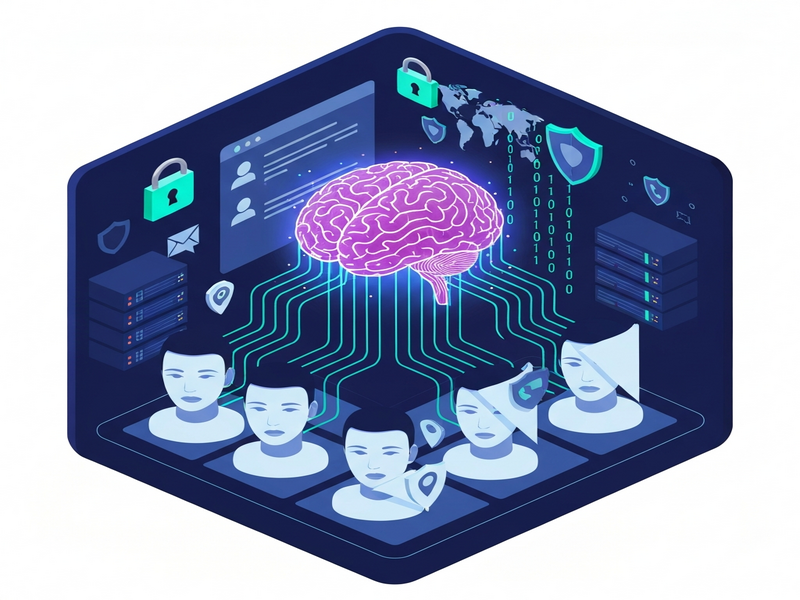
What the new study reveals
A research team published this week a breakthrough paper showing that modern LLMs can link anonymous social‑media posts to real‑world identities far more efficiently than classic deanonymization attacks. By feeding free‑text excerpts into a large language model, the system extracts identity signals, searches the web autonomously, and validates candidates with a precision that rivals human investigators.
The findings, reported by Ars Technica, demonstrate recall rates as high as 68 % and precision up to 90 % across multiple datasets, including Reddit, Hacker News, and LinkedIn. This marks a dramatic shift in the threat landscape for AI privacy and data security professionals.
Methodology and key results
Dataset construction
The researchers assembled three public datasets:
- Cross‑platform posts from Hacker News paired with LinkedIn profiles.
- Micro‑identity records from a Netflix‑style recommendation dataset.
- Reddit comment histories from r/movies combined with smaller niche subreddits.
LLM‑driven deanonymization pipeline
Each pipeline followed three core steps:
- Signal extraction: The LLM parsed free‑text to identify personal clues (e.g., job titles, locations, favorite movies).
- Web‑scale search: Using the extracted signals, the model performed autonomous web queries to locate candidate profiles.
- Verification: The model cross‑checked all claims against the candidate’s public data, accepting only matches that satisfied every signal.
Performance metrics
Results were measured by recall (percentage of true identities recovered) and precision (percentage of correct guesses among all attempts). The table below summarizes the outcomes across the three experiments.
| Experiment | Recall @ 90 % Precision | Recall @ 99 % Precision | Peak Precision |
|---|---|---|---|
| Hacker News ↔ LinkedIn | 68 % | 45 % | 90 % |
| Netflix micro‑identity set | 7 % | 3 % | 85 % |
| Reddit movie‑interest clusters | 48 % (≥10 shared movies) | 17 % (≥10 shared movies) | 99 % |
Even the modest 7 % recall in the Netflix‑style experiment is significant because it proves that LLMs can identify individuals from a single, unstructured transcript—a capability that older, structured‑data attacks could not achieve.
Privacy implications and emerging risks
The ability to deanonymize at scale reshapes the threat model for millions of users who rely on pseudonymity for:
- Participating in sensitive political or health discussions.
- Sharing whistleblowing information without fear of retaliation.
- Testing new products or services under a veil of anonymity.
When LLMs can bridge the gap between free‑text and a concrete identity, the following risks become realistic:
- Doxxing and stalking: Malicious actors can harvest personal details and target individuals offline.
- Hyper‑targeted advertising: Brands could build exhaustive consumer profiles, violating AI privacy norms.
- State‑level surveillance: Authoritarian regimes may use the technique to unmask dissidents.
- Social engineering attacks: Tailored phishing campaigns become more convincing when attackers know a victim’s interests, job, and location.
“Our findings have significant implications for online privacy. The average user has long assumed pseudonymity provides adequate protection, but LLMs invalidate that assumption.” – Simon Lermen, co‑author.
Proposed mitigations and best‑practice recommendations
Both platform operators and LLM providers can adopt technical and policy safeguards to blunt the deanonymization threat.
Platform‑level defenses
- Rate‑limit API access: Restrict bulk data pulls that fuel large‑scale crawling.
- Detect automated scraping: Deploy behavioural analytics to flag non‑human query patterns.
- Limit export of historical data: Offer users the ability to purge old posts after a configurable retention period.
- Introduce noise: Add plausible deniability tokens or synthetic posts to dilute signal quality.
LLM‑provider safeguards
- Guardrails against identity queries: Train models to refuse requests that explicitly seek personal identifiers.
- Usage monitoring: Flag high‑volume identity‑extraction attempts and throttle offending accounts.
- Transparency reports: Publish statistics on how often deanonymization‑type prompts are blocked.
User‑centric actions
- Regularly delete or archive old posts.
- Prefer platform‑provided pseudonyms that lack personally identifiable information.
- Use privacy‑focused browsers and VPNs to mask IP addresses.
- Adopt end‑to‑end encrypted communication channels for truly sensitive exchanges.
How UBOS helps organizations mitigate AI‑driven privacy risks
Businesses looking to safeguard their data and their customers’ anonymity can leverage the UBOS platform overview, which integrates privacy‑by‑design controls directly into AI workflows.
Key capabilities include:
- AI marketing agents that respect user consent and automatically filter out personally identifiable information – see our AI marketing agents page for details.
- Enterprise AI platform by UBOS offering granular role‑based access and audit logs to monitor who queries LLMs and for what purpose.
- Workflow automation studio that can embed privacy checks into any data‑processing pipeline – learn more at Workflow automation studio.
- Web app editor on UBOS enables rapid creation of secure front‑ends that hide user identifiers from downstream models (Web app editor on UBOS).
For startups and SMBs, the UBOS for startups and UBOS solutions for SMBs provide cost‑effective bundles that include privacy‑preserving AI templates such as the AI Article Copywriter and the AI SEO Analyzer. These templates come pre‑configured with data‑masking rules that prevent accidental leakage of user identifiers.
Pricing is transparent and tiered to match growth stages; see the UBOS pricing plans for a detailed breakdown.
Researcher perspective
Simon Lermen, co‑author of the study, emphasized the urgency of the issue:
“The same techniques that enable powerful personalization can also be weaponized to strip away anonymity at scale. We must rethink privacy safeguards before these methods become commoditized.”
Conclusion: Act now to protect pseudonymity
The research confirms that LLM deanonymization is no longer a theoretical concern—it is a practical, measurable threat. Organizations, developers, and everyday users must adopt a layered defense strategy that combines platform controls, LLM guardrails, and disciplined personal habits.
UBOS offers a comprehensive suite of tools to embed privacy into every stage of AI development. Explore our UBOS templates for quick start, experiment with the AI Video Generator, or join the UBOS partner program to stay ahead of emerging AI security challenges.
Stay informed, stay secure, and remember: in the age of generative AI, privacy is an active practice, not a passive assumption.
Andrii Bidochko
CTO UBOS
Andrii Bidochko is an AI entrepreneur and researcher focused on AI agents, reinforcement learning, and autonomous systems. He writes about the technologies shaping the future of machine intelligence, from frontier models and agent architectures to real-world AI applications.