

- Updated: February 23, 2026
- 5 min read
Ladybird adopts Rust: Boosting performance and safety
Ladybird has completed a major Rust adoption by porting its core JavaScript engine, LibJS, to Rust, achieving byte‑for‑byte compatibility, zero regressions, and a clear roadmap for further Rust integration.
Rust Adoption in Ladybird Browser: How a Memory‑Safe Rewrite Is Shaping the Future of Web Development
The open‑source original Ladybird announcement revealed that the project’s founder, Andreas Kling, has steered a rapid, AI‑assisted migration from C++ to Rust. This move aligns Ladybird with industry‑wide trends where browsers such as Firefox and Chromium are increasingly embracing Rust for its safety guarantees and modern tooling. For tech‑savvy developers and IT decision‑makers, the story offers a concrete case study of how a strategic language shift can be executed without sacrificing performance or stability.
Why Rust? Benefits and Motivations Behind the Switch
Rust’s appeal stems from three core pillars that directly address the pain points of legacy C++ codebases:
- Memory safety without a garbage collector, eliminating whole classes of bugs such as use‑after‑free and buffer overflows.
- Strong type system that enforces ownership and borrowing rules at compile time, reducing runtime crashes.
- Vibrant ecosystem with crates for async I/O, parsing, and WebAssembly, making it a natural fit for modern web‑engine development.
When Ladybird evaluated Rust in 2024, the language’s perceived mismatch with the object‑oriented patterns of the web platform was a concern. However, after a year of stagnation with Swift and limited cross‑platform support, the team recognized that Rust’s safety guarantees outweighed the learning curve. The decision also mirrors broader programming language trends where enterprises prioritize long‑term maintainability over short‑term familiarity.
Technical Details of the Port: From LibJS to Rust
The first target for migration was LibJS, Ladybird’s JavaScript engine. The team chose this component because it is self‑contained, has extensive test coverage via test262, and its lexer, parser, AST, and bytecode generator can be isolated from the rest of the browser stack.
AI‑Assisted Translation Workflow
Rather than a manual rewrite, Kling leveraged OpenAI ChatGPT integration and Claude Code to generate Rust snippets. The process involved:
- Defining a migration plan and ordering of modules.
- Issuing hundreds of targeted prompts to guide the AI models.
- Running adversarial reviews where separate models audited the generated code for anti‑patterns.
The result was roughly 25,000 lines of Rust produced in under two weeks—a task that would have taken months if done by hand.
Zero‑Regressions Guarantee
The primary success metric was byte‑for‑byte identical output between the original C++ pipeline and the new Rust pipeline. To verify this, the team:
- Executed the full
test262suite (2,898 tests) with no failures. - Ran Ladybird’s own regression suite (12,461 tests) and recorded 0 regressions.
- Benchmarked JavaScript performance across common workloads, confirming no degradation.
Additionally, a “lockstep” browsing mode was employed where both C++ and Rust engines processed the same pages simultaneously, confirming identical DOM and script outcomes for every visited site.
Compatibility‑First Rust Code
The Rust implementation intentionally mirrors C++ register allocation patterns to ensure identical bytecode generation. While the code is not yet idiomatic Rust, this pragmatic approach guarantees a smooth coexistence phase. Future refactoring will simplify the codebase once the C++ components are retired.
Future Roadmap: Gradual Integration and Long‑Term Vision
Rust adoption is not a binary switch for Ladybird; it is a phased strategy. The roadmap outlines three key stages:
- Coexistence Phase – New Rust modules will interoperate with existing C++ code through well‑defined FFI boundaries.
- Selective Porting – The core team will prioritize subsystems that benefit most from Rust’s safety (e.g., networking stack, CSS parser).
- Full Migration – Once a critical mass of Rust components is stable, the C++ pipeline will be deprecated.
Community contributors are encouraged to coordinate with the core team before embarking on any porting effort to avoid duplicated work and ensure mergeability. This collaborative model reflects the open‑source ethos that powers both Ladybird and the broader Rust ecosystem.
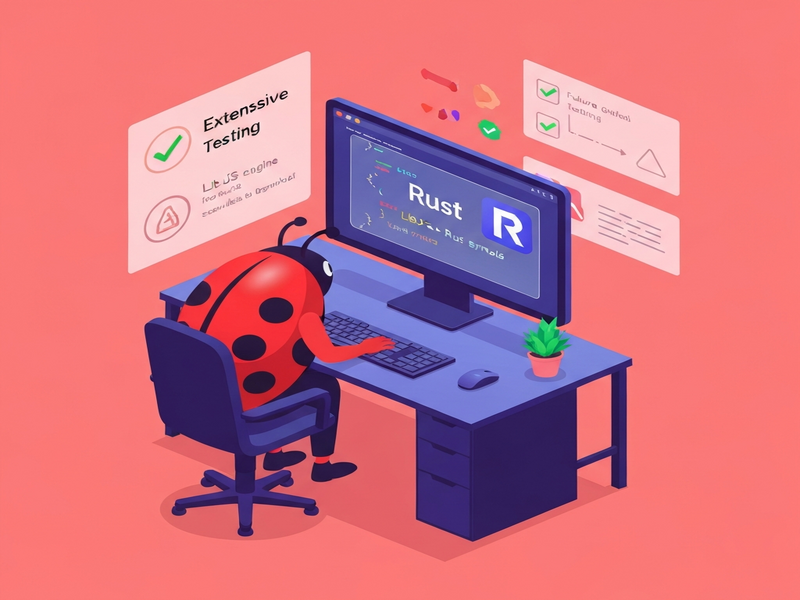
Figure 1: High‑level flow of Ladybird’s Rust migration, from AI‑assisted code generation to zero‑regression testing.
Related UBOS Resources for Developers
While Ladybird’s journey showcases Rust’s impact on browser engines, developers looking to experiment with AI‑enhanced workflows can explore UBOS’s suite of tools:
- UBOS homepage – Central hub for the Enterprise AI platform.
- UBOS platform overview – Detailed architecture and integration points.
- AI marketing agents – Automate campaign creation with generative AI.
- UBOS for startups – Scalable AI services for early‑stage companies.
- UBOS solutions for SMBs – Tailored AI tools for small and medium businesses.
- Enterprise AI platform by UBOS – Enterprise‑grade security and compliance.
- Web app editor on UBOS – Drag‑and‑drop UI builder with AI code suggestions.
- Workflow automation studio – Orchestrate multi‑service pipelines.
- UBOS pricing plans – Transparent pricing for AI workloads.
- UBOS portfolio examples – Real‑world AI deployments.
- UBOS templates for quick start – Pre‑built AI app templates.
For developers interested in hands‑on Rust projects, the AI Article Copywriter template demonstrates how to combine Rust‑based back‑ends with UBOS’s low‑code front‑end. Similarly, the GPT‑Powered Telegram Bot showcases seamless integration of Rust‑compiled WebAssembly modules into messaging platforms.
Conclusion: Rust Adoption Sets a New Benchmark for Browser Innovation
Ladybird’s successful Rust migration proves that a memory‑safe language can be introduced into a mature codebase without sacrificing performance or stability. By leveraging AI‑assisted code generation, rigorous testing, and a phased integration plan, the project delivers a compelling blueprint for other browsers and large‑scale C++ projects.
As the web development ecosystem continues to evolve, Rust’s role is expanding from low‑level system components to high‑level application logic. The Rust adoption story not only reinforces the language’s credibility but also highlights the importance of strategic AI tooling—something UBOS’s platform is uniquely positioned to amplify for enterprises and startups alike.
Stay tuned to UBOS news for more updates on AI‑driven development, Rust integrations, and the next generation of intelligent web tools.
Andrii Bidochko
CTO UBOS
Andrii Bidochko is an AI entrepreneur and researcher focused on AI agents, reinforcement learning, and autonomous systems. He writes about the technologies shaping the future of machine intelligence, from frontier models and agent architectures to real-world AI applications.