

- Updated: March 26, 2026
- 7 min read
Jury Verdict Holds Instagram and YouTube Liable for Child Addiction in Landmark Social Media Lawsuit
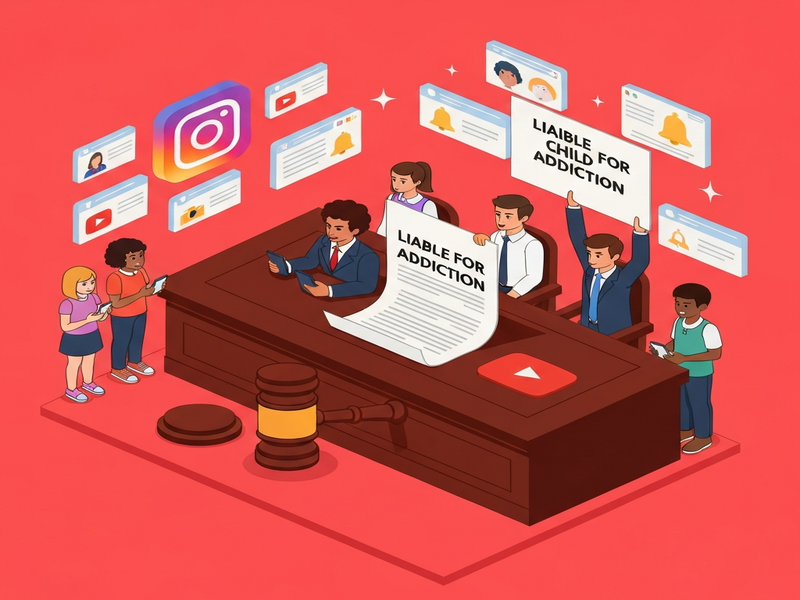
A Los Angeles jury has found Instagram and YouTube liable for designing platforms that deliberately addict children, awarding a total of $6 million in compensatory and punitive damages.
On March 25, 2026, jurors in the Los Angeles County Superior Court delivered a landmark verdict that could reshape the legal landscape for the world’s biggest social‑media giants. The jury concluded that Meta’s Instagram and Google’s YouTube were negligent in creating features that hook young users, assigning $3 million in compensatory damages to the plaintiff and an additional $2.1 million in punitive damages against Meta and $900,000 against Google. The decision follows a wave of similar rulings, including a $375 million verdict against Meta in New Mexico just 24 hours earlier.
Parents, educators, and policymakers are now watching closely as the case sets a precedent for thousands of pending lawsuits that allege tech companies profit from children’s addiction.
Background of the Lawsuit
The case originated in Chico, California, where 20‑year‑old Kaley G.M. (referred to as “K.G.” in court filings) sued Instagram and YouTube for the mental‑health harms she experienced after becoming “hooked” on the platforms in elementary school. Her legal team argued that the companies engineered “addictive loops”—infinite scroll, autoplay, and algorithmic recommendation engines—specifically to capture children’s attention.
Kaley’s claim was selected from a consolidated pool of more than 200 similar suits filed across California state courts. The plaintiffs sought to prove that the harm stemmed not from user‑generated content but from the very design of the apps, a distinction that could pierce the protective shield of Section 230 of the Communications Decency Act.
During the seven‑week trial, both sides presented internal documents, expert testimony, and vivid demonstrations. Meta’s defense emphasized parental responsibility and the lack of a formal medical diagnosis for “social‑media addiction,” while the plaintiffs highlighted internal emails that described children as “high‑value users” and detailed experiments to increase session length.
Jury Findings and Damages Awarded
The jury’s deliberations spanned 40 hours over nine days. Their findings can be broken down into three core conclusions:
- Negligence: Both Instagram and YouTube were found negligent for failing to warn users—especially minors—about the addictive nature of their platforms.
- Proportional Liability: The jury assigned 70 % of the liability to Meta (Instagram) and 30 % to Google (YouTube), reflecting the plaintiff’s testimony that Instagram was her primary gateway to addiction.
- Damages: $3 million in compensatory damages to Kaley, plus $2.1 million in punitive damages against Meta and $900,000 against Google, totaling $6 million.
Judge Carolyn B. Kuhl warned the courtroom to remain silent during the reading of the verdict, underscoring the high‑stakes nature of the case. The punitive awards, while modest compared to the New Mexico verdict, signal that juries are willing to penalize tech firms for profit‑driven design choices that harm children.
Reactions from Meta, Google, and Experts
Meta’s response: A spokesperson for Instagram’s parent company issued a brief statement: “We respectfully disagree with the verdict and are evaluating our legal options.” The company also reiterated its ongoing investments in parental‑control tools and AI‑driven safety features.
Google’s stance: Google’s legal team declined to comment directly but filed a motion to appeal the punitive damages, arguing that the jury’s findings overstep the scope of existing privacy and consumer‑protection statutes.
Legal scholars: Erwin Chemerinsky, dean of UC Berkeley School of Law, warned that “the case pits free‑speech protections against real‑world harms, and the jury’s decision may force Congress to revisit Section 230.” Meanwhile, Georgia State law professor Eric J. Segall described the verdict as “a watershed moment that could force the tech industry to redesign core engagement loops.”
Industry analysts predict a surge in settlement offers from other platforms, noting that Snapchat and TikTok already reached undisclosed settlements with Kaley before the trial began.
Implications for Social‑Media Regulation
The verdict arrives at a critical juncture for tech policy in the United States. Several key implications are emerging:
- Section 230 Scrutiny: Lawmakers on both sides of the aisle are using the case to argue for reforms that would limit the immunity granted to platforms for algorithmic design choices.
- Design‑by‑Default Safeguards: Regulators may soon require “age‑appropriate design” standards, similar to the EU’s Digital Services Act, mandating that platforms implement default safety settings for minors.
- Increased Litigation: The Los Angeles decision is expected to embolden plaintiffs in the pending federal cases slated for trial in San Francisco later this year, potentially creating a cascade of multi‑million‑dollar judgments.
- Corporate Accountability: Companies may accelerate the rollout of AI‑driven monitoring tools—such as AI marketing agents and Workflow automation studio—to demonstrate proactive risk mitigation.
For parents and educators, the ruling underscores the importance of digital‑literacy curricula and the need for robust parental‑control solutions. Many schools are already piloting AI‑enhanced monitoring platforms that flag excessive screen time, a trend that could gain momentum as legal pressure mounts.
Key Takeaways
- Los Angeles jury finds Instagram and YouTube liable for designing addictive platforms for children.
- Total damages awarded: $6 million (compensatory + punitive).
- Liability split: 70 % Meta, 30 % Google.
- Verdict follows a $375 million New Mexico ruling against Meta.
- Potential ripple effect on pending federal lawsuits and Section 230 reform.
- Companies may need to adopt “age‑appropriate design” standards.
- Parents, educators, and policymakers are urged to increase digital‑literacy efforts.
For the full reporting from the Los Angeles Times, see the original article: LA Times – Social Media Lawsuit Verdict.
Related Resources on UBOS
While the legal landscape evolves, businesses can explore AI‑powered solutions that help manage compliance, content moderation, and user‑experience design.
- UBOS homepage – Overview of the AI platform.
- About UBOS – Company mission and expertise.
- UBOS platform overview – Core capabilities for developers.
- Enterprise AI platform by UBOS – Scalable solutions for large organizations.
- UBOS for startups – Fast‑track AI integration.
- UBOS solutions for SMBs – Affordable AI tools for small businesses.
- Web app editor on UBOS – No‑code UI builder.
- UBOS pricing plans – Transparent pricing models.
- UBOS portfolio examples – Real‑world case studies.
- UBOS templates for quick start – Pre‑built AI app templates.
- AI SEO Analyzer – Optimize content for search engines.
- AI Article Copywriter – Generate high‑quality articles quickly.
- Talk with Claude AI app – Conversational AI powered by Anthropic.
- GPT-Powered Telegram Bot – Automate messaging with AI.
- AI Video Generator – Create video content from text.
What This Means for the Future
The Los Angeles verdict is more than a headline; it is a catalyst that could force the tech industry to rethink the very architecture of social platforms. By holding Instagram and YouTube accountable for design choices that target children, jurors have signaled that profit‑driven addiction is no longer a legally defensible strategy.
For parents, educators, and policymakers, the ruling provides a legal foothold to demand stronger safeguards. For developers and SaaS providers, it underscores the market opportunity for AI‑driven compliance tools, safe‑design frameworks, and transparent user‑experience audits—areas where platforms like UBOS are already innovating.
As the legal battles continue and potential legislative reforms loom, staying informed and proactive will be essential. Whether you are a concerned parent, a school administrator, or a tech entrepreneur, the message is clear: the era of unchecked digital addiction is ending, and responsible design is the new competitive advantage.
Andrii Bidochko
CTO UBOS
Andrii Bidochko is an AI entrepreneur and researcher focused on AI agents, reinforcement learning, and autonomous systems. He writes about the technologies shaping the future of machine intelligence, from frontier models and agent architectures to real-world AI applications.