

- Updated: April 4, 2026
- 4 min read
Iranian Missile Strikes Cripple AWS Data Centers in Bahrain and Dubai – Impact and Recommendations
Iranian missile strikes have taken down AWS data centers in Bahrain and Dubai, forcing the cloud provider to declare multiple zones “hard‑down” and triggering a massive regional outage.
What happened and why it matters
In early April 2026, the Islamic Revolutionary Guard Corps (IRGC) launched missile attacks that struck Amazon Web Services (AWS) facilities in the Bahrain (BAH) and Dubai (DXB) regions. AWS confirmed that several availability zones are now in a “hard‑down” state, meaning they are completely unavailable, while other zones remain “impaired but functioning.” The disruption has immediate consequences for thousands of enterprises that rely on these regions for critical workloads.
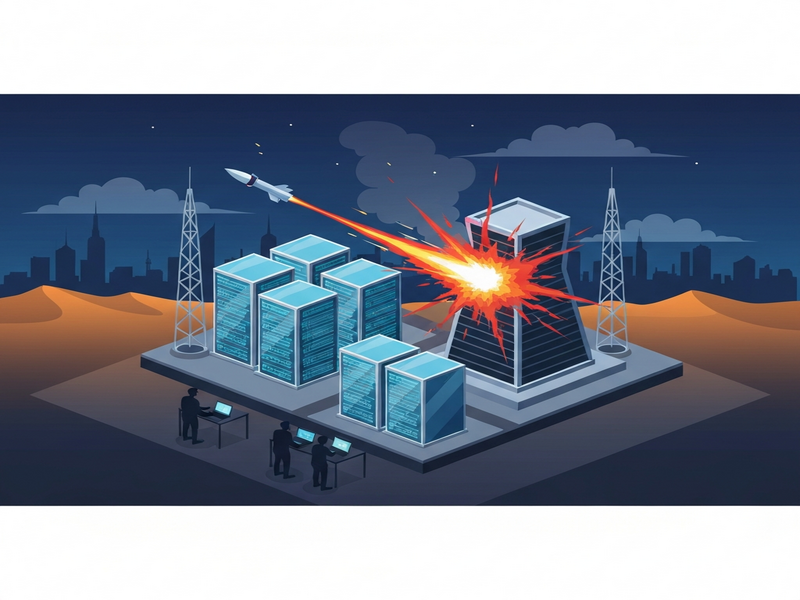
Missile strikes and the affected AWS zones
The attacks targeted the BAH1 and DXB2 compute zones, which host a mix of EC2, RDS, and S3 services. According to an internal AWS memo obtained by Tom’s Hardware, the following zones are now hard‑down:
- BAH‑a (Availability Zone A)
- BAH‑c (Availability Zone C)
- DXB‑b (Availability Zone B)
- DXB‑c (Availability Zone C)
The remaining zones (BAH‑b, DXB‑a) are still operational but operating at reduced capacity. AWS is actively migrating workloads to other global regions, but the process is constrained by network bandwidth and the need to preserve data integrity.
Impact on customers and emergency response
The outage has rippled across multiple industries:
- E‑commerce platforms have reported checkout failures and delayed order processing.
- Financial services are experiencing latency in transaction processing and real‑time analytics.
- Media streaming services see buffering spikes as edge caches lose connectivity.
- Healthcare applications that rely on real‑time data ingestion are forced into manual fallback procedures.
AWS’s emergency response includes:
- Activating the Global Accelerator to reroute traffic through unaffected regions.
- Deploying additional Capacity Reservations in the EU (Frankfurt) and APAC (Singapore) regions.
- Issuing a “hard‑down” status alert via the AWS Personal Health Dashboard.
Geopolitical implications for cloud providers
The strikes underscore a growing trend: critical digital infrastructure is becoming a direct target in geopolitical conflicts. Cloud providers, traditionally seen as neutral, now face strategic risk assessments that include missile‑range maps and regional stability indexes.
“The cloud is no longer just a technical asset; it is a strategic asset that can be weaponized.” – Industry Analyst, 2026
For AWS, the incident raises questions about the adequacy of its Enterprise AI platform by UBOS‑driven predictive maintenance tools. While AI can forecast hardware failures, it cannot prevent kinetic attacks. The broader industry is now evaluating:
- Geographically diversified multi‑region architectures.
- Edge‑centric compute that reduces reliance on centralized data halls.
- Enhanced physical security partnerships with local governments.
How businesses can improve cloud resilience
Companies that depend on AWS should adopt a layered resilience strategy:
1. Multi‑region and multi‑cloud design
Deploy critical workloads across at least two AWS regions outside the Middle East, and consider a secondary cloud provider (e.g., Azure or Google Cloud). UBOS’s Workflow automation studio can orchestrate cross‑cloud failover with minimal manual intervention.
2. Automated disaster‑recovery testing
Schedule quarterly DR drills that simulate hard‑down scenarios. Use the Web app editor on UBOS to build custom recovery playbooks that trigger data replication to safe zones.
3. Real‑time health monitoring
Integrate AWS Health APIs with UBOS’s AI marketing agents‑style dashboards to surface alerts instantly. Pair this with the OpenAI ChatGPT integration for natural‑language query capabilities.
4. Data encryption and immutable backups
Store encrypted snapshots in Amazon S3 Glacier Deep Archive and replicate them to a different continent. UBOS’s Chroma DB integration can index backup metadata for rapid retrieval.
5. Leverage AI‑driven predictive analytics
Deploy UBOS’s AI YouTube Comment Analysis tool‑style models to monitor regional news feeds for early warning signs of conflict escalation.
Next steps for cloud‑focused decision‑makers
The Iranian missile strikes are a stark reminder that cloud resilience is no longer optional. Evaluate your current architecture against the checklist above, and consider a partnership with a platform that offers built‑in AI automation and cross‑cloud orchestration.
Explore the UBOS homepage for a free resilience assessment, or join the UBOS partner program to get dedicated support for multi‑region deployments.
Related UBOS resources
Andrii Bidochko
CTO UBOS
Andrii Bidochko is an AI entrepreneur and researcher focused on AI agents, reinforcement learning, and autonomous systems. He writes about the technologies shaping the future of machine intelligence, from frontier models and agent architectures to real-world AI applications.