

- Updated: March 27, 2026
- 7 min read
Iran School Bombing: High‑Speed Targeting System, Not Rogue AI, Behind Tragedy
Answer: The February 2026 bombing of a primary school in Minab, Iran, was caused by a high‑speed, human‑configured targeting system (Project Maven) that relied on outdated data, not by a rogue artificial‑intelligence chatbot.
Introduction – What Happened and Why It Matters
On 28 February 2026, a U.S. airstrike hit the Shajareh Tayyebeh primary school in Minab, Iran, killing between 175 and 180 people, most of them girls aged seven to twelve. Within hours, headlines across the globe framed the tragedy as a “rogue AI” incident, pointing fingers at a language model named Claude. The narrative was amplified in congressional hearings, tech‑policy podcasts, and social‑media threads, creating a moral panic around “machine‑made” warfare.
While the Guardian investigation later clarified that no autonomous AI selected the target, the initial misinformation has already shaped public opinion and policy debates. Understanding the real cause—a high‑speed targeting workflow that compressed human deliberation—reveals deeper flaws in modern combat systems and helps prevent future tragedies.
The Real Culprit: A High‑Speed Targeting System, Not a Rogue Chatbot
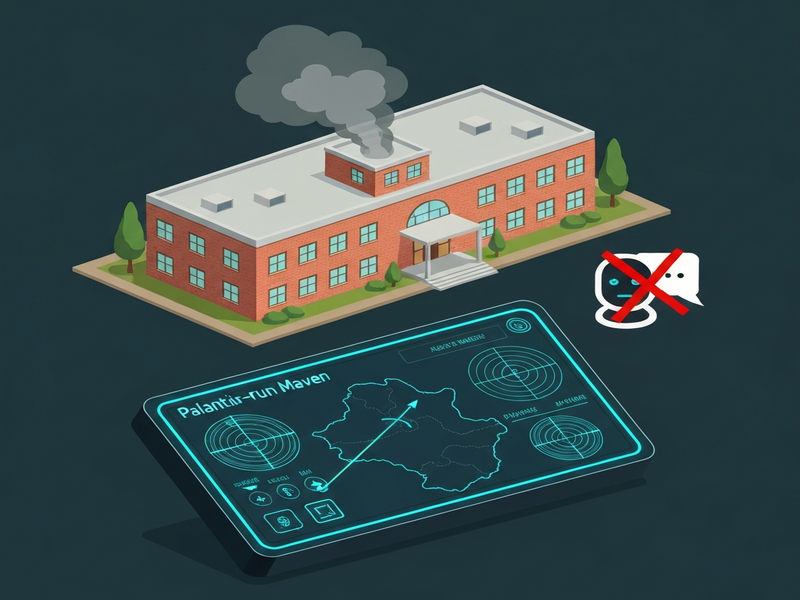
Contrary to popular belief, the strike was not the product of a thinking machine. The decision chain was powered by Project Maven, a data‑fusion platform now owned and expanded by Palantir Technologies. Maven’s core mission is to shrink the “kill chain” – the sequence from target detection to weapon release – from hours to seconds. This speed‑first philosophy is reflected in the system’s architecture:
- Data aggregation: Satellite imagery, signals intelligence, and drone feeds are merged into a single dashboard.
- Automated classification: Machine‑learning models tag objects (vehicles, buildings, etc.) and assign confidence scores.
- Workflow compression: Operators move a target through a Kanban‑style pipeline, making a decision in under three seconds.
The system’s design intentionally treats any “latency” as inefficiency. As a result, the human analyst who entered the target package had only moments to verify the underlying data. When the Defense Intelligence Agency (DIA) database still listed the school as a military facility—a classification that had not been updated since before 2016—the system dutifully generated a strike package. The tragedy was therefore a failure of process, not of intelligence.
Project Maven in the UBOS Context
For enterprises building similarly aggressive automation pipelines, the lessons are clear. The UBOS platform overview emphasizes transparent data pipelines, versioned datasets, and built‑in audit trails—features deliberately missing from Maven’s original design. By integrating these safeguards, developers can avoid the “speed‑over‑accuracy” trap that led to the Minab disaster.
Human Error Meets Systemic Design
The outdated DIA entry was a classic case of “circular reporting”: a single erroneous record propagated through multiple layers without independent verification. In a slower workflow, an analyst might have cross‑checked the coordinates against open‑source maps or queried local intelligence. Maven’s compressed timeline eliminated that friction.
Start‑up teams can learn from this by adopting UBOS for startups best practices, such as:
- Maintaining a single source of truth for critical metadata.
- Embedding human‑in‑the‑loop checkpoints that trigger only when data confidence falls below a threshold.
- Running automated regression tests on geographic databases after each update.
Investigation Findings – What the Evidence Shows
Multiple U.S. defense auditors, independent journalists, and satellite‑imagery analysts converged on the same conclusion:
- The target was mis‑classified in a DIA database that had not been refreshed since 2014.
- Satellite images from 2016 clearly showed a schoolyard, but the images were never cross‑referenced.
- Palantir’s Maven interface displayed the target as a “high‑value military site” without prompting the operator for additional verification.
- Post‑strike reviews revealed that the system logged the decision as “compliant” because the automated confidence score exceeded 92 %.
These findings underscore a systemic bias toward confidence over certainty. The UBOS pricing plans page illustrates a different philosophy: tiered access to advanced validation tools, ensuring that higher‑risk decisions receive extra scrutiny.
Historical Precedents – When Speed Overrode Scrutiny
The Minab incident is not an isolated case. History offers several cautionary tales where accelerated targeting led to catastrophic errors:
- Operation Igloo White (Vietnam): Sensor networks fed data to IBM mainframes, producing inflated kill counts that were never independently verified.
- 1999 Chinese Embassy Bombing (Belgrade): Outdated maps and a rushed approval process caused a strike on a civilian diplomatic mission.
- 2003 Iraq “high‑value” strikes: A rapid targeting cycle produced 50 strikes, none of which hit the intended individuals.
These episodes share a common thread: a relentless drive for operational tempo that marginalizes human judgment. Modern AI marketing agents face a similar dilemma—automating campaign decisions at scale can amplify a single data error across millions of impressions.
Implications for AI Discourse – Why the “Rogue AI” Narrative Is Misleading
Framing the tragedy as an AI malfunction simplifies a complex sociotechnical problem into a binary “good vs. evil” story. This has several dangerous side effects:
- Policy distraction: Lawmakers focus on “AI guardrails” while ignoring the human governance structures that authorized the strike.
- Public complacency: Audiences assume that “AI‑free” systems are safe, overlooking the fact that most modern weapons rely on algorithmic decision‑support.
- Innovation chill: Companies may over‑engineer “explainability” features for the wrong reasons, diverting resources from essential data‑quality initiatives.
For developers building generative tools, the lesson is to prioritize data integrity and human oversight over flashy AI capabilities. The UBOS templates for quick start include pre‑built validation modules that can be dropped into any workflow, ensuring that a single erroneous entry cannot cascade unchecked.
Among the UBOS Template Marketplace, several solutions directly address the challenges highlighted by the Minab case:
- AI SEO Analyzer – demonstrates how automated scoring can be paired with manual review checkpoints.
- AI Article Copywriter – showcases the balance between AI‑generated drafts and editorial sign‑off.
- AI Video Generator – illustrates the need for content verification before public distribution.
Call to Action – Building Safer Automated Systems
Policymakers, defense contractors, and tech firms must adopt a three‑pronged approach:
- Mandate data‑refresh cycles: Critical target databases should be audited at least quarterly, with automated alerts for stale entries.
- Embed “friction” by design: Workflow tools must require a human confirmation step whenever confidence scores exceed a predefined threshold.
- Promote transparent accountability: All strike packages should be logged in an immutable ledger accessible to oversight bodies.
UBOS offers a practical pathway to implement these safeguards. By joining the UBOS partner program, organizations can co‑develop compliance‑first automation stacks that respect both speed and safety.
For readers seeking to explore how AI can be responsibly integrated into high‑stakes environments, the About UBOS page provides a deeper look at the company’s mission to align powerful technology with ethical governance.
Conclusion – Learning from Tragedy to Prevent the Next One
The Minab school bombing starkly illustrates that “AI” is often a convenient scapegoat for deeper systemic failures. The real danger lies in systems that prioritize velocity over verification, allowing outdated data to become lethal. By re‑introducing deliberate human checkpoints, maintaining rigorous data hygiene, and fostering transparent oversight, the defense community—and any industry that relies on rapid automated decision‑making—can avoid repeating this tragedy.
As the world grapples with the ethical frontiers of autonomous technology, let us remember that the most powerful safeguard is not a more sophisticated algorithm, but a well‑designed process that keeps humans in the loop.
Explore more resources on the UBOS ecosystem:
Andrii Bidochko
CTO UBOS
Andrii Bidochko is an AI entrepreneur and researcher focused on AI agents, reinforcement learning, and autonomous systems. He writes about the technologies shaping the future of machine intelligence, from frontier models and agent architectures to real-world AI applications.